
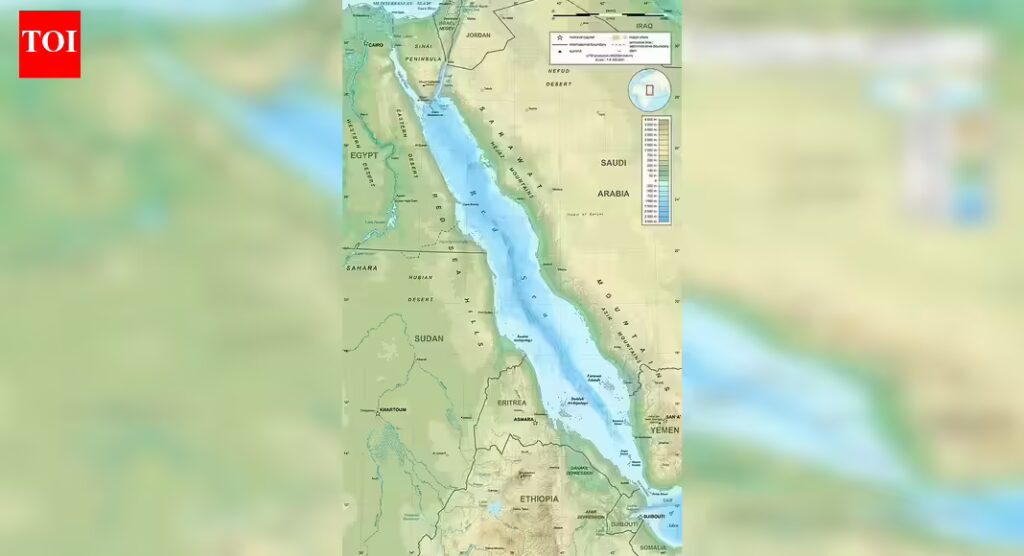
The Red Sea is a narrow stretch of water that runs southeast from Suez in Egypt for about 1,200 miles (1,930 km) all the way to the Bab el-Mandeb Strait, which links it to the Gulf of Aden and then the Arabian Sea. It separates the coasts of Egypt, Sudan, and Eritrea on the west from Saudi Arabia and Yemen on the east. At its widest, the sea stretches 190 miles, and it plunges to a maximum depth of 9,974 feet. Known for some of the hottest and saltiest waters on the planet, the Red Sea is also a major global route, connecting to the Mediterranean via the Suez Canal and carrying ships between Europe and Asia. A narrow but mighty waterway, it has played a key role in trade and travel for centuries.The different theories behind, how Red Sea got its nameThe first known explorers of the Red Sea were the Ancient Egyptians, who navigated these waters around 2500 BC in search of trade routes to the south. The water itself is typically a clear blue-green. But how did this sea come to be called the Red Sea? There are many theories, yet its true origin remains a mystery.According to the Smithsonian Science Education Centre, the Red Sea’s name is a straight translation of its ancient Greek name, Erythra Thalassa. However, only European languages make any mention of “red.” It is known in Hebrew as Yam Suph, or Sea of Reeds, most likely because of the reeds in the Gulf of Suez, and in Egypt as “Green Space.”The Red Sea is the saltiest of all seas that connect to the ocean, with not a single river meeting it. One popular theory for the origins of the Red Sea’s name is because it includes cyanobacteria called Trichodesmium erythraeum, which colours the normally blue-green water reddish-brown. Another theory links the name to cardinal directions. In some ancient Asian languages, colours were used to represent directions, with “red” often indicating the south and “black” (as in the Black Sea) representing the north. From an Anatolian or Greek perspective, the Red Sea lay to the south, so its name may have simply meant “Southern Sea.” The reddish hue of the mountains and rocky terrain along parts of the coast, particularly on the western side of the Arabian Peninsula, may have inspired the name “Red Sea,” according to one theory based on the iron-rich rocks in the region.The name “Red Sea” is a translation of the ancient Greek name Erythra Thalassa. In Hebrew, it is called Yam Suph, which translates to “Sea of Reeds,” referring to the many papyrus reeds in the Gulf of Suez. When this Hebrew name was translated into Greek in the Septuagint, it became “Red Sea,” a name that later spread to other European languages.The Red Sea is a very special place with lots of amazing things to discover:
- With more than 1,166 fish species, the Red Sea is one of the richest marine areas in the world, from which around 165 species are only found in this sea.
- The Red Sea has a shark population of approximately 44 species, which is another factor that has made the sea rich in marine biodiversity.
- Coral reefs, which can be found in the Red Sea, run along the coastline for about 1,240 miles (2,000 km) and are the longest in the world.
- Some of the corals in the reefs are extremely ancient, being as old as 7,000 years, making them part of the world’s oldest reef systems.
- Within the Red Sea, there are more than 346 species of hard corals, which are the main producers of the reef structure.
- The reefs create a habitat not only for sea turtles and other reef-associated species but also for a great variety of invertebrates, thus contributing to the region’s biodiversity.
- The Red Sea is also a habitat for the famous sailfish, which is recognised as the fastest fish in the world, and it can swim at a speed of 68 miles per hour.
- The Red Sea is still an important trade route and plays a major role in connecting Europe and Asia via the Suez Canal.
- The northern and central parts of the Red Sea have much more reef diversity than the southern parts.
The Red Sea is a strange and significant waterway, teeming with history, biodiversity, and economic importance. The sea has always had a mysterious name and an ancient trail of exploration. Its colourful coral reefs and breathtaking marine life guarantee that the sea will always be a source of fascination for nature and humanity. Its dual role as a trade route and that of possessing ecological wonders place the Red Sea as a very remarkable spot where the intertwining of natural wonders and human history takes place.