
At her home in Vaddera Colony in Rajiv Nagar on the outskirts of Vijayawada city, 16-year-old Sushma is getting ready to leave for school. She looks smart in her green-white uniform and long braided hair neatly folded and tucked behind her ears. Around her, the colony, a dense grid of modest, one-room houses packed tightly against one another along narrow lanes, drowns in the din of morning rush hour.
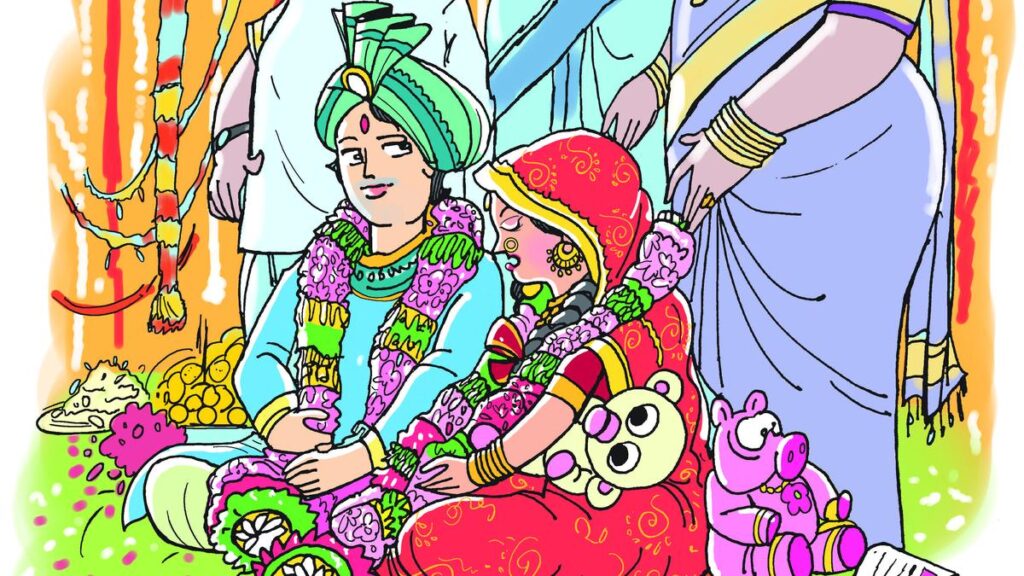
Hardly six months ago, however, Sushma was married off to a 22-year-old day labourer from Devarapalli village in Rajamahendravaram district. It was after the intervention by a team of volunteers from an NGO and government officials, who arrived at her home soon after the ‘wedding’ on June 11, that she was put back in school.
“I have been instructed to ensure that the two live apart until she turns 18,” says Bathina Penchalamma, her mother. The groom, who fled the scene in panic that day, returned later to sign an undertaking, agreeing to wait until she attained the age of 18. Sushma was produced before the Child Welfare Committee and later shifted to a Child Care Institution (CCI) at Krishnalanka for two months.
At the time of marriage, Sushma was just 15 years old, says O. Sowjanya, a volunteer from the NGO Vasavya Mahila Mandali (VMM), which works in collaboration with Delhi-based Just Rights for Children (JRC) to end child marriages in Andhra Pradesh. The JRC is a network of over 250 organisations working to protect, promote and advocate for the rights and welfare of children, especially those in vulnerable situations.
An entrenched practice
It has been 18 years since the Prohibition of Child Marriage Act, 2006, came into force in India, but the practice continues to take its toll on countless children, at times with the tacit approval of officials. Sowjanya recalls an incident to this effect. When she learnt that a 17-year-old was being married off to a 30-year-old man at Luna Centre of Singhnagar, she rushed to the venue along with local anganwadi staff and police personnel to stop the wedding. “I would have reached in time to prevent the marriage, but some local staff, apparently under political pressure to overlook the case, misled me by giving me the wrong address,” says Sowjanya.
A local secretariat staff, who requested anonymity, says that there is little that can be done in cases wherein the entire family appears complicit in violating the law. “Their indifference to the Prohibition of Child Marriage Act was evident from their earlier two failed attempts to marry the girl off to the same man, a relative, when she was just 15 years old. The girl’s paternal grandmother expressed her anger at the volunteer and the government officials, accusing them of “unnecessary interference” in what she described as a matter that concerns only her family.


In another case, a team comprising a volunteer and mahila police personnel swooped in on the house of B. Lakshmi Prasanna at Old Rajarajeswaripeta on August 14, a day before the wedding of her 17-year-old daughter, Puja, with a 30-year-old man, who already had two children from his previous marriage. Prasanna, who separated from her husband 14 years ago, eked out a living as a fruit vendor while raising three of her four children as a single mother. Puja, the eldest, had been living with her father, a lorry driver in Karnataka. After his death due to a heart attack in 2023, however, she joined her mother and three siblings in Vijayawada.
Officials learnt of the wedding through a tip-off from Prasanna’s sister, who was reportedly upset after her sister declined a match she had proposed for Puja. “I thought that since the man seemed good, he would take care of her, and I could focus on my three other children,” says Prasanna.
Puja was shifted to a home for two months and allowed to return home after her mother signed a written undertaking that Puja would not be married off before she attains 18 years of age. Puja’s younger sister dropped out of school after completing Class 10 and stays at home. Another sister is studying in a government residential school, while the youngest sibling, a boy, is academically bright but suffers from a liver ailment.

Like in the case of Puja, a vicious cycle of poverty lies at the heart of many child marriages among the poorer sections of society. Families caught in this trap often perpetuate child marriages out of desperation, unintentionally harming the very children they seek to protect. “It’s tragic that the practice continues to endanger the health, education and future of young girls,” says president of VMM B. Keerthy.
Beacon of hope
There are, however, stories of transformation that show change is possible, she says, citing the case of a woman in her 30s who was married off at 15 and subjected to domestic violence. Through VMM’s training programme in fashion designing, she acquired the skills that transformed her into a confident entrepreneur who now exports garments and has emerged as a change-maker.
In Anantapur district, the NGO Rural and Environment Development Society (REDS) documented another exemplary case wherein a father prevented the marriage of his 16-year-old daughter, Namita, an Intermediate student.
Despite pressure from maternal relatives to marry her off to an older, alcoholic cousin in the name of tradition and “security,” the father opposed the proposal, insisting on his daughter’s education and legal age of marriage. When the mother left home with Namita against his wishes, he sought help from the NGO and the police and lodged a missing-person complaint.
Prompt action by the police and the NGO resulted in Namita’s rescue within 10 days. Following sustained counselling by REDS, the Child Welfare Committee, and the police, her mother acknowledged the legal and social consequences of child marriage and agreed to support Namita’s education.
Government efforts
Principal Secretary, Andhra Pradesh Women Development and Child Welfare Department, A. Surya Kumari says the government is trying to achieve lasting results. Without explicitly referring to child marriage, efforts are being made to educate adolescent girls on related issues, enabling them to arrive at their own understanding of the harms of the practice, she says.
The government revised the ‘Andhra Pradesh Prohibition of Child Marriage Rules, 2012’ in 2023 for effective implementation of The Prohibition of Child Marriage Act, 2006. District Collectors have been designated district-level Child Marriage Prohibition Officers (CMPOs) and nodal officers for the implementation of the Act and Rules, and extensive awareness campaigns are being organised, engaging all stakeholders, including religious leaders, managements of wedding halls, catering services and event managers.
“Special vigilance drives are being organised during auspicious periods such as Akshaya Tritiya and the Sravana and Megha months, during which period a high number of weddings takes place, to prevent child marriages,” says Surya Kumari.
Girls in the age bracket of 15-18 years and boys between the ages 15 and 21 are being identified and enrolled into Open Schools, Open Intermediate and other distance education programmes. Also, skill development training programmes for out-of-school adolescent girls and awareness programmes on child rights child protection and child helpline services are being conducted.
Surya Kumari says 47,047 CMPOs have been appointed so far, and 10,541 Child Marriage Prohibition and Monitoring Committees have been constituted to ensure continuous and community-level vigilance. The department data shows that since 2023, 3,967 child marriages were reported and 3,828 of them were prevented. A total of 116 First Information Reports were filed in various police stations across the State.
“Child marriage prevalence in Andhra Pradesh is high but what sets the State apart is the collective resolve to change this reality. The State government, district administrations, local communities and grassroot partners work in close coordination with one another to make Andhra Pradesh a child marriage-free State by 2030,” says Ravi Kant, convenor of the JRC, which is working with 17 NGO partners in the State.
(Names of the girls and their family members have been changed to protect identity)