Had it stood, it would have completed 125 years in November this year. Moore Market, however, still remains, 40 years after a disastrous fire engulfed it, as an evergreen memory. It is just that I find with some digging, that there were clearly two views about it: the roseate nostalgic one, and the other, more based on reality – of an urban facility that was a byword for chaos and many malpractices.
Planned as the central market for the city after Popham’s in Broadway was condemned as unsanitary, work on it began in 1898 and was completed in November 1900, when Governor Sir Arthur Havelock threw it open. The earlier market, named after the man who planned out Broadway, was demolished and a park, the acme of Victorian ideals in planning, was laid out in its place. It was named Loane’s Square, after S.J. Loane, the then Corporation engineer. It is now Sriramulu Park, after a former mayor.
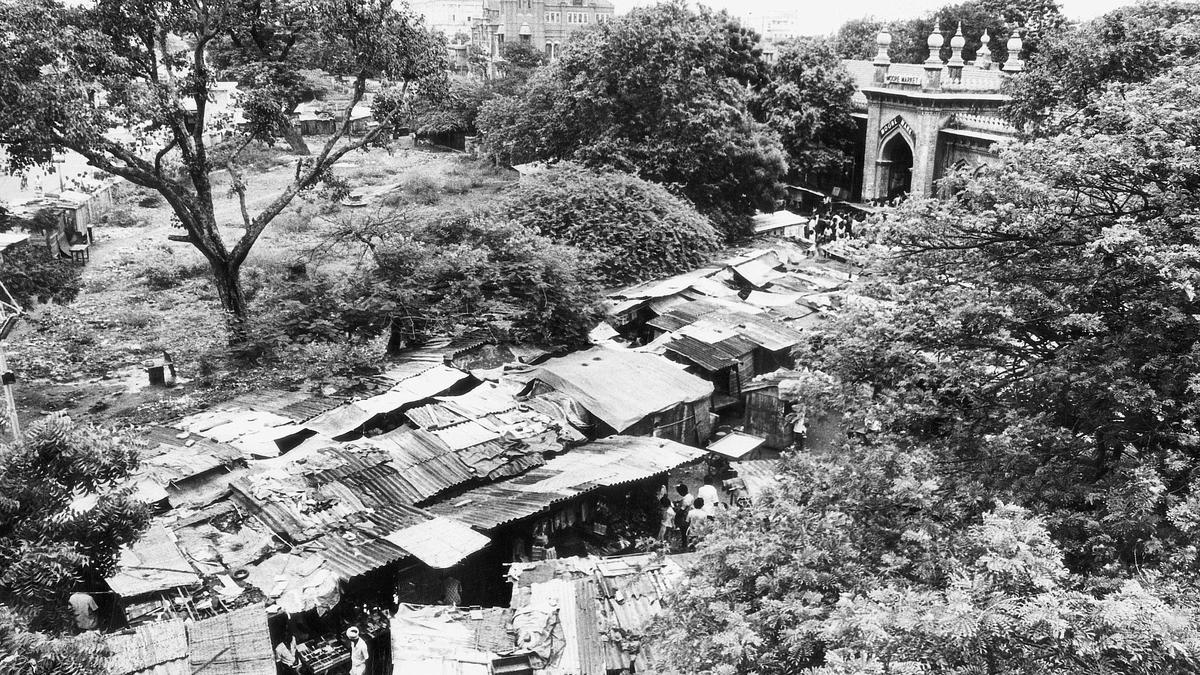
Shopkeepers occupy the space inside Moore Market in Madras. The photo was taken on May 31, 1971.
| Photo Credit:
The Hindu Archives
The new facility, built alongside Central Station, was named after Lt. Col. Sir George Moore, President of the Madras Corporation in 1898 when the market was planned.
Built at a cost of 26,000 pounds, Moore Market had 291 stalls, and spanned a massive site, 350 ft. by 240 ft. It was designed as a rectangle around an open, central, courtyard, so as to allow free circulation of air and light. The Indo-Saracenic structure had a verandah on the outer periphery with a series of arches allowing entry.
Planned as it was as a general market, Moore Market had sections for vegetables, meat, fish, poultry, general provisions and other goods as well. That may have well been the plan, but what emerged was a haven for second-hand, spurious, and very often stolen goods.
Poor administration
A benign/negligent administration watched but never took steps to correct the situation. Thus, while officialdom in its reports merely trotted out statistics of number of stalls occupied, rent collected and funds spent on upkeep, we need to turn to popular writing to get an idea on how badly the place was run. An article by Sa. Viswananathan in Ananda Vikatan of 1962 gives us a clear idea of the chaos that prevailed in Moore Market. While there may have been officially a certain number of stall hirers, in reality, there were plenty of itinerant vendors who were a grey population as it were, out of sight of the authorities but very much a presence as far as shoppers were concerned. And they could make a visit for the unwary a most harrowing experience.
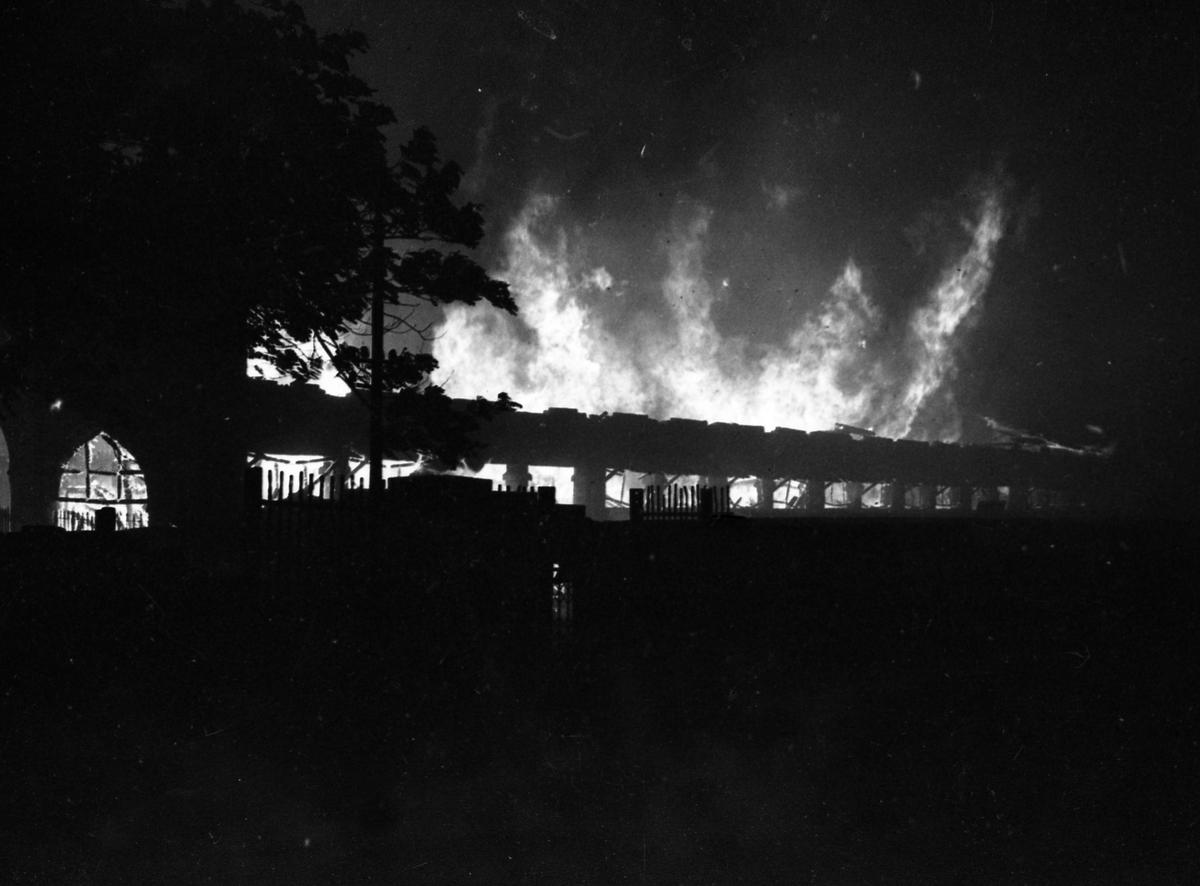
The fire that broke out at Moore Market in on May 30, 1985.
| Photo Credit:
The Hindu Archives
If you touched something, it was considered sold. And if you tried to argue, a group would suddenly form around you and force the sale. The place was also known for stuff that did not work or was branded only in name but not by way of the product. A brilliant passage about Moore Market at its worst emerges in Kothamangalam Subbu’s Thillana Mohanambal the novel. The scene, however, was not featured in the film. As the story is set in the 1920s/1930s, we can imagine that Moore Market had degenerated even by then. And it was visitors from the countryside who were apparently cheated the most.
By 1962, when the film Anubhavi Raja Anubhavi was made, Moore Market, in Kavignar Kannadasan’s eyes, symbolised all that was bad with the city. In the song ‘Madras, Nalla Madras’, he included a line – Ooru Kettu Ponadukku Mooru Market Adaiyalam – which meant just that. The vendors of Moore Market rose up in protest and demanded an apology from Kannadasan. He did not budge from his position.
Thus, a deadly combination of administrative negligence, the general lawlessness in any vending zone in the city, and public apathy sounded the death knell for Moore Market. With the railways needing land to expand and the hawkers refusing to move, the great fire, the first of many in heritage buildings of Madras, proved very convenient. The vendors were provided alternative accommodation of a very poor kind in the Lily Pond Complex, which as the name indicates, was built on a filled-up lake.
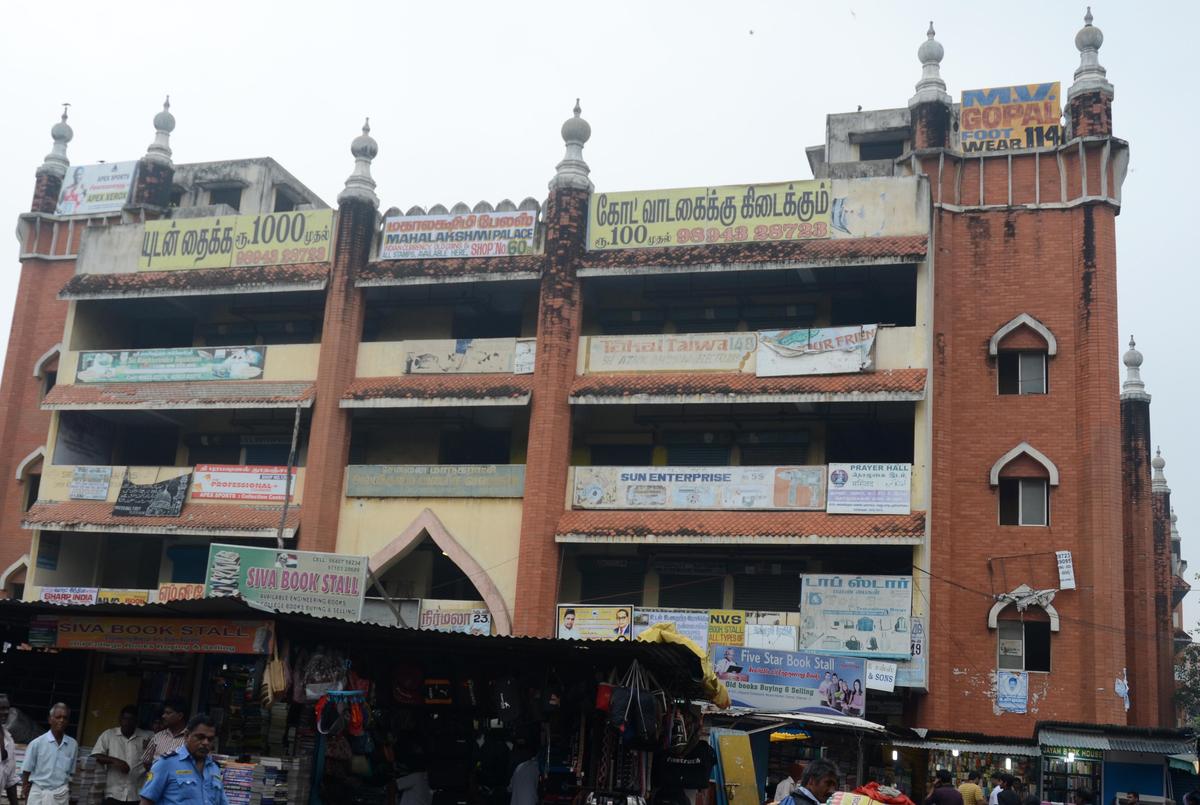
The Lilly Pond Complex.
| Photo Credit:
B. Jothi Ramalingam
Perhaps ,it was only the booklovers and gramophone record collectors who mourned the passing of Moore Market.
The sad aspect is that the building was made to pay the price. Surviving photos show that it could have been repurposed beautifully for the suburban railway terminus, with may be a multi-storey structure to its rear. But years of maladministration of Moore Market had brought it to a point where only a catastrophe could bring about change. And that is how it came to be.
There was one silver lining. Moore Market, and other heritage buildings of the city that no longer exist, paved the way for a more caring administration. Heritage buildings are not demolished with impunity any more.
(Sriram V. is a writer and historian.)
Published – December 17, 2025 06:00 am IST