
A long legal battle
Thousands of villagers have been pursuing legal action for over a decade.
Ratre says more than 6,000 farmers filed petitions in the Bilaspur High Court in 2011, seeking fair compensation and rehabilitation. Sixteen years later, many cases remain unresolved. “For the past decade and a half, we have only been given dates,” he says.
To press their demands, farmers once walked 112 km from Raipur to Bilaspur over four days to file their petitions.
They allege that land was acquired forcibly and without adequate compensation. These claims continue to be contested in court.
The prolonged legal battle has also taken a toll. According to Ratre, at least four farmers who filed petitions have died while waiting for a resolution. Despite these grievances, development in Nava Raipur Atal Nagar has continued.
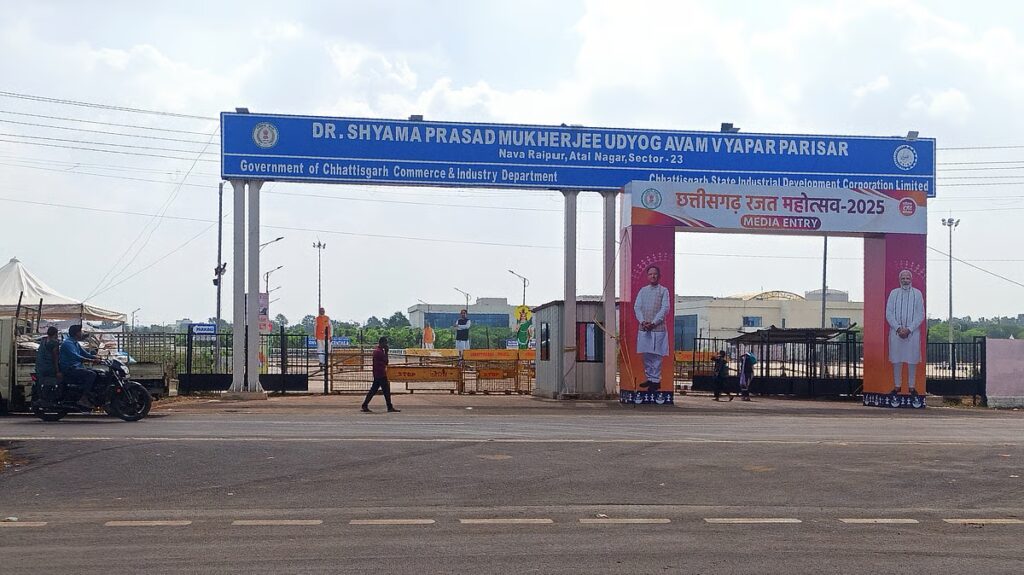
The township spans over 8,000 hectares and includes six-lane roads, residential complexes, clubs, a hospital, an international cricket stadium, a new secretariat, the legislative assembly, a jungle safari, a botanical garden and a central park.
Yet many displaced residents say they have not benefited from the project. “There is no work for us,” says Ashok Kumar, a displaced resident of Titha village. “We sit at Raipur’s labour chowk every day, waiting for someone to offer work. Some weeks, only one or two people get work. The rest of us return home empty-handed.”
Local leaders say employment opportunities promised under rehabilitation plans have not materialised. Chandrakar says thousands of families are still waiting.
“More than 6,000 families have been affected, but not a single one has received employment,” he says.
Some villagers were allotted shops under rehabilitation schemes, but they say they are now required to pay rent for them.
Residents also point to social changes following displacement.
Ratre says that while men struggle to find work, women often travel to cities for labour. “In recent years, many women from our villages have gone out for work and some have not returned,” he says, claiming that more than 2,000 women are unaccounted for.
A vision still unfolding
Chhattisgarh was formed on November 1, 2000, and discussions on building a new capital began soon after, with officials looking to develop a planned city on the lines of Bhopal, the capital of neighbouring Madhya Pradesh.
The state government consulted nine experts from around the world to identify a suitable site within 50 km of Raipur. The location was expected to require minimal displacement, have access to water, lie close to a major railway line, be near an airport, be environmentally viable and include sufficient non-fertile government land.
The selected location between National Highways 6 and 43 was chosen for its access to water, proximity to transport links and availability of land. However, the site also included 41 existing villages, setting the stage for one of the state’s largest land acquisition exercises.
More than two decades later, the project remains incomplete, even as questions continue over its costs, timelines and human impact.
The idea of a new capital for Chhattisgarh has also evolved over time. In 2002, then Chief Minister Ajit Jogi laid the foundation stone for New Raipur in Pauta village, with Congress leader Sonia Gandhi in attendance. The initial plan covered 61 villages.
After the Bharatiya Janata Party came to power in 2003, the project was revised. In 2005, a new foundation stone was laid in Rakhi village, and the number of affected villages was reduced from 61 to 41. Restrictions on the sale and purchase of land were imposed in 27 of these villages.
According to local leaders, the restrictions were initially broader. Ratre says that following the 2002 announcement, land transactions were effectively halted across all 61 villages. Later, the restrictions were formally retained in only 27 villages, and after prolonged protests, reduced further.
On March 7, 2022, the state government accepted six of the farmers’ eight demands, reducing the number of restricted villages to 14.