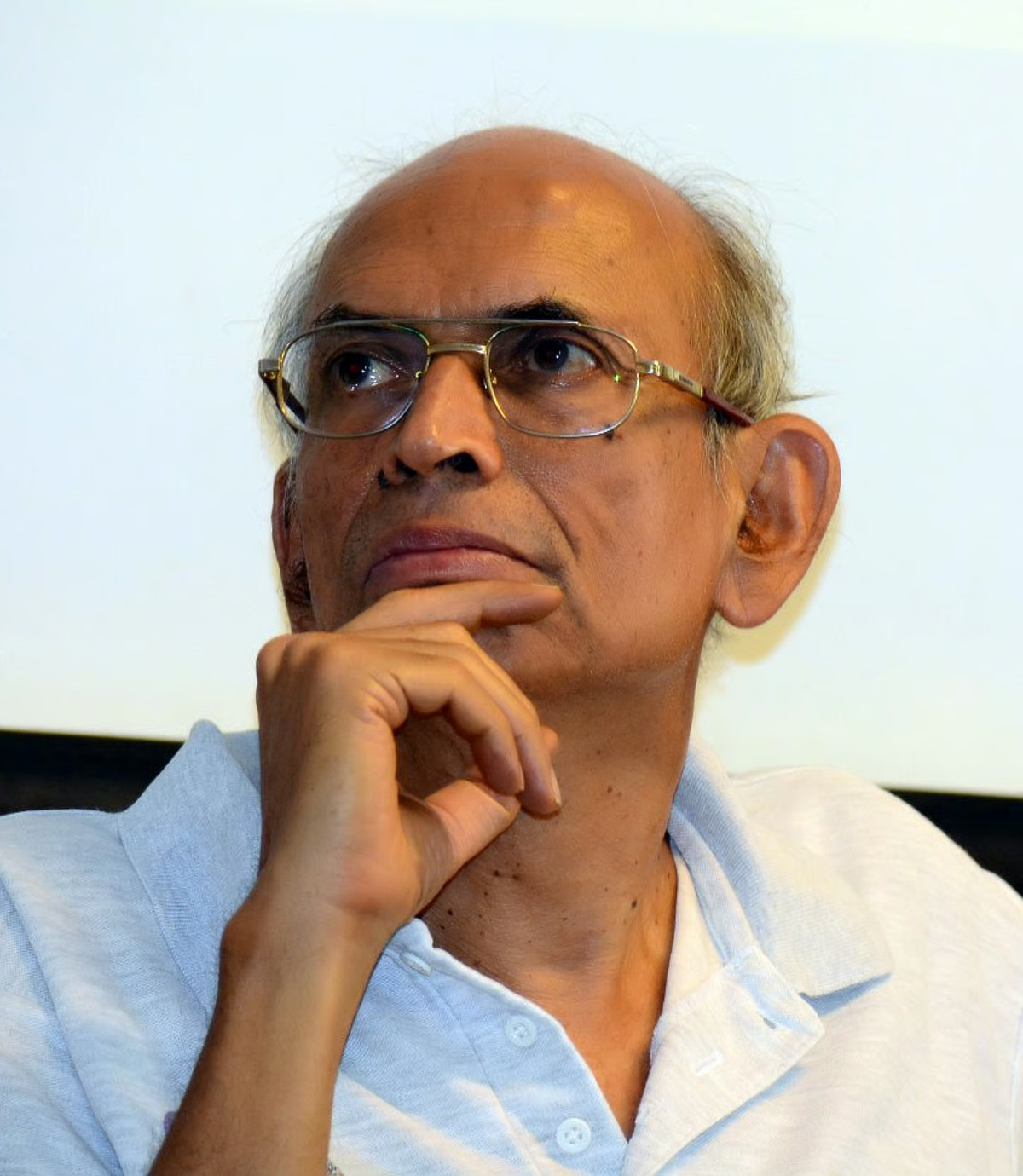
Every time the hills of Kerala slipped, cracked or came rushing down as mud and water, one name returned to public conversation with unsettling regularity. It surfaced in newspaper columns, television debates, official committee reports and private conversations among administrators and activists. Often it was spoken with irritation, sometimes with anger, increasingly with a quiet sense of regret. Madhav Gadgil.
He did not belong to Kerala by birth. A Marathi from Pune, trained far from the humid southern slopes of the Western Ghats, Gadgil nevertheless became one of the most consequential public figures in Kerala’s environmental and political life. Over four decades, the state argued with him, resisted him, occasionally honoured him and, in moments of calamity, returned to him as if to an uncomfortable truth it had never fully absorbed.
Kerala made Gadgil more than a scientist. It turned him into a symbol, a warning and finally a mirror held up to its own development choices.
Silent Valley and the habit of ecological debate
Gadgil’s imprint on Kerala dates back to a time when the state was still learning how to argue about ecology in public. The Silent Valley controversy of the late 1970s and early 1980s was not merely about a hydroelectric project. It marked Kerala’s political awakening to environmental limits. Scientists entered mainstream debates, poets shaped ecological language and conservation moved out of expert rooms into the streets and legislatures.
Gadgil was part of the scientific scrutiny that questioned the ecological wisdom of damming Silent Valley. That intervention helped reinforce an idea Kerala would never quite abandon, that development was not automatically virtuous and that expert knowledge could legitimately challenge state power. When Silent Valley was eventually saved, Kerala internalised a habit that would later make its ecological conflicts sharper rather than quieter.
Environmental writer and activist Sridhar Radhakrishnan has often described this phase as foundational. “Silent Valley taught Kerala that ecology is not a specialist’s luxury,” he has said. “It is a political responsibility. Gadgil belonged to that tradition of speaking science in the language of democracy.”
That early association ensured Gadgil was never seen as a distant academic parachuted into Kerala’s affairs. He was already part of a lineage the state recognised.
The Western Ghats report and a collision of anxieties
When the Union environment ministry appointed Gadgil to chair the Western Ghats Ecology Expert Panel in 2010, expectations were high and anxieties quietly building. The panel’s mandate was ambitious. It was asked to assess the entire Western Ghats as a single ecological system across six states and to recommend measures to protect it from irreversible damage.
The report submitted in 2011 was rigorous and unsettling. It argued that the Ghats were already under severe stress and that unregulated quarrying, mining, large infrastructure, road expansion and construction would trigger cascading ecological failures. It proposed graded ecological sensitivity zones and emphasised decentralised governance, placing faith in local bodies and gram sabhas rather than distant bureaucracies.
Nowhere did this land with greater force than in Kerala.
Unlike most hill regions in India, Kerala’s high ranges are densely inhabited. Settler farmers, plantation workers, small traders and migrant communities live on slopes that were forests within living memory. Land is livelihood, security and identity. Any external intervention, however nuanced, is quickly filtered through fear of eviction, loss of income and bureaucratic control.
The Gadgil report entered this fragile terrain not as a carefully explained ecological document but as a political object freighted with rumour.
From science to street conflict
In districts like Idukki and parts of Wayanad and Kozhikode, fear travelled faster than fact. Protests erupted. Government offices were vandalised. Gadgil’s name became shorthand for land freezes and displacement, even though the report explicitly rejected mass evictions.
What followed was a failure of political communication. The report was not meaningfully translated into Malayalam in its early stages. Misinformation flourished. Local leaders, sensing electoral danger, chose ambiguity over clarity. Religious and political organisations framed the report as an existential threat to settler communities. Political parties across the spectrum quietly distanced themselves from its recommendations.
Environmental journalist N Badusha, who reported extensively from the high ranges during this period, later observed that the conflict was less about ecology than about trust. “People were never told what the report actually said,” he noted. “Gadgil became a villain not because of his recommendations, but because the state failed to communicate honestly with its own citizens.”
The Centre’s decision to appoint a second committee under K Kasturirangan diluted key aspects of the original report. Even then, Kerala struggled to implement the revised framework. The damage was already done. Gadgil had become a contested name, heavy with political meaning.
Friends, critics and an unusually public scientist
Few scientists in India have acquired the kind of public visibility Gadgil did in Kerala. He was debated in tea shops and television studios, attacked in political speeches and defended in editorials. Environmental groups and river activists saw in the Western Ghats report the most serious attempt India had made to confront ecological limits honestly. They argued that Gadgil articulated what politicians were unwilling to say, that fragile landscapes demand restraint and that development has consequences.
His critics, particularly in the high ranges, saw something else. For them, Gadgil represented an elite driven conservation agenda disconnected from everyday anxieties and the state’s inability to provide alternatives. The word “Gadgil” became something to fear.
Ecologist S Usha, who has worked closely with community-based conservation initiatives in Kerala, believes the polarisation was deliberate. “The report asked difficult questions about power and resource use,” she has said. “Instead of engaging with that, it was easier for the system to personalise the debate and turn Gadgil into the problem.”
What made Kerala distinctive was that neither side ever fully won the argument. Gadgil was resisted politically but retained intellectually. He was sidelined administratively but never erased from public memory.
Calamities and the return of the warning
Kerala’s recurring ecological disasters ensured that Gadgil’s ideas never entirely faded. The floods of 2018 marked a turning point. As rivers overflowed and hills collapsed, questions arose that went beyond rainfall statistics. Why had quarrying been allowed on steep slopes. Why were wetlands systematically reclaimed. Why were dams operated without coordination during extreme weather.
Suddenly, the Western Ghats report no longer sounded abstract. Its warnings about cumulative impacts, landscape fragmentation and governance failures appeared painfully concrete.
Subsequent landslides in Wayanad, Kottayam and Idukki reinforced the pattern. Each tragedy revived the same uncomfortable thought. The risks had been identified. The science was available. The political will had faltered.
Gadgil himself resisted the language of prophecy. He spoke instead of systems, feedback loops and institutional responsibility. Yet public perception shifted. Kerala had been warned, and it had chosen delay.
A realist, not a romantic
One of the enduring ironies of the Gadgil debate is how persistently he was caricatured as an impractical conservationist. In reality, he consistently argued for balancing ecological protection with livelihoods. He rejected fortress conservation and insisted that people are part of the Western Ghats, not intruders to be removed.
His emphasis on decentralised governance reflected faith in local knowledge and democratic processes. In a state with a strong tradition of local self government and participatory planning, this aspect of his thinking quietly resonated, even if it was rarely acknowledged publicly. His work on People’s Biodiversity Registers aligned closely with Kerala’s institutional culture.
Gadgil was neither a romantic preservationist nor a development absolutist. He was an ecologist asking uncomfortable questions about limits.
Why Kerala treated him like a public personality
Kerala does not easily elevate scientists to public prominence. That Gadgil achieved this status speaks to the nature of his intervention. He spoke of land, livelihoods and governance, not just forests and species. He challenged entrenched interests and forced political actors to respond.
In Kerala’s intensely politicised society, such challenges inevitably became personal. Gadgil was invited, opposed, debated and remembered with a familiarity usually reserved for politicians and cultural figures. He was disagreed with fiercely but never ignored.
That, perhaps, explains why a man from Pune came to be treated in Kerala almost as one of its own public intellectuals.
Madhav Gadgil did not belong to Kerala by geography. He belonged to it by argument. He forced the state to confront the limits of its development story and to debate, publicly and painfully, what sustainability actually demands.
In a state that prides itself on debate, that may be the most enduring legacy of all.