It is a daily onslaught. Every morning, teenage Israeli settlers drive a herd of goats from their outpost in the hills down into the valley towards the Palestinian village of Ras Ein al-Auja.
The local men, women and children retreat inside their huts and tents. Any hint of resistance from a Palestinian is likely to bring in the Israeli army or the border police, confiscation of property and disappearance into the maw of “administrative” detention without trial, for months or years.
Instead, a small group of volunteers step forward each morning to face the descending settlers whose stated aim is to overrun and trample the village with their livestock, and drive Palestinians out.
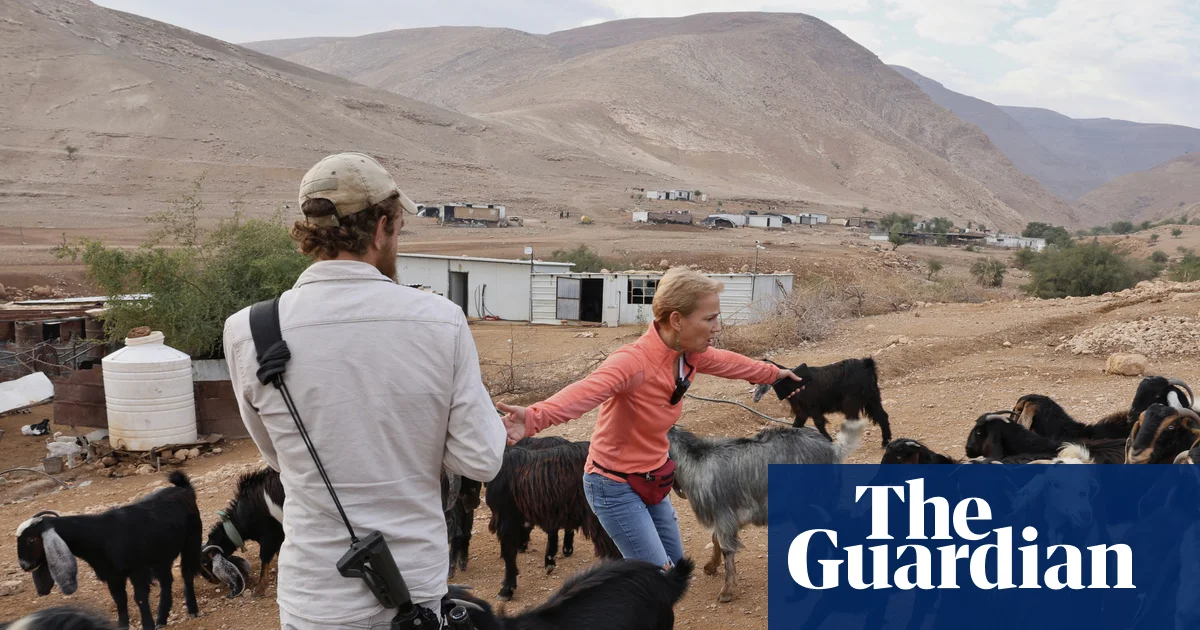
On this particular Saturday, the defenders of Ras Ein al-Auja are four Israeli Jews, a Hungarian and an American, who make a screen around Palestinian homes to shoo away the encroaching animals.
“The settlers are trying to provoke the local people into protecting themselves, but if they do the army and police will storm the community and arrest everyone,” said one of the Israeli volunteers, Amir Pansky, a retired Israeli army major.
“We are a protective presence because we are putting our bodies between the Jewish settlers and the Palestinians.”
For every defensive move they make, the teenage settler goatherds respond with an offensive counter-move to outflank the village guardians. The boys walk right up to the volunteers until their faces are inches apart, and the latter try to stand their ground, waving their arms and shouting.
The goatherds hold up their phones to record the scene, and give a running commentary, while each defender wears a body-cam, an insurance policy against any false claims of assault.
It is a tense battle of wits. Chess, but played with goats. Just when the face-off is at its peak, the settlers in the outpost half a kilometre uphill unleash a surprise move – driving a herd of about 50 camels down towards the other end of the village, like a cavalry charge ordered by some unseen hilltop Napoleon, forcing the defenders to split up to confront the new threat.
For all its outward absurdities, the game is played in deadly earnest. The goatherd boys carry sticks and clubs and have shown themselves ready to use them in tussles with volunteer defenders.
There are older settlers waiting in the wings with other weapons. On 3 December, assailants on all-terrain vehicles raided the compound where international volunteers stay in Ras Ein al-Auja, and aimed pepper spray in the face of several of them.
On the day of the camel charge, a man with a light brown uniform and assault rifle slung around his shoulder arrived at the scene in a white pickup truck and walked alongside the goatherd boys in a show of support.
Israeli activists identified the newcomer as Gabriel Kalish, the local security coordinator from Me’vo’ot Yericho, about 9km farther down the Jordan valley.
Kalish refused to give an interview to the Guardian, suggesting that he happened to be passing by. However he added: “This land belongs to the Jews.” Activists have photographed many times, in a variety of different uniforms, at the site of settler incursions on Palestinian villages.
As a security coordinator in a settlement, Kalish’s wages and gun are paid for by the government, and his presence at the daily campaign of intimidation against Palestinians is a link between the teenagers herding goats and camels and the extremists currently in cabinet positions, who are bent on the annexation of the West Bank.
Lev Taor, a young settler whose turn it was a few days earlier to drive a goat herd through Ras Ein al-Auja, made no secret of the overall objective.
“I came with my flock to protect the land. The goal is to expel these people,” Taor said, referring to the local Palestinians.
The lives of the people of Ras Ein al-Auja have been increasingly hemmed in over recent years. They can no longer graze their herds on the western slopes of the Jordan valley, as previous generations had done.
Since the beginning of the Gaza war, and the radical acceleration of an Israeli land grab across the West Bank, the 700 local people have largely been confined to the village, a string of huts, tents and animal shelters along a creek running east from a spring towards the River Jordan. They have cut down their flocks and bought feed for them, but refused so far to give up Ras Ein al-Auja altogether.
“It was very quiet here before. You could graze your flock east, west, north, south and there was no problem,” Naef Ja’alin, one of the villagers, said. “The settlers started harassing us years ago, when we were grazing our flock, but that was some distance from the village. But since 7 October [2023], they have come closer and closer, to the point that today nobody takes their herd outside the village.”
He said his son slept in his shoes so he is ready to run if the family is attacked at night.
Settler outposts have sprung up on two sides of the village, and the Palestinians have been stopped from using the local spring, one of the most renowned in the Jordan valley.
The Ja’alin family were moved to the area from southern Israel after the 1967 war, which began the occupation. Naef Ja’alin says they have nowhere else to go but credits their remaining tenuous grip on the hillside to the thin line of volunteer defenders.
“Without these people, we would have been gone a long time ago,” he said. “Nobody helps us. Only these people protect us.”
The volunteers are a mix of young and old. Both Israelis and foreigners are seeking to make a difference, to compensate for what they see as the complicity of their governments in the victimisation of Palestinian civilians.
The Israeli volunteers are part of an organisation called Looking the Occupation in the Eye, a pithy description of what they set out to do.
“The main thing that motivated me is what I’m going to tell my grandsons about what I was doing during the disaster the government of Israel has made in this area,” one senior volunteer, Doron Meinrath, said. “I want to be able to look in the mirror and be able to say I did all I could do.”
Like Pansky and many other elder members of the organisation, Meinrath was a senior officer in the Israeli army who feels that the force has changed out of all recognition in recent years, from one focused on Israel’s defence to an aggressive accomplice in the ethnic cleansing of the West Bank.
“For young children here, it is the first time they have seen a Jewish guy who is not attacking them, and who they are not afraid of. It’s important to show not all Jewish people are the same.”
The international volunteers at Ras Ein al-Auja have come through an organisation called Unarmed Civilian Protection in Palestine, one of several volunteer groups seeking to protect West Bank Palestinians from attack.
Josie, one of the volunteers, who preferred not to give her full name for her own safety, said it was impossible for her to stay safe and comfortable at her home in north Wales in the face of such obvious oppression.
“I don’t like injustice anywhere. I don’t like it in the UK, in my everyday life. Equality, human rights and justice matter to me,” Josie said. “Families are being driven away from their homes and there’s no one to call. There’s no one on their side. If they ring the police, they get taken to jail. And it saddens me that the whole world, the international community, is failing to stand up for Palestinians and their defence and independence in the same way it is standing up for Ukraine.”
Josie sees the recent pepper-spray attack on the volunteers’ compound as an uncomfortable but ultimately encouraging sign.
“It shows we are interfering with the plan,” she said. “We’re making it harder for the settlers to take what they want.”
Settler attacks on international volunteers are on the rise, as they become more of an obstacle to the seizure of Palestinian land. At the end of November, three Italians and a Canadian were attacked and robbed in the nearby village Ein al-Duyuk, close to Jericho.
On 7 December, a gang of eight masked Israeli settlers armed with clubs raided a Palestinian family home on a hillside outside the village of al-Mughayyir, north-east of Ramallah, injuring a 13-year-old Palestinian boy, his 59-year-old grandmother and international volunteers with the International Solidarity Movement from Colombia, the US, France and the UK.
Phoebe Smith, the 31-year-old British volunteer, suffered extensive bruising, and a gash in her arm. She was recovering last week but determined to go back to help defend the Abu Hamam family, the Palestinians the volunteers have been trying to shield.
“I want to support the family in any way that I can and just show them that we can’t be pushed away. They have to remain there. Their livelihood is tied to being at the home and that is their life,” Smith said.
“I was a charity worker in the UK working closely with refugees and had come across a lot people who’ve been forcibly displaced from their homes,” she said. “Coming to Palestine felt like one small way of something that was not just watching from the sidelines.”