 PA Media
Mia Hansson is in a race against time.
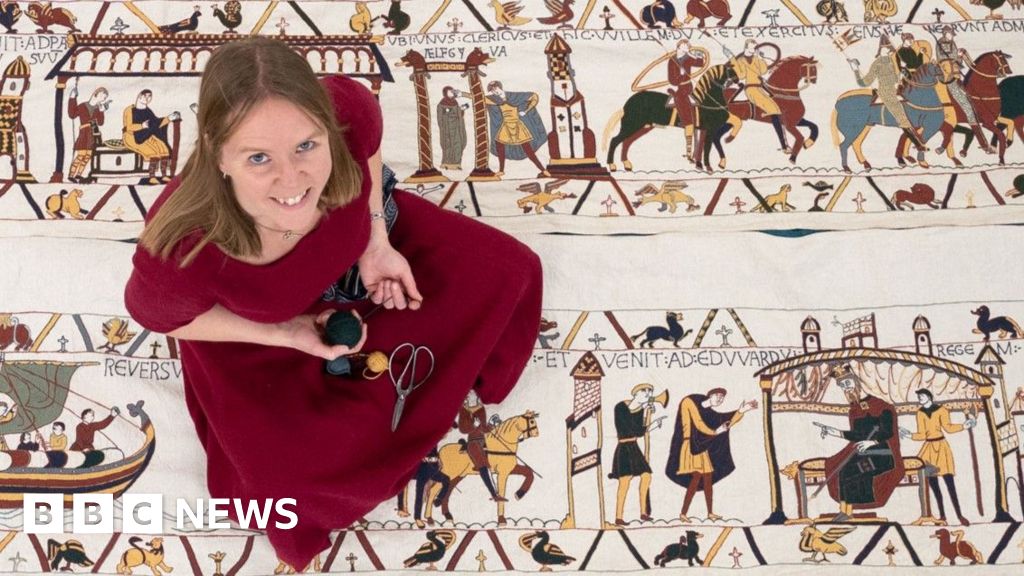
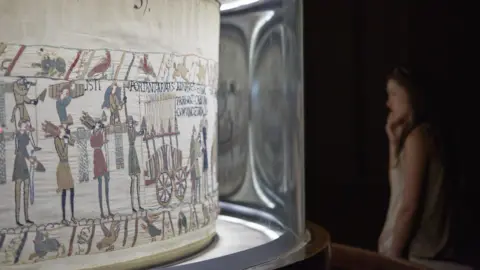
As the British Museum prepares to put the Bayeux Tapestry on display in London next September, the Cambridgeshire-based artist is furiously working away on her own full-size replica.
The original, nearly 1,000 years old and 70m (230ft) in length, tells the story of the 1066 Norman conquest of England and the Battle of Hastings.
It is being displayed at the museum as part of a cultural exchange announced in the summer.
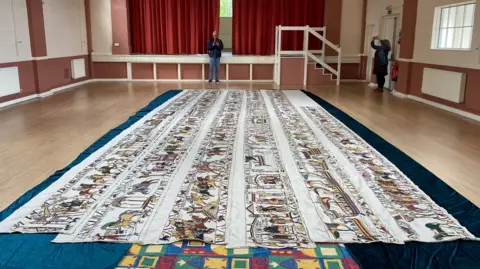
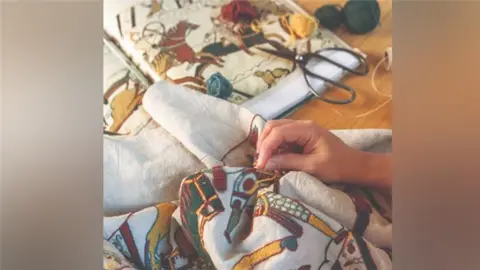
In Wisbech, Mia, who’s 51, has been meticulously sewing her own faithful replica for the last nine and a half years.
She says the impending arrival of the real thing has spurred her to stick to her completion deadline of October 2027.
“If I finish the following year, I’ll be old news,” she says. “I want to ride that wave.”

 Search Press/Mark Davison
Mia began her work on an authentic stitch-by-stitch copy of the original 11th Century embroidery in 2016 “because I just wanted something to do and needed a project I couldn’t finish in a hurry”.
Since then, she has been working at a steady rate of 6m (20ft) a year.
She wants to finish by 2027, when the tapestry returns home to the newly reopened Bayeux Museum in Normandy.
Fittingly, that year is also the 1,000th anniversary of William the Conqueror’s birth.
“It will be a bit of a push,” Mia admits.
“When I finish the image I’m working on right at this minute, I will have completed 55m, which means I have 13.7 left to go. Which is proper downhill from now on.
“But anything is doable. Who needs sleep?”
 Search Press/Mark Davison
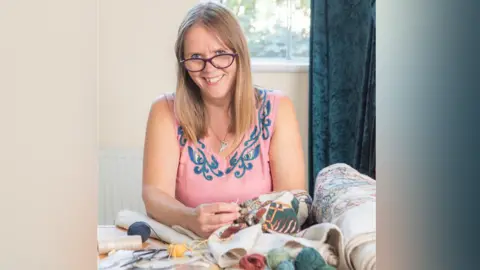
Mia says she first got a taste for embroidery aged six when her stern Swedish grandmother, Greta, gave her some sewing to do “when I might have been naughty”.
“When I finished, she turned it over and said, ‘This is how I check that you’ve done it properly’ – and that’s when I learned that the back needs to be as neat as the front.”
She adds: “I found out immediately, not only that I enjoyed it, but I was naturally good at it.”
 Julie Cave
She is currently working on “the first English shield wall”, in which nine soldiers are standing close together with overlapping shields.
Mia admits that, for the first time, the enormity of the detailing has caused sleepless nights.
“Above the legs there was a sea of heads in helmets, and every one with one arm up, holding some sort of weapon, mainly spears of all different colours,” she says.
“I thought, ‘I don’t know how to tackle it – if I do one line wrong or the wrong colour, I’m off.’ For the first time in nine and a half years, I thought, ‘I can’t do it.'”
Mia works from a self-imposed “roadmap” and plans her next scene “so I don’t have to tie off the thread too often”, but reveals that on this occasion “it was like the map flew out the window and a great big seagull ate it”.
She says: “Eventually there is a hill and there’s at least one tree, and I do like the trees – they break up the horses and the chain-mail.
“I hate chain-mail.”
 Search Press/Mark Davison
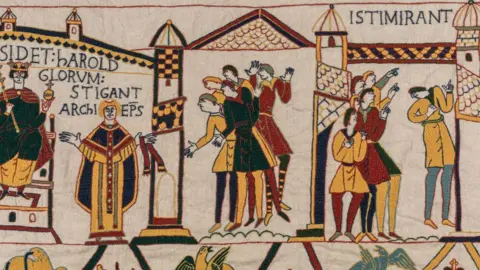
Remarkably, the original tapestry contains just seven colours – light and dark blue, light and dark green, a dark turquoise, a red and a yellow.
Other colours tend to be “repairs added a lot later, including a bright orange and an almost-black”.
 Search Press/Mark Davison
Mia has also identified a seamstress who made persistent errors in the original work.
“We have invented Mildred, the rebel seamstress from the 11th Century,” she says.
“She single-handedly gets the blame for all of the oddities that we find. She just did not follow any rules.”
She cites a “drunken bird” and the addition of a random human leg “protruding from a wall of horses, which looks like it has been put on backwards… bent like a banana.
“That is Mildred.”
As a result, Mia has to keep to the sometimes “wonky” original to maintain authenticity and admits: “If my lines are too straight, I have to go against myself a bit to make it look not so perfect. I unpick a lot.”
 Mia Hansson
Mia has published five colouring books linked to the tapestry, and has now produced a larger book containing 25 full-scale transfers of scenes for embroidery enthusiasts.
Embroider the Bayeux Tapestry will be available from June next year. The foreword has been penned by Jan Messent, a renowned authority on embroidery.
Mia hopes it will be on sale at the British Museum while the original is on display there.
As for her replica, that, too, could eventually sell, with a £1m price tag suggested.
 Getty Images
“I will not promise it to anyone before I finish it, because it has to remain mine,” she says.
“Part of me wishes that I hadn’t started at all. It’s like if you watch a really good film – you can watch it again but you will never get that experience of watching it the first time.”
Mia says she has thought about life after the tapestry visits the UK.
“The British Museum will have to specially make a display case, and that will cost a lot of money. When they take it down to send it back they will have an empty case.
“I will have something that will fit perfectly in that space,” she says.
“It won’t be the original, but it will still be something really quite spectacular.”