Sean Ruiz always leaves his training-ground office door wide open. He is no fan of enclosed spaces, but there is much more to it. The passing Wolves defender Yerson Mosquera spots Ruiz and pops in for a brief chat with a fellow Colombian. Minutes later an under-21s player seeks Ruiz’s counsel on a non-footballing matter.
“It’s a blessing to have these relationships,” Ruiz says. “To see them not just for what everybody else sees: a centre-back, a striker for Wolves. These guys are like family to me. I’m lucky to get to see this side of them, to be there when things are good, when things are bad. We’re not just players and staff here. It’s something more.”
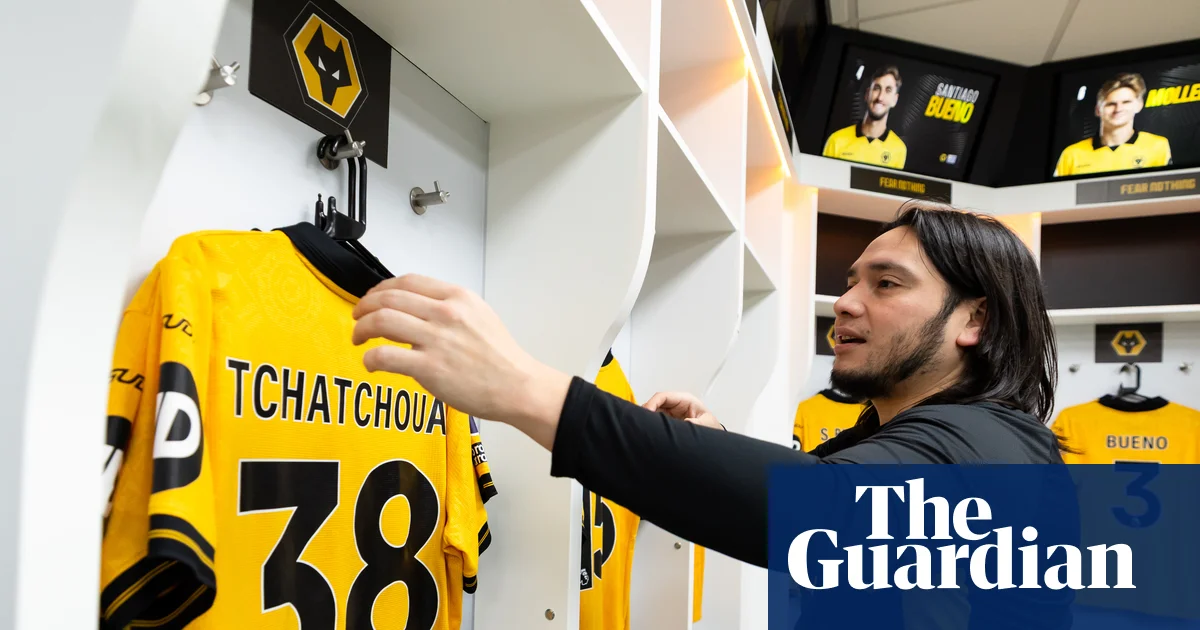
Ruiz’s office has no desk or computer. Scores of gold shirts glisten on hangers. Two printing machines sit in one corner. Every inch of every wall is covered in shelving and pigeonholes, each crammed with kit, badges, lettering and numbering. Ruiz is Wolves’ head of kit, but he and his team – assistant Barry Piper and part-time staff Ian Round and Steve Hooper – are far more than simply shirt sorters.
Snow covers the ground at Wolves’ intimate and buzzing Sir Jack Hayward complex, but Ruiz, who joined in August after more than 20 years in New York, staunchly wears his shorts. What turns out to be Wolves’ first Premier League victory of the season is 24 hours away, an honourable draw at Old Trafford having concluded little more 48 hours earlier.
Despite the packed schedule, Ruiz aims to have two sets of everything ready. As he adds José Sá’s name to goalkeeping tops, Ruiz estimates that badges, numbers and names (approved at the start of each season) are affixed to 50-plus shirts weekly.
Letters are centred by eye, with the drop from the collar measured using a small piece of card. How long is that? “No idea,” Ruiz says. “It was just here when I arrived and I’ve continued using it.”
Next to the club shirts are dozens of opposition kits swapped post-match. “Eventually the players remember they’ve given them to us to wash. Sometimes weeks later they’ll wander in like: ‘Oh, do you have this jersey?’ It’s funny.”
In a standard one-game week, Tuesday is prep day and on Wednesday “we really bang everything out”, Ruiz says. Staff and player kit bundles are made up, leaving Thursday and Friday as “loose-end days”.
Each player gets two match shirts, with a third set printed just in case. Most players change at half-time, making it easy to gather a shirt for sale on matchwornshirts.com.
Some want long sleeves, others short. Some like baggy, others tight. Under-18s are not allowed to wear gambling sponsor logos. Where is all this information held? “In here,” Ruiz says, tapping his head. “I’ve always said I should do lists, but …”
Can he name each player, number, size and shirt preference from memory? “No problem – from 1 to 38,” he says with a laugh before admitting he is still haunted by a missing two digits during his time at New York Red Bulls.
When unpacking shirts in Los Angeles, Ruiz discovered that 23 was missing. Fortunately, the shirt manufacturer was based nearby and his contact sourced a co-worker to sort one. “Any other city in the country and that doesn’t happen. We were using red letters and numbers no other team used.”
Behind Ruiz, a list stuck to the wall sets out Wolves preferred colours for each fixture and is submitted to the Premier League for approval. Late changes are the bane of kit staff’s existence.
Boots require a post-training clean, when the grass is freshest, and the day’s final task is resetting the training-ground dressing room.
Ruiz did not dream of this career; he stumbled into it. He assisted his dad, Fernando, as a teenager at the MetroStars, now the Red Bulls. Upon Fernando’s cancer diagnosis, Ruiz stepped up to the first team. Thankfully, Fernando recovered fully, but after graduation Ruiz became a “full-blown kit guy”.
Molineux matchdays begin six hours before kick-off. Ruiz and Piper, an eight-year veteran who worked with England, load their blank white van (branding would increase susceptibility to theft on away trips) with shirts, shorts, goalkeeping gloves, coats, base layers, towels, boots, flip-flops, chewing gum, coffee and, crucially, a small white tactics board.
A 10-minute drive later, security guards are helping unpack laundry bins, boxes and igloos into a vast multi-room dressing area. Once the team is confirmed, Ruiz can hang shirts in formation order – a new request by Rob Edwards. He then calls the digital department so that the screens above each place can be set accordingly.
As the dressing room fills, the individual routines and nuances show themselves. The goalkeeper Sam Johnstone always clocks his socks and requests an extra pair anyway. Tolu Arokodare trusts only Harry Warren, a matchday assistant, to steam his boots. Warren must inflate the match ball. “Matchdays are the best days,” Piper says as he flits around arranging bench coats. “Training days are about ticking over – this is when it comes alive.”
The game brings little respite. Up. Down. Up. Down. Up again. Hwang Hee-chan needs his trainers. More bananas are required. The substitutions board must be set.
That was a new one for Ruiz who told a white lie when he was asked about previous experience. “I had no idea what I was doing,” he says, grinning. “But you can’t say no in a new place, can you? You’re in the service business. You’ve got to figure it out.” His first task? A quadruple switch against Manchester City.
After the rarest of victories, 3-0 against West Ham, the buzz under the main stand is palpable. Ruiz’s team enjoy a brief catchup with their West Ham counterparts, who face a long drive and an evening’s work.
Then it is back to the training ground. “1pm leave for Everton on Wednesday?” Ruiz says. Piper and Warren nod. And on it goes.