Irish teen Kamto Chukwureh hopes to be able to represent his country at the Esports Olympics, if the IOC can finalise a plan to hold the inaugural Games.
Not long before I sit down to chat with Kamto Chukwureh and his dad Emeka, the International Olympic Committee (IOC) announces that the deal to have the world’s first Esport Olympic Games in Saudi Arabia has been cancelled. The competition had been planned for Riyadh in 2027 as part of a 12-year deal with the country. Now the IOC is going back to the drawing board. It plans to “pursue a new partnership model” and hopes to have the inaugural Games “as soon as possible”.
This is disappointing news for Kamto, who is a competitive sim racer and had his sights set on the Olympics in two years. It would have marked 10 years since he first started sim racing – a virtual reality motorsport.
Kamto’s parents bought him a basic racing simulator when he was just 11. A couple of years later, he upgraded to a more sophisticated simulator – one that he says even F1 drivers use for practice. In 2023, he started to take racing more seriously.
Just after he finished his Leaving Certificate exams, his parents surprised him with a trip to France to race with a Formula 4 team. He got to train with the coaches and race in a real car on a real track.
“I think the goal is to try to get into real-life racing,” Kamto tells me.
To an outsider, sim racing and real-life racing might seem quite different but Kamto says that a lot of the skills translate. He was able to get around the track “quickish” by the end of the week. The main difference is the G-force you experience with real driving, he says.
Kamto’s dad Emeka tells me that the present of a racing simulator for his then 11-year-old son wasn’t random. Kamto has always been interested in cars and racing, he says, even when he was a baby. “He had a toy truck that went absolutely everywhere with him,” Emeka recalls.
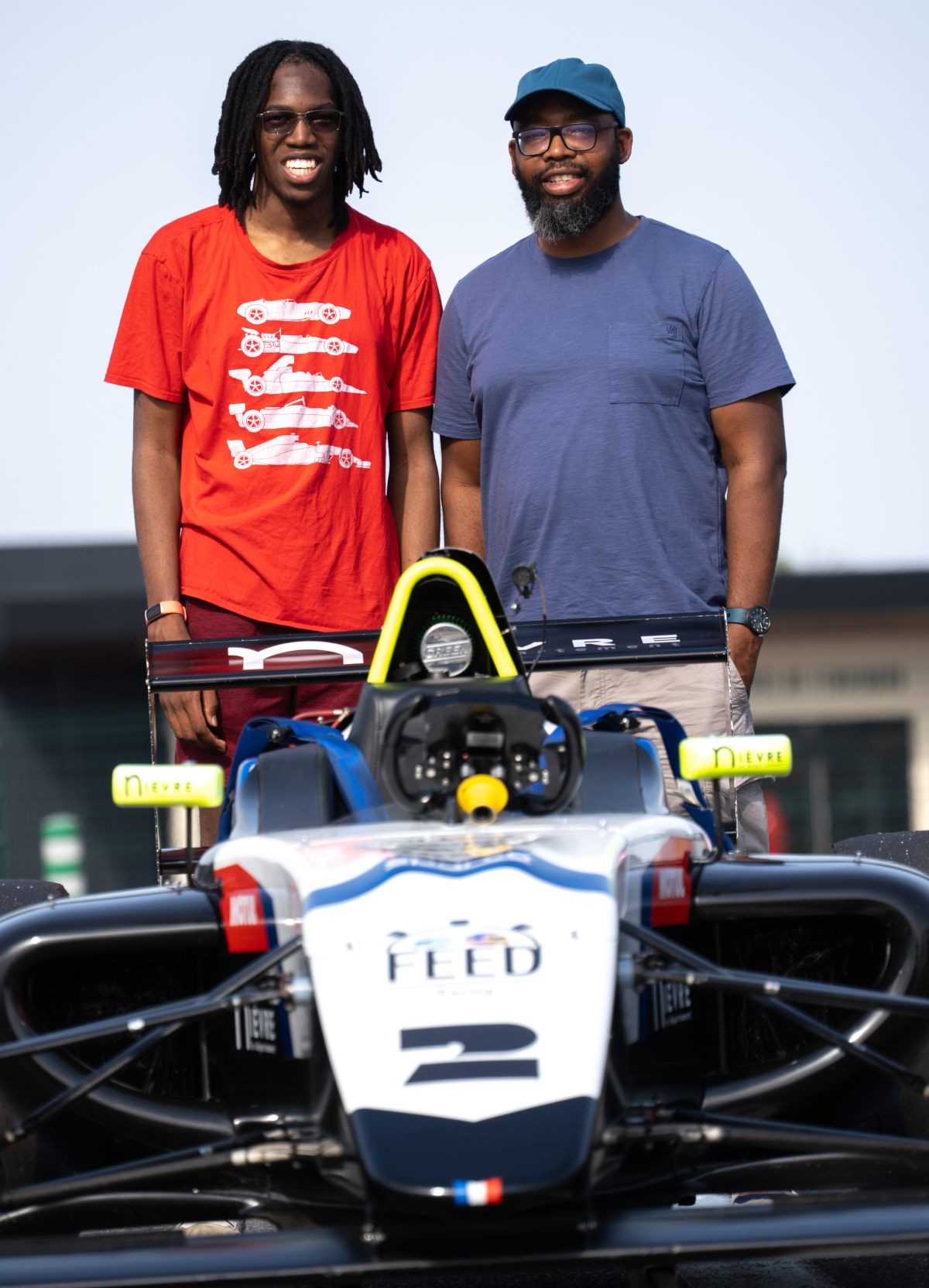
Kamto and Emeka Chukwureh at a racing event. Image: Emeka Chukwureh
When Kamto was five or six, the family had a Nintendo Wii and he would only play Mario Kart. And on every holiday, they would always have to find a go-karting range. It’s essentially an obsession, Emeka says.
By encouraging the interest, Emeka thought Kamto would eventually steer towards automotive engineering as a career. “He was having none of it. The only interest he has is the racing,” the proud dad says.
Growing esports industry
Gaming has been growing in popularity in recent years. According to Statista, 2.7bn people play video games, making it one of the most popular hobbies worldwide. And esports – competitive gaming – is also increasing in popularity, both for participants and as a spectator sport.
Kamto’s esport of choice, sim racing, surged in popularity during the Covid-19 pandemic. When real-life races were cancelled in 2020, the Formula 1 Virtual Grand Prix series drew 30m views and sim racing platforms including iRacing saw an increase in subscribers.
In response to this growing interest, non-profit Ireland Esports Federation (IEF) was set up to promote gaming and esports across the island of Ireland in 2020. And earlier this year, the Irish Government invested €1m in the National Esports Centre (NEC), which opened in Cork city.

Kamto Chukwureh at the NEC in August 2025. Image: Emeka Chukwureh
Lorraine Lucid is the operations manager at the NEC and a member of IEF’s advisory board. She tells me that she ended up working in the centre by happy accident and has found it hugely exciting to be involved at such an early stage in its development.
Ireland’s gaming community is growing all the time, she says, and as a result, “the foundations for esports are strengthening quickly”.
At the moment, the data for gaming and esports tends to be counted together, and one of the aims of the NEC is to improve the evidence base for esports activities, she says. The idea is to get a fuller picture of the community in Ireland to figure out how the NEC can best support it.
The centre has seen great interest already, Lorraine says, and has hosted a number of competitions, camps and other events.
One of the issues Kamto notes in our discussion is that Ireland has less formalised support for esports players compared to some other countries. Lorraine agrees that some countries including France and the UK have “moved sooner in establishing policy and infrastructure” but she feels Ireland’s approach has been “steady and practical”.
With the IEF and NEC now established, she says the next steps are to create clearer pathways from school and third level into national teams and professional careers; expand policies and funding supports for events, player development and international representation; and, as already mentioned, improve data collection to accurately measure esports participation and growth.
Gaming education
Lorraine speaks eagerly about the focus on education at the NEC. She says that one of the centre’s main goals is to make esports accessible for everyone, and emphasises in particular supporting young women to get involved. The centre has hosted women who are successful esports professionals, she says, to engage with girls and give them an insight into esports careers.
Another part of the education programme is developing gamified learning courses to help students engage with STEM skills such as coding, game design and digital skills in a fun way.
Emeka also mentions the potential value of gaming for education. He says the interest in gaming is so high among young people that he thinks it’s affecting how they learn and how they build careers. It’s important, he thinks, for policymakers to recognise that influence and harness it.
Emeka speaks highly of the NEC, saying he is grateful to Steve Daly in particular for his support. Steve is the CEO and co-founder with Usain Bolt and David Cronin of Wylde, an esports club and professional services company, which operates the NEC. Daly is also president and a founding board member of the IEF.
For Emeka, having access to world-class racing simulators in Cork is a great way to democratise access to the esport and sees it as a “sign of good progress for Ireland”.
Kamto has participated in races at the centre. He knew a lot of the competitors already but going to the NEC was his first time meeting them in real life, which he enjoyed.
He started a degree in digital marketing this September. I ask how he finds time for training on top of a busy college schedule. He says he’s able to balance it all quite well. And when it comes to making plans for the future, he’s happy to just take things as they come. His calm attitude at such a young age is possibly a signal as to how he can handle the pressure of competitive sim racing.
As for having his dad as a manager, he says, if anything, it’s brought them closer together rather than causing any stress. Emeka says all he wants is for his three kids to excel in whatever they’re interested in. He feels lucky to be in a position to support their ambitions.
Although the cancellation of the Olympics is a blow, Kamto has his sights set on other international competitions, including the Esports World Cup, an annual competition that started in 2023, and the Esports Nations Cup, a new tournament scheduled for its inaugural competition in November 2026.
Though Emeka thinks the Olympics is the thing that will really bring esports to “mass consciousness” so he’s hopeful the IOC will announce a new plan soon. He predicts the industry will blow up everywhere when it gets a dedicated Olympic Games, a prospect that clearly drives his excitement.
Don’t miss out on the knowledge you need to succeed. Sign up for the Daily Brief, Silicon Republic’s digest of need-to-know sci-tech news.