
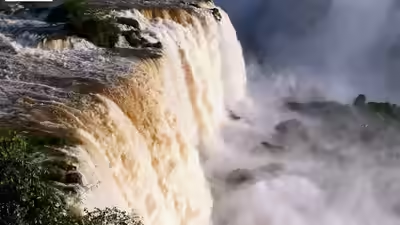
Waterfalls have a way of announcing themselves before they come into view. You hear them first, then feel the air change, then see water rising instead of falling. Victoria Falls does all of this at once. Long before you reach the edge, there is sound and mist and a sense that something large is moving nearby. People have stood here for generations, watching the river break open and disappear into a narrow gorge. The name it carries did not come from maps or explorers but from people who lived with it. They described what they experienced rather than what they measured. Smoke rising, thunder rolling, water everywhere. Even now, with paths and viewpoints and cameras, the first reaction is often silence. It is not a delicate place. It does not need to explain itself.
How Victoria falls earned the name ‘Smoke That Thunders’
Victoria Falls is known as the Smoke That Thunders. It sits on the Zambezi River, right where Zambia and Zimbabwe meet. The local name, Mosi oa Tunya, describes exactly what people saw and heard long before the modern name existed. When the river drops into the gorge, it throws mist high into the air. From a distance, that mist looks like smoke rising from the earth. At the same time, the sound of water crashing into rock carries far across the landscape. The two together gave the waterfall its name. It is not poetic in a soft way. It is direct and physical.
Why does Victoria Falls make so much mist and noise
The shape of the land plays a big role. Victoria Falls is wide rather than extremely tall, and the river falls all at once into a narrow space. This creates a solid wall of water instead of separate streams. When that volume hits the gorge below, it has nowhere to spread out. The impact sends water spray straight up. During the rainy season, the mist can rise hundreds of metres and drift across nearby forests and towns. The sound comes from the same force. Water hitting rock at that scale does not fade quickly. It echoes and rolls, changing slightly as the river level rises and falls.
Victoria Falls located on border of two countries
The waterfall lies in southern Africa, forming a natural border between Zambia and Zimbabwe. On the Zambian side, the nearest town is Livingstone. On the Zimbabwean side, it is Victoria Falls Town. Both offer access, but the views differ. One side feels closer to the falling water, the other gives a broader sense of the river and gorge. The surrounding area is protected as a national park, and the constant moisture from the mist supports thick vegetation. Even in dry months, parts of the forest stay green because of the spray drifting inland.
What makes Victoria Falls different from other waterfalls
Victoria Falls is not the tallest or the widest on its own, but the combination matters. Its width and height together create the largest continuous sheet of falling water in the world. The mist shapes the environment around it, creating a rainforest in a region that would otherwise be much drier. Rainbows appear often, and on clear nights with a full moon, moonbows sometimes form. These details are not always visible at once. They come and go with light, season, and water level.Movement is part of why its name still fits. It keeps breathing, and it keeps thundering, without trying to be anything else.