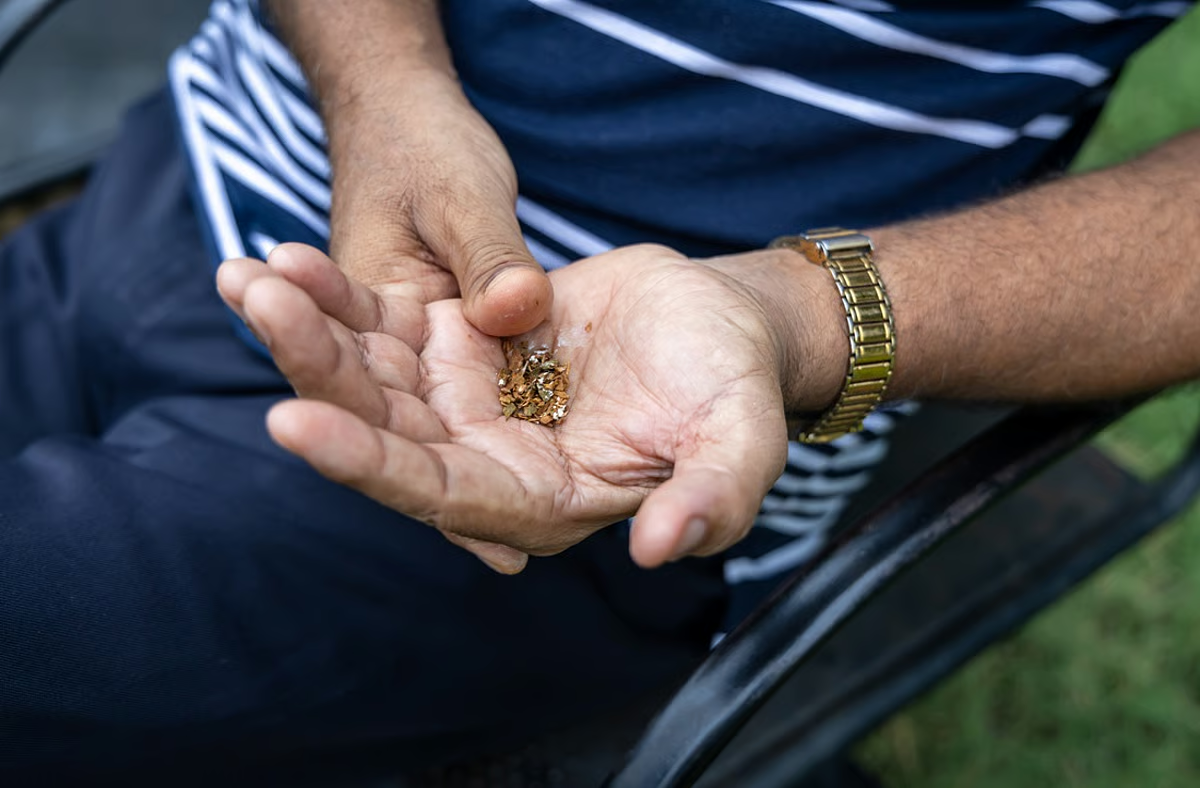
Indian households continue to spend more on tobacco and intoxicants than on nutritionally essential food items such as pulses and fruits, underscoring a persistent public health failure that has survived economic growth, repeated tax hikes and decades of regulation.
Data from the Household Consumption Expenditure Survey conducted by the National Sample Survey Office (NSSO) under the Union Ministry of Statistics and Programme Implementation (MoSPI) shows that in 2023-24, pan (betel leaves), tobacco and intoxicants accounted for 5-9 per cent of monthly average total rural household expenditure in several states, frequently exceeding spending on pulses, fruits and, in some cases, even milk. Urban consumption shares are lower but remain significant, often surpassing expenditure on pulses.
The pattern is not new. Data from the NSSO’s 55th Round (1999-2000) shows that Indian households already devoted nearly 10 per cent of total consumption expenditure to pan, tobacco and intoxicants at the all-India level. Even at the turn of the millennium, tobacco spending rivalled or exceeded expenditure on nutritionally important food groups such as pulses and fruits, particularly among poorer households. While cereals dominated food budgets in the 1990s, tobacco had already emerged as a major non-food claim on household resources, indicating that the crowding-out of nutrition by addictive substances is a long-standing structural feature of household consumption.
Tobacco outpaces essential food spending
In Chhattisgarh, rural households in 2023-24 spent 7.08 per cent of total consumption on tobacco and intoxicants, more than double the share allocated to pulses (3.22 per cent) and almost three times that spent on fruits (2.65 per cent). In Meghalaya, rural tobacco consumption rose to 9.04 per cent, dwarfing expenditure on pulses (1.01 per cent) and exceeding fresh fruit consumption by more than three times.
Even in relatively higher-income regions, the pattern holds. In Chandigarh, urban households spent 2.95 per cent of total consumption on tobacco-related items in 2023-24, still higher than spending on pulses (0.7 per cent) and nearly equal to fresh fruit consumption. In Sikkim, rural households now spend more on tobacco (8.79 per cent) than on cereals, fruits or pulses individually.
By contrast, pulses, the cheapest and most accessible source of protein, consistently attract the lowest expenditure shares across states, often below 1 per cent in urban areas and rarely exceeding 3 per cent in rural India. The nutritional trade-off is stark: discretionary spending on addictive products routinely crowds out spending on basic nutrition.
A problem rooted in history, not income
The persistence of this trend challenges the assumption that rising incomes automatically lead to healthier consumption choices. Monthly per capita spending has increased sharply over time. Rural consumption rose from Rs 3,773 in 2022-23 to Rs 4,122 in 2023-24, while urban spending climbed from Rs 6,459 to Rs 6,996. Yet tobacco’s share has not declined proportionately, particularly in rural areas.
In 1999-2000, tobacco consumption was often explained as a poverty-linked coping mechanism. Today, the data suggests something more entrenched: habitual consumption reinforced by cultural norms, easy availability and weak deterrence, especially outside cities.
Urban areas show a modest decline in tobacco’s budget share, reflecting better health awareness and substitution effects. Rural India, however, tells a different story. In states such as Meghalaya, Chhattisgarh, Sikkim and Arunachal Pradesh, rural tobacco spending has either increased or remained stubbornly high, even as food prices and health risks mount.
Work, fatigue and addiction, not prosperity
Experts argue that rising tobacco consumption has little to do with prosperity and far more to do with changing labour conditions and physical exhaustion among manual workers.
“Tobacco chewing in manual labour has become almost a pandemic kind of situation,” said Anil Sood, a member of the Indian Agricultural Science and Climate Council (IASCC), who has observed these patterns in his residential community for decades. “People are working 12 to 14 hours a day, often without proper breaks. They chew tobacco to stay awake and keep going, and they sacrifice food in the process.”
Sood said the trend cuts across sectors, from construction sites and dairy farms to taxi drivers in cities, and spans age groups. “I’ve seen young workers, even 18- or 19-year-olds, pick up the habit early from others. They believe it gives them energy, and once it starts, it doesn’t go away,” he said.
While smoking has declined in urban India, chewing tobacco has become more prevalent, particularly among migrant workers who carry the habit from rural areas into cities. “Urban or rural, it’s equally bad,” Sood said. “You will hardly find taxi drivers today who don’t chew tobacco.”
A policy blind spot
India’s tobacco control efforts have largely focused on cigarettes, while smokeless tobacco, pan masala and local intoxicants remain cheap, widely available and weakly regulated, particularly in rural markets. Repeated GST hikes have failed to curb consumption, suggesting that price signals alone are insufficient when tobacco is used as a functional substitute for rest, nutrition and humane working conditions.
“It’s a trade-off for workers,” Sood said. “Cost doesn’t matter. They just need to work 12 or 14 hours, and tobacco is what they rely on. So, they cut back on food instead.”
Policy failure in plain sight
India’s tobacco control framework—anchored in taxation, packaging warnings and advertising restrictions—has largely targeted cigarettes, while smokeless tobacco products continue to slip through regulatory cracks. These products are cheaper, culturally normalised and widely consumed in rural areas, where enforcement is weakest.
At the same time, nutrition policy has focused heavily on calorie sufficiency through cereals, while protein and micronutrient deficiencies persist. The data shows that households are not reallocating expenditure from tobacco to nutritious foods as incomes rise, suggesting that health and nutrition policies are operating in silos and failing to confront real competition within household budgets.
Public health experts have long warned that tobacco use exacerbates poverty by diverting income away from food, healthcare and education. The consumption data now quantifies that warning: in many states, households are spending more to damage their health than to protect it.
Policy architecture exists but enforcement remains weak
India has no shortage of tobacco control policies on paper. The Cigarettes and Other Tobacco Products Act (COTPA), 2003 bans advertising, restricts public smoking, mandates pictorial health warnings, and prohibits sales to minors and near educational institutions. The National Tobacco Control Programme (NTCP), launched in 2007-08 and implemented through the National Health Mission, now covers all states and Union Territories and more than 600 districts, with funding earmarked for enforcement, awareness campaigns and cessation services.
Fiscal measures have also been tightened. Tobacco products remain among the highest-taxed “sin goods” under GST, with additional compensation cess and excise duties on cigarettes, pan masala and smokeless tobacco. The Centre continues to frame taxation as a deterrence tool, even as it relies heavily on tobacco revenues.
Yet implementation remains uneven. While health warnings and public-place smoking restrictions are visible in urban centres, enforcement in rural and informal settings (where smokeless tobacco dominates) remains weak. Parliamentary committees and public health experts have repeatedly flagged poor monitoring, limited manpower and low conviction rates for COTPA violations, even as India committed to reducing tobacco use by 30 per cent under national and World Health Organization targets.
States act selectively, patchwork enforcement
Several states have moved beyond central norms by imposing outright bans on gutkha and chewable tobacco products. Odisha, West Bengal, Jharkhand, Maharashtra and Haryana have notified bans or renewals under food safety laws, often citing rising oral cancer cases. Maharashtra has also announced plans to invoke organised crime laws against large-scale illegal suppliers.
However, enforcement remains fragile. Banned products routinely re-enter markets through inter-state smuggling, rebranding and legal loopholes, while small retailers continue to sell tobacco with limited fear of penalties. States with high tobacco consumption such as Chhattisgarh, Meghalaya and parts of the Northeast show little evidence that bans or awareness drives have translated into sustained declines in household spending.
Public health activists also point to surrogate advertising, lax oversight of pan masala branding, and the political sensitivity of regulating products linked to livelihoods and tax revenues as key reasons for limited impact.
A warning signal for India’s demographic dividend
With India banking on its demographic dividend and workforce productivity, the implications are serious. High tobacco consumption is linked to rising healthcare costs, reduced labour productivity and long-term economic losses: burdens that fall disproportionately on poorer, rural households.
The continuity between 1999-2000 and 2023-24 suggests that India has not broken the cycle; it has merely normalised it. As food inflation bites and nutrition outcomes stagnate, the data sends an uncomfortable message: economic growth alone will not fix public health failures.