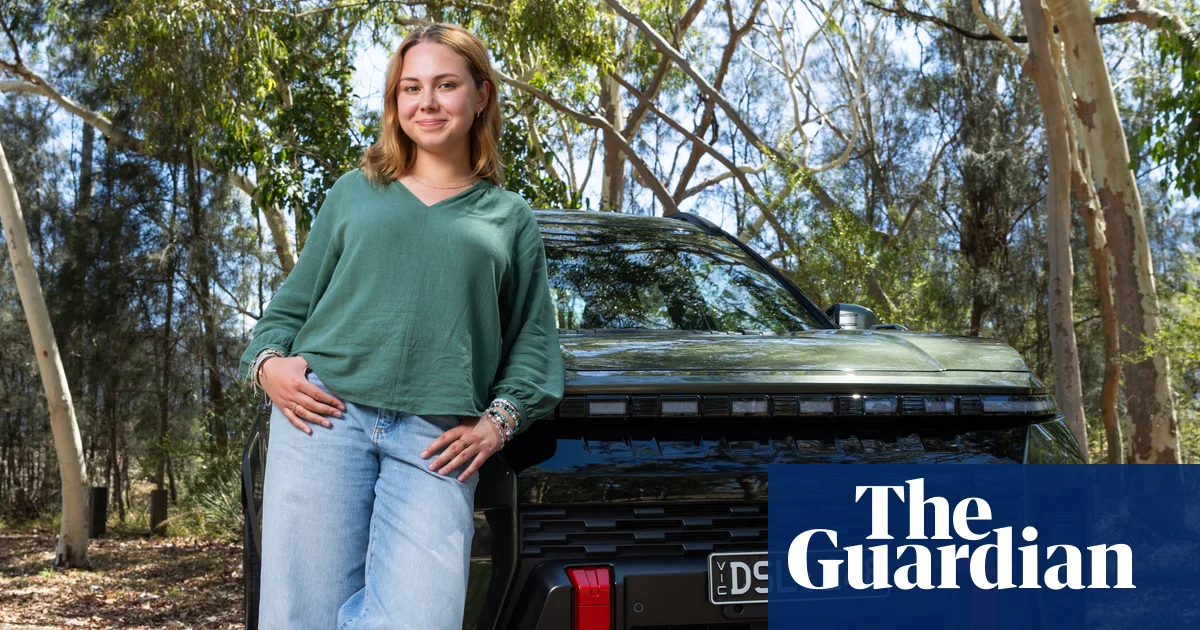
When I am handed the keys to Australia’s first affordable fully electric ute, to say I feel nervous is an understatement.
I’ve been driving a 2014 Volkswagen Polo for the past four years, and before that, a Holden Astra that was older than me.
A few minutes later, my clammy hands firmly on the steering wheel, and sitting very upright to see over the wide bonnet, I am reminded of the uneasiness I felt when I first learned to drive.
Australia’s love affair with huge utes and SUVs is well documented. Large cars dominated the list of the top 10 most-purchased vehicles last year, and demand is growing, despite safety and environmental concerns.
Sign up: AU Breaking News email
But electric car sales have also continued to grow, accounting for 9.7% of new cars sold in the three months to September, according to the Australian Automobile Association (AAA).
Enter the Musso EV, the first electric ute made by the South Korean brand KGM, which has a claim to being the first affordable electric ute on the Australian market. In its publicity, the company skims over the vehicle’s environmental benefits, but says it combines “the refined styling of an SUV” with the “rugged practicality” of a ute.
Is this enough to convert gas-guzzling ute and SUV drivers, or newcomers like me? And with road fatalities rising, are electric utes the answer? Can I even find somewhere to charge it?
My driving confidence restored after practising two wide turns and a quick kerbside stop, I head out to the main road to find out.
For mainstream buyers or early adopters?
I quickly notice the ute – not surprisingly – is fitted with more modern technology than my Polo, including a wireless phone charger, a start button instead of a key ignition, and a 360° camera system (helpful for reverse parking).
The Musso EV comes as a two-wheel or an all-wheel drive. I’m in a green all-wheel drive model.
The two-wheel drive starts from $60,000, less than its fully electric competitors, including Tembo’s Tusker, which sells for $74,000, LDV’s eT60, (from $92,990), and Ford’s F-150 Lightning (from $169,900).
The Musso is the “first genuinely affordable” electric ute in Australia, says professor of future urban mobility at Swinburne University, Hussein Dia. It drives a long way on a single charge and has features normally seen only in “fancy SUVs”, he says.
“But people who use their ute for tough jobs might feel it is not built for heavy work.”
KGM describes the vehicle as “purpose-built for lifestyle” and the company’s Australian marketing manager Stevan Dimitrovski tells me the model is “the first EV that you can actually do stuff with”.
“It’s probably less about towing boats and caravans … and more about throwing bikes and golf clubs in the back.”
Dia says the Musso EV’s price would appeal to “mainstream buyers rather than early adopters”.
But Nathan Moore, a behavioural scientist at the University of Technology Sydney, says SUV and ute drivers typically buy them for work or because they aspire to a “rugged”, off-road lifestyle.
Moore says these groups tend to see EVs as neither capable nor rugged.
“The real motivations for people who’d want to buy an electric SUV are similar … to people who are buying EVs anyway,” he says. These tend to be “early adopters” with enough disposable income to take a financial risk.
The ultimate suburban road test
Keeping the Musso EV’s design as a “lifestyle ute” in mind, I take it for the ultimate Sydney suburban road test.
It survives a Bunnings car park, a Red Rooster drive-through, a Westfield shopping centre and a few laps around Parramatta Park.
I don’t need to charge the ute before returning it, but I am curious to see how easy it is to find a public charger.
About 80% of EV owners charge their vehicles at home or at work. But public chargers remain essential for Australians who don’t have access to off-street parking and those travelling long distances.
When Dia conducted his own experiments into “charging deserts”, he found a 4,000km drive from Melbourne to Darwin needed careful planning. The Musso EV claims a range of 380km in the all-wheel drive, and 420km in the two-wheel drive.
Dia warns driving it would be a challenge in rural areas, some of which “don’t have any coverage at all”.
Even in the suburbs of Sydney, finding a public charger proves difficult.
Using the state government electric vehicle charging map, I drive to three charging stations in western Sydney. At the first, in a local club car park, all three spots are occupied and only available to patrons. The second appears not to exist. The third is also occupied.
In a Bunnings car park on a sunny summer morning, I seek the views of ute drivers on the Musso.
Tully, an electrician, likes the idea of electric utes, but says he would “probably wait until they’d been around a bit longer” before he bought one.
Sue, a retiree, likes how the Musso looks but is concerned that EVs are so quiet: “There’s no noise, so that does worry me.”
Another retiree, Jim, worries about its range and access to charging stations. He says he would only switch if using it “around the city”.
Jack, an engineer, says he doesn’t think Australia’s infrastructure is “quite there yet”, and will stick with a diesel ute when he travels for work.
Only one ute driver is sold – handyman Steve, who says: “For work around the city, where you’re not going off-road and you just need to carry a load … [an] electric [ute] would be perfect.”
Are electric utes the answer?
Utes were three of the top five most-purchased cars of 2024, according to data from the Federal Chamber of Automotive Industries, a list led by the Ford Ranger and the Toyota HiLux.
Dia says he hopes electric utes will soon slot into these high-ranking positions.
“For a long time, the market has been dominated by a few players, and most of them were diesel and petrol engine manufacturers, but the electric vehicle manufacturing game is different.”
The environmental benefits of electric utes are obvious, so why does KGM make barely any mention of them? Belinda Noble of the advertising climate advocacy group Comms Declare says this goes back to “the genius Elon Musk had with Tesla”.
“He didn’t advertise it, like the Nissan Leaf, as an environmental car, he just made it the best car and the best driving experience possible, and that’s what sold it.”
Noble says not focusing on environmental benefits is less concerning than the message that “you will dominate the landscape in these massive cars, which is the opposite of an environmental message” (KGM says the Musso EV is “powered by toughness”).
Road safety remains a huge concern. About 1,300 people died on Australia’s roads last year, a 12-year high and a rate of increase not seen since the 1960s. Experts have said car bloat is the one trend going directly against efforts to improve road safety.
Although the Musso EV may be more environmentally friendly, it is still a big vehicle, at 5.2 metres long, 1.9m wide and 1.8m high, only slightly smaller than conventional utes like the Ranger or Hilux.
I felt safe driving such a big car and being so high up, even if those outside may not have done.
But when I get behind the wheel of my Polo again, it’s a relief to enter a shopping car park without worrying about hitting the height bar.
Guardian Australia took the Musso EV for an unpaid road test.
Additional reporting by Penry Buckley