- The Mallah community is opposing the acquisition of around 100 acres of land in Varanasi, Uttar Pradesh, for the development of a freight village as part of the Ramnagar multi-modal terminal.
- Despite falling in the Varanasi urban extension area, the compensation for the land is being fixed at the lower circle rate of Chandauli district, whereas the market value is said to be many times higher.
- Experts are concerned that dredging, large ships and cruise operations will worsen the pollution levels in the Ganga River and impact its ecology.
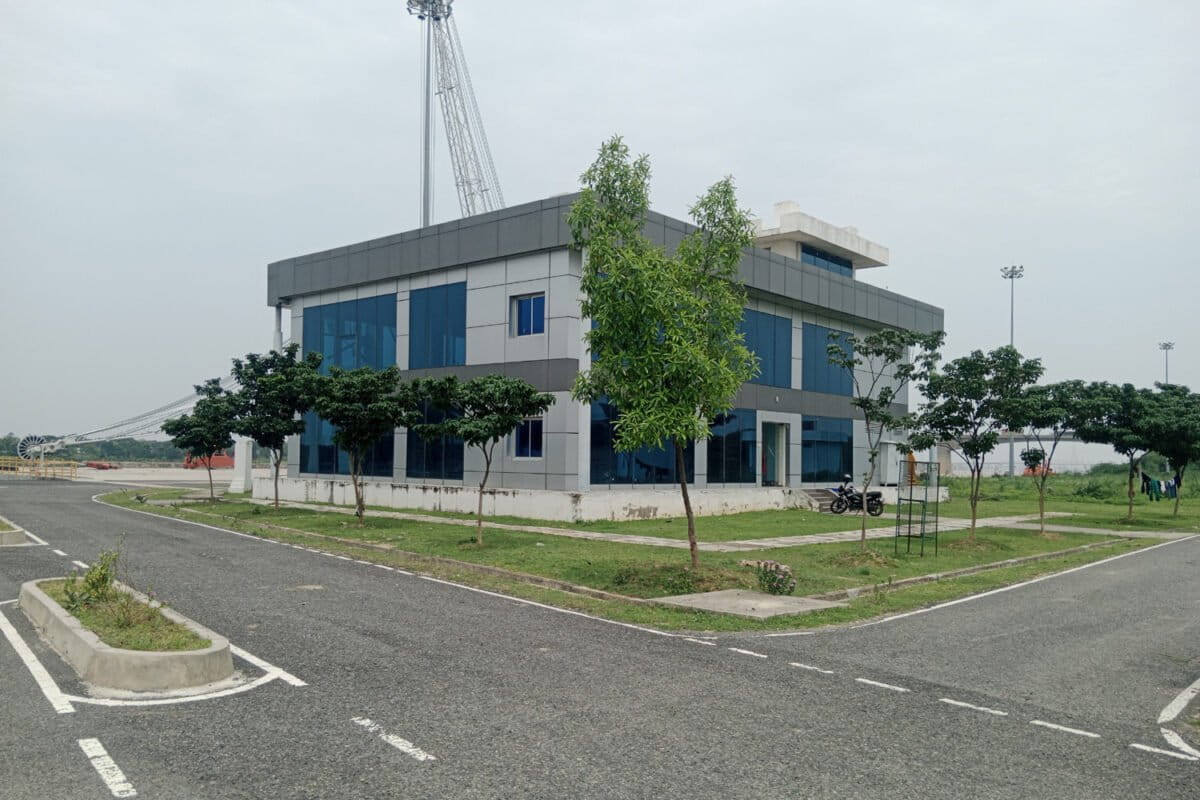
A multi-modal terminal (MMT) has been constructed on the banks of the Ganga river in Ramnagar, Varanasi, Uttar Pradesh, under the National Waterways Project, a venture of the central government. As part of this project, the Ministry of Ports, Shipping and Waterways also approved the construction of a freight village in Milkipur in December 2018, with a budget of ₹156 crore and the foundation stone for it was laid on September 2025. The village is to be developed on approximately 100 acres of land as a cargo hub.
In a report submitted by the Parliamentary Standing Committee in the Rajya Sabha in December 2024, the Minister of Ports, Shipping and Waterways Shripad Naik stated that the freight village would facilitate the shift of cargo from rail and road to waterways. The land is to be acquired from villages in Varanasi and surrounding districts by the Inland Waterways Authority of India (IWAI).
However, this land largely belongs to the Mallah community which is native to the region. They claim that this land is being acquired from them at very low prices, and that the project will adversely impact their long-standing traditional livelihoods as boatmen of the Ganga.
Concerns related to land acquisition
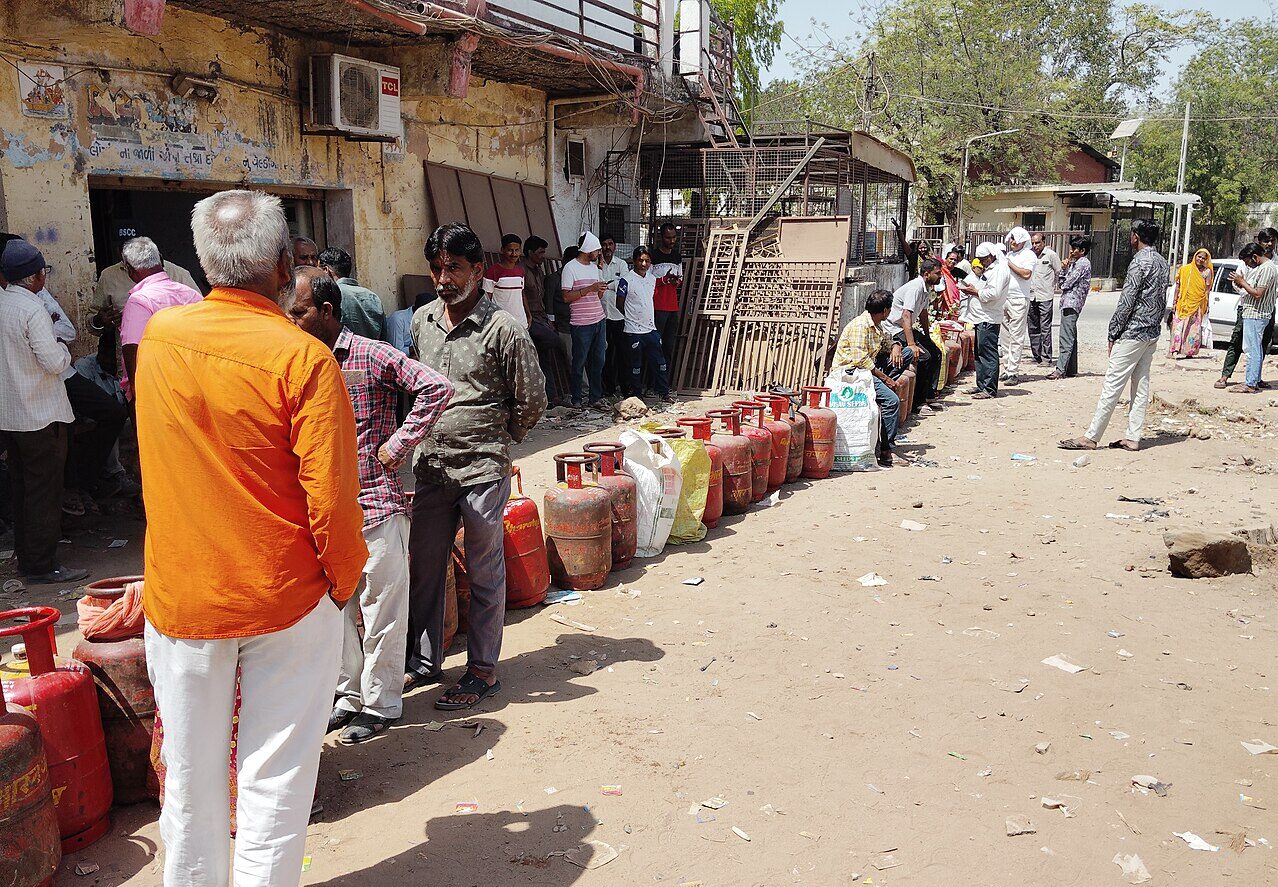
The announcement of the freight village has left 43-year-old Chhaya Devi worried for her future. She is a resident of Tahirpur village in Mughalsarai tehsil of Chandauli district, which is adjacent to Varanasi. “We will not give our land to the port (IWAI) to build the freight village. If we lose our land, we will cease to exist. We have nothing but our house,” she says. “Most people here are from the Mallah caste and depend on the Ganga for their livelihood. In addition, we also have Muslims, Harijans, Patels and Yadavs living here.”
As per the official document from the Chandauli district administration, approximately 70% of the project will be located in Tahirpur (about 16 hectares) and Milkipur (about 12 hectares). A total of 415 families (including 170 native families) in these villages will be affected by the acquisition.
“The port people have demarcated our land. They came along with police and other forces, but we strongly opposed them,” says Vimla Devi, 60, a resident of Tahirpur village.
Ishan Milki, a youth from the same village, says, “On May 20, 2025, a police force led by the Sub-divisional Magistrate (SDM), Mughalsarai, came to the village to mark the land, and were opposed by the women of the village. Following this, we submitted a letter to Akhilesh Yadav, the president of the Samajwadi Party, the main opposition party in the state, expressing our concerns and demanding his intervention. We have also requested the intervention of Virendra Singh, the Member of Parliament (MP) from our constituency, Chandauli.”
Mongabay-India reached out to Singh, who said, “This is the Prime Minister’s pet project, but it’s not practical to implement his vision on the ground. Ninety percent of the affected families are poor. I even raised this issue in the Parliament. The government must acquire land only after obtaining the consent of the local people and then properly rehabilitate them, providing them with the opportunity and space to relocate. We have a welfare government, and it cannot ignore the interests of the poor.”
Socio-economic surveys conducted in both villages prior to land acquisition revealed that most people are from economically disadvantaged communities, and places of cultural importance may be impacted.
Ramnagar, where the freight village is to be built, is home to a Buddhist site Buddha Vihar, and a Mata Londa Devi temple. Vinay Maurya, a resident of Ramnagar and a Buddhist Vihar trust member, says, “The trust owns 8.5 bighas of land. No one has the right to sell it. We have been protesting against this continuously.”

Circle rate vs market rate
According to a notification from the Chandauli district administration, the average circle rate for land in Milkipur is ₹75,000-100,000 per biswa (one biswas is around 1,360 square feet), while that of the land to be acquired is about ₹93,000 per biswa. Meanwhile, the circle rate for land to be acquired in Tahirpur is ₹85,000-118,000 biswa.
Meanwhile, the market rate of land in these villages is as much as 15-20 times higher than the circle rate.
“The land here is priced at the market rate of ₹15-20 lakh per biswa,” says 70-year-old Vidyadhar, the general secretary of the Buddha Vihar and a retired teacher. “But the IWAI wants to pay compensation based on the circle rate under the Land Acquisition Act,” he adds.
Bhai Ram Sahni, the former head of Tahirpur panchayat and now a resident of Milkipur, says, “Most of the land for this project has to be acquired from these two densely-populated villages. The local people are always the worst affected.”
Tahirpur, on the Varanasi border, is administratively in Chandauli, where circle rates are significantly lower than Varanasi’s. In Tahirpur though, the market rate is similar to Varanasi’s rate because of the proximity.
An official from VDA, speaking on the condition of anonymity, told Mongabay-India, “When a village is included in the VDA’s jurisdiction, we do not make any changes to its circle rate; the District Magistrate (DM) of the respective district has the exclusive right to do so.” The official added that they only carry out development work in extended areas of Varanasi city.
In response to a Right to Information application filed by this correspondent, the VDA said that the circle rates of the districts are decided by the DMs and the circle rates of the three districts — Varanasi, Chandauli and Mirzapur — are different.
Under the Varanasi-Mughalsarai-Ramnagar Master Plan 2031 prepared by the VDA as part of the Atal Mission for Rejuvenation and Urban Transformation, 97 revenue villages in Ramnagar and Mughalsarai have been selected for urbanisation. The 46 revenue villages selected within the Ramnagar Master Plan 2031 and lie outside the Ramnagar municipal limits include Ralhupur, where the MMT is located, as well as Tahirpur, Milkipur, Rasulganj and Gopalpur.
The villagers also organised a petition against the land acquisition plans.
In August last year, a delegation from the Samajwadi Party, representing Chandauli district administration, visited Tahirpur village and met with Mughalsarai SDM Anupam Mishra. Prabhunarayan Singh Yadav, the MLA who was part of the delegation, told Mongabay-India, “We have spoken to the district administration. We will take it up again. The farmers in the affected villages have said they will not give up their land. The district administration has not given any concrete assurances on the nature of the land acquisition.”

Mallah boatmen’s union oppose
In line with the launch of Cruise India Mission in September 2024, the Centre is planning cruises along the Ganga, while IWAI is offering various incentives to cruise operators. The government has set a target of increasing the number of cruise passengers to one million per year by 2029, up from 4.71 lakh in 2023-24.
Prithvinath Sahni, the patron of the Maa Ganga Nishad Raj Seva Trust, an organisation of boatmen that operates boats on the ghats (steps) along the river in Varanasi, says, “Boating is our ancestral profession and we wouldn’t want anyone to interfere with it. Government policies are limiting our space on the ghats. Varanasi is nurtured by three communities: Mallahs (boatmen), Pandas (priests performing rituals) and Doms (those who manage cremations). The government doesn’t interfere with the work of Pandas and Doms, but it has been constantly interfering in our lives.”
He adds, “The government is encouraging tourist cruises and not issuing licenses to our small boats. Earlier, we used to take tourists on boats and show them the Ganga aarti, but now, the government is restricting us in the name of security while at the same time, promoting cruise operators.” According to him, approximately 1,500 boats line the ghats, employing 10,000 boatmen. He urges that cruise ships should not be allowed to enter the ghats where boatmen have been traditionally ferrying pilgrims.
Durga Manjhi, a boatman from Rajghat, Varanasi, says, “The cruise operators are harassing us. They are not letting us anchor or operate our boats. They are dumping human waste into the Ganga. By doing so, they are polluting the river and destroying the traditions of the holy city of Kashi. Smaller boats and boatmen are not polluting the river.”
Ravi Shekhar, the co-founder of Climate Agenda, a Varanasi-based environmental think tank, says, “Mallahs and small fishermen use the river only to the extent necessary to sustain their livelihoods without harming the ecology. Even today, there are many ghats in Varanasi where fishermen do not fish. But dredging the Ganga to allow larger ships to operate to expand cruise tourism will threaten the very existence of these boatmen.”
He adds, “Varanasi is a pilgrimage town where the money from the arrival of pilgrims goes to every small shopkeeper, boatman or Panda priests. But if it develops as a tourist town, the distribution of money will become centralised.”
He feels that an MMT or freight village would harm the river’s ecology and its wildlife, and the project appears unfeasible. Despite being constructed with government funds, it will be transferred to private ownership.
In response to a question asked by Chandauli MP Virendra Singh in Parliament, the government had said that 87 cargo and cruise ships would run on the Haldia to Varanasi waterway route and that the public-private partnership model would be adopted for the operation of the MMT and other plants already built.
Shripad Dharmadhikari of the Manthan Study Centre says, “Cruise tourism is taking over the jobs of traditional boatmen, forcing them out of their profession. Smaller fishermen are denied permission to operate whereas cruises are being allowed. The ghats of Varanasi are defined by small fishermen and their boats. The city is losing its character and identity.”
This story was reported by Mongabay’s Hindi team and first published on our Hindi site on January 21, 2026.
Banner image: The main building of the Varanasi MMT. Image by Rahul Singh.