
- Coastal fishers in Tamil Nadu are forgoing hunting practices and instead increasingly rescuing dolphins, turtles, and dugongs during nearshore fishing operations.
- Long-term ecological knowledge, combined with fishing methods such as shore seine and hook-and-line fishing, enables rapid release of bycatch and adaptive responses to changing marine conditions.
- Incentive schemes, social recognition, and youth participation have reinforced conservation practices, even as conflicts and economic losses persist.
- The views in the commentary are that of the authors.
“Neither turtles nor dolphins harm us when we rescue them. Many people from our village have saved them before. They cooperate with us and do not cause any trouble,” says Sheenik Abdullah, a 23-year-old fisher-rescuer from Valinokkam in Ramanathapuram district, Tamil Nadu.
Fishers along the Gulf of Mannar coast in southern Tamil Nadu once caught marine animals, including the Indo-Pacific humpback dolphin (Sousa chinensis), hawksbill turtle (Eretmochelys imbricata), loggerhead turtle (Caretta caretta), green turtle (Chelonia mydas), olive ridley turtle (Lepidochelys olivacea), and dugong (Dugong dugon). Today, many of them are recognised for protecting the very species they once pursued. This shift reflects a gradual reworking of human-marine relations, shaped by experiential learning at sea, locally grounded ecological knowledge, and state-led conservation incentives.
In villages such as Keelamundal, Valinokam, and Mel Mundal, conservation is enacted through everyday decisions made on the shore and during fishing trips.
A changing tide
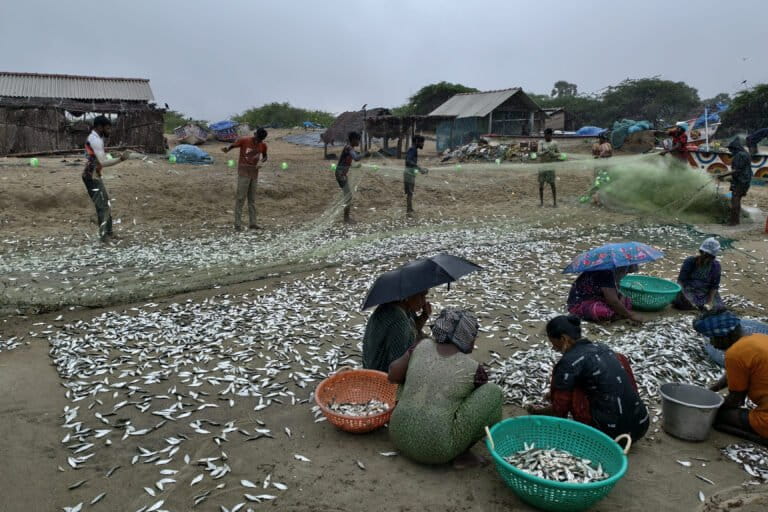
The waves crash loudly against the shore of Keelamundal as seagulls, known locally as kadal kaka, hover low above the surf. Fishing nets lie spread across the sand, mended by men and women who do not pause their work even as rain falls. Boats returning from the morning’s fishing trip are pulled ashore using tractors, while ice-filled storage boxes are opened to sort the catch ahead of evening sales.
For generations, the hunting of marine animals has formed part of the coastal economy. Dugongs were prized for their meat, while an age-old belief existed that consuming turtle meat ensured a long life. These practices were not seen as destructive, but customary, embedded within inherited livelihoods and local morals shaped by dependence on the sea. Several fishers recall that marine animals were once shared or sold locally, long before formal conservation laws were enacted.
For many fishers, the knowledge about the ecological importance and declining numbers of marine species did not arise solely through external regulation or enforcement, but through repeated encounters with animals caught alive in nets. That shift did not happen overnight.
Fishers describe the late 1980s and 1990s as a turning point, when the Gulf of Mannar region was designated a UNESCO Biosphere Reserve and conservation measures intensified. Awareness campaigns by the Forest Department and conservation organisations highlighted the ecological importance of marine animals, especially dugongs, which help maintain seagrass meadows that act as critical nurseries for fish stocks. Fishers also recall increased patrols, penalties for violations, and direct engagement by officials who began visiting landing sites during fishing operations.
The change resonated unevenly at first, but gradually, particularly among older fishers, hunting gave way to rescue. Younger generations grew up hearing fewer stories of consumption and more accounts of release and survival.

Fishing practices and local knowledge
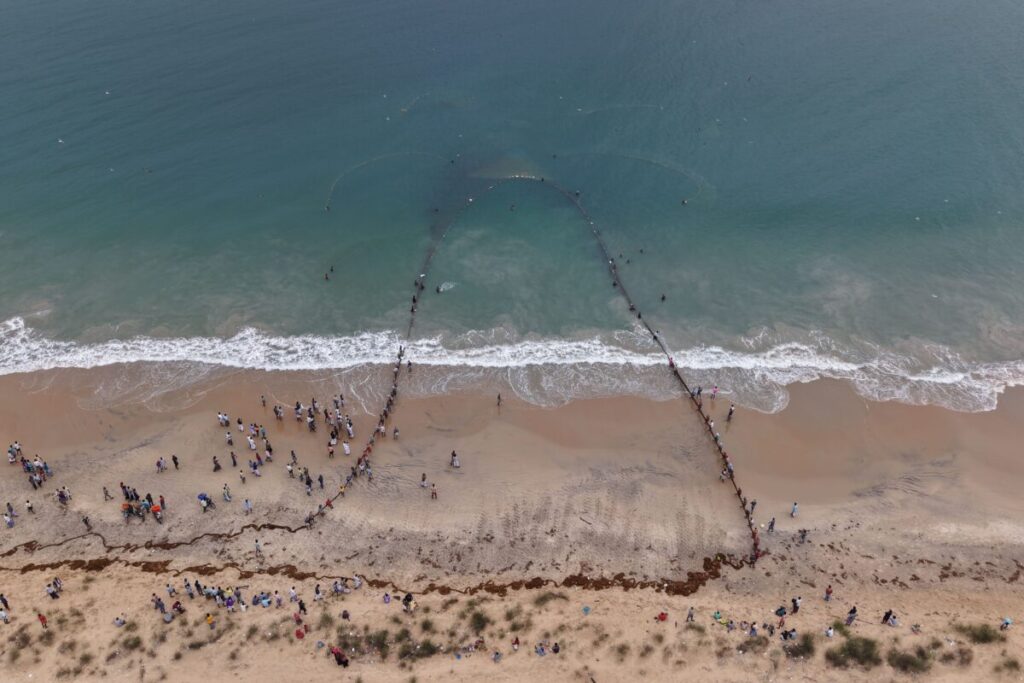
The fishing methods practised in Keelamundal and neighbouring villages play an important role in enabling the rescue of marine animals. Most fishers here do not venture into deep-sea fishing, relying instead on nearshore techniques such as shore (or beach) seine fishing. This method involves deploying stationary nets offshore and gradually pulling them in from the shore. Fishers explain that this labour-intensive technique allows for continuous visual monitoring of the nets and enables the rapid release of bycatch. Such interventions are rarely possible in offshore fishing, where animals caught in deeper waters often die before they can be rescued. Dolphins, in particular, are vulnerable in these cases due to their limited constraints on voluntary breath-hold duration.
Another commonly used method is hook-and-line fishing, which rarely results in the accidental capture of marine animals and is widely regarded as one of the most sustainable fishing practices, and a large proportion of fishers in the region are engaged in it. Fishing activities are highly seasonal and limited to a few months each year, making livelihoods closely tied to environmental conditions and therefore vulnerable to fluctuations in these conditions. Other practices, including crab nets and gill nets, are also used. During the off-season, many fishers take up secondary work such as livestock-related activities and small coastal businesses to supplement household incomes.
Fishers in the region display a detailed, practice-based understanding of local marine ecology, developed through long-term observation of winds, currents, species behaviour, and seasonal change. This knowledge also informs conservation practices. While incentive schemes administered by the Forest Department have reinforced these practices, fishers emphasised that rescue efforts are also shaped by long-standing beliefs, skill, and familiarity with animal behaviour. In some villages, fishers reported that dolphins and dugongs were never consumed, citing ancestral beliefs that these animals are not meant to be eaten.

Incentives and recognition
The Forest Department has formalised marine animal rescue through an incentive-based mechanism that provides compensation for safe release of protected species such as turtles, dolphins, and dugongs, following their accidental capture. Dugongs, which are listed on the IUCN Red List of Threatened Species, are critical beneficiaries of such mechanisms.
Fishers said the incentives help offset tangible losses associated with rescue efforts, including damaged nets, lost catch, and the additional time required to release large animals safely. However, they emphasised that financial compensation alone does not drive their participation, but rather appreciation from the Forest Department and their communities.
Fishers described how photographs and videos of successful rescues are widely shared on WhatsApp groups, reinforcing social recognition within and beyond the community. The fishermen association has also played a role in spreading awareness and normalising rescue practices within the community. Over time, these networks have helped frame rescue not as an exceptional act, but as a shared responsibility tied to community identity and stewardship of the sea.

The challenges in conducting rescues
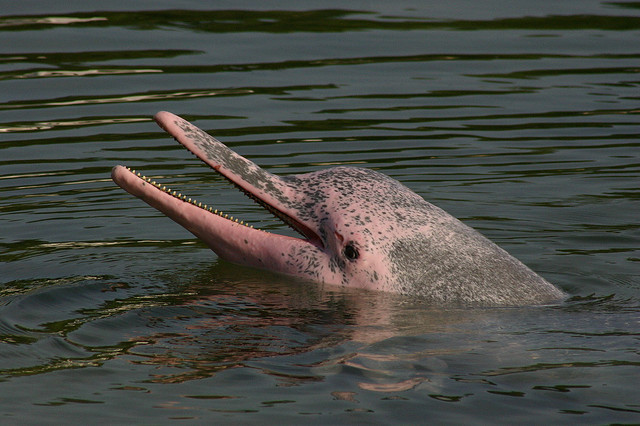
In Valinokam, fishers reported frequent sightings of dolphins near the shore seine fishing nets. Dolphins, often attracted by the concentration of fish catches, typically move away once the nets are hauled in. These accounts were corroborated during field observations, when we sighted two dolphins close to the shore, later identified as Indo-Pacific humpback dolphins. Depredation, where dolphins feed on fish caught in the nets, remains a concern for fishers.
Rescue, however, is far from easy. Fishers described situations in which sudden waves or panicked animals pulled nets and people underwater. Dolphins, they added, can strike forcefully with their tails during rescue attempts, posing risks to those involved. Rescues can also damage nets or result in fish escaping, sometimes wiping out an entire day’s earnings. “If the fish escape while we are rescuing, we lose our income,” one fisher said. “But we still do it. Now, we know it’s the right thing.”
Interactions between fishers and dolphins are also marked by conflict. Studies from the Gulf of Mannar and Palk Bay have documented long-standing tensions arising from dolphin depredation.
Youth and new roles
Younger fishers have emerged as key actors in this transition. Abdullah began accompanying his father to sea and started documenting rescues on social media, helping spread awareness beyond the village.
Others coordinate fishing activities to minimise harm, particularly from larger mechanised boats, which fishers widely identify as the biggest threat to vulnerable marine species.
Fishers share real-time information with Forest Department staff, report strandings, and coordinate rescues through informal networks that now function faster than formal enforcement systems.
What has unfolded along this coastline reflects more than an economic adjustment within fishing communities. Relations with government authorities, previously characterised by distance or mistrust, are gradually taking on more collaborative forms.
Maintaining these changes will require sustained support, including reliable funding, training in safe rescue practices, and reliable compensation mechanisms. Integrating fishers into formal conservation programmes, or into ecotourism and community-based monitoring initiatives, may offer additional meaningful livelihood options.
The authors are researchers at ATREE.
Citation:
- IUCN. Dugong (Dugong dugon) – Red List Assessment. 2018.
- Ministry of Environment, Forest and Climate Change. Biosphere Reserve – Gulf of Mannar (official note). 2024.
- Muralidharan, R. (2013). Sightings and behavioural observations of Indo-Pacific humpback dolphins Sousa chinensis (Osbeck, 1765) along the Chennai coast, Bay of Bengal. Journal of Threatened Taxa, 5(15), 5002–5006.
- Sutaria, D., Panicker, D., Jog, K., Sule, M., Muralidharan, R., & Bopardikar, I. (2015). Humpback dolphins (genus Sousa) in India: An overview of status and conservation issues. Advances in Marine Biology, 72, 229–256.
Banner image: A shore seine net is hauled ashore at Valinokam, Tamil Nadu, while people gather along the beach to watch. Image by Vinod Kumar.

