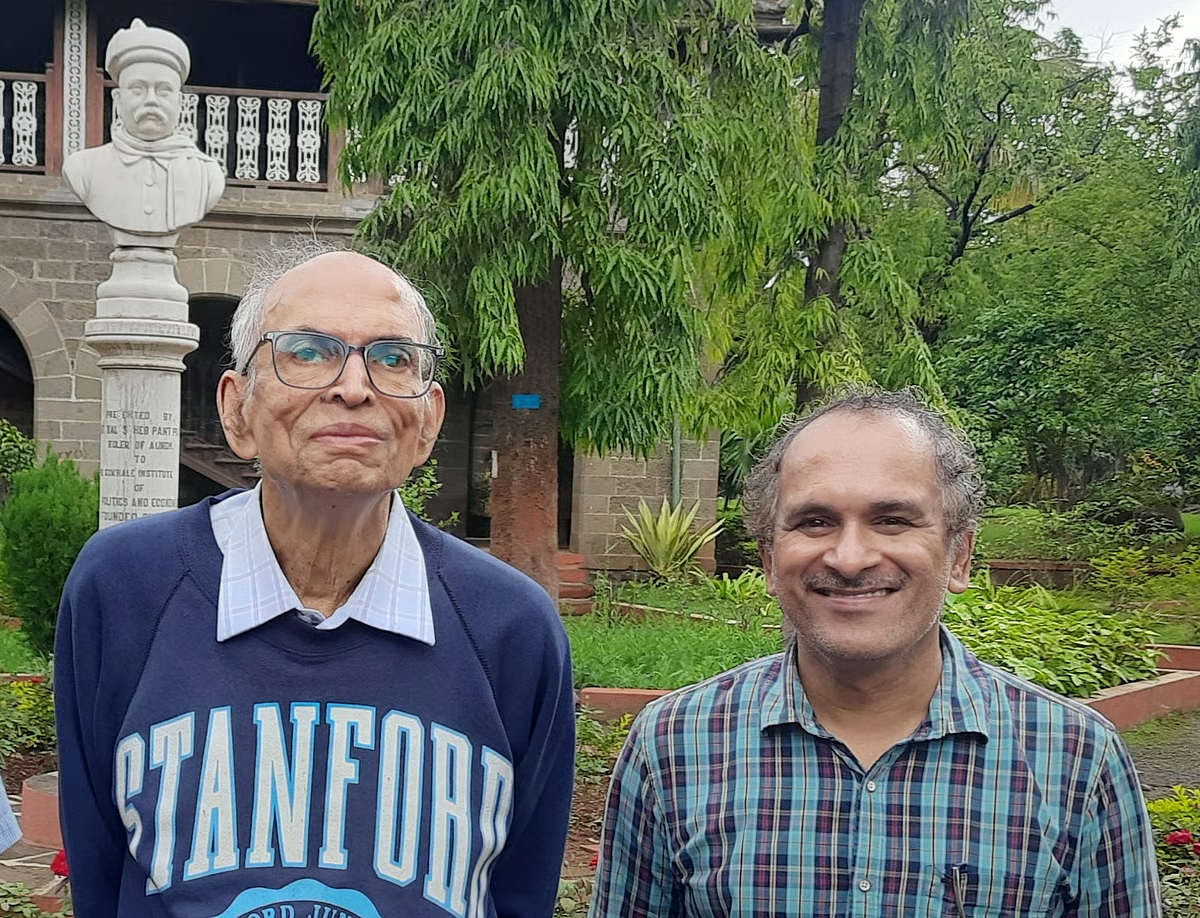
My acquaintance with Professor Madhav Gadgil dates back to 2006. Before that I had, of course, heard of his name, his pioneering work and his contributions to the study of sacred groves.
He was already a legend in Indian ecology and I was star-struck when I first met him during my work for the Maharashtra Gene Bank project, initiated by the Rajiv Gandhi Science and Technology Commission of the Government of Maharashtra. I was working as a research scientist with the Agharkar Research Institute after my PhD.
Until then, my academic training had confined me within the well-defined boundaries of plant taxonomy. My earlier research had been satisfying, but this new appointment opened a window to a much wider ecological and social landscape.
Over the next three years, I had the privilege of travelling across Maharashtra with Professor Gadgil — exploring forests, interacting with local communities and understanding their deep ecological knowledge. I met countless people — fisherfolk, forest dwellers, tribal communities, social activists, teachers, volunteers and NGO workers — each working closely with nature. Many of these encounters grew into lifelong bonds.
During these journeys, which connected us to almost every district of Maharashtra, I would constantly ask him questions, and he, with great generosity, quenched my curiosity. It was through him that I discovered and read authors like JBS Haldane, Edward O Wilson and Jared Diamond, Matt Ridley and developed a fascination for evolutionary biology — a field that had remained largely hidden from us in formal curricula.
After the Maharashtra Gene Bank project concluded, I joined as a scientist at the Agharkar Research Institute, but my association with Gadgil continued. Together, we wrote a research paper on Goa’s mining landscapes. Through that work, I was introduced to his remarkable grasp of mathematics — we applied the species–area relationship to estimate species richness in different areas. I was fascinated by the mathematical depth behind the paper, which was later published in Current Science.
We also co-authored an article interpreting the natural and geographical imagery in the fourth canto of Kālidāsa’s Raghuvaṃśa.
My learning curve continued to rise as we often visited Vetal Hill, a forested patch in Pune city, where we would talk for hours about life, ecology and research. I would ask him endless questions — why he chose a particular research problem, how he designed his methods and how he interpreted his results. He would often tell me how to look at an issue — not merely as a scientist observing from a distance, but as someone trying to understand the social and ecological currents shaping it.
He patiently explained the background of every idea, the reasoning behind each initiative and how he had gone about implementing it. Through these conversations, I came to realise the magnitude of his contribution in placing people’s participation at the very heart of India’s environmental policy.