U.S. and Iranian negotiators will meet in Geneva on Thursday for what officials frame as a last-ditch effort at diplomacy amid President Donald Trump’s talk of military action against Iran.
The meeting comes as multiple members of Congress are demanding more information about President Trump’s plans and a greater say in decisions on the use of force.
While Mr. Trump has not laid out a specific set of objectives, his past statements indicate his priorities are pressuring Iran to agree to a deal to limit its uranium enrichment and ballistic missile program and to end support for regional proxies like Hamas. He also promised Iranian protesters facing violent repression in January that “help is on the way.”
Why We Wrote This
President Donald Trump says he’s deciding whether to take military action against Iran. Some members of Congress say a president isn’t the only decision-maker on the use of force – and they want a vote on a war powers resolution.
“My preference is to solve this problem through diplomacy,” Mr. Trump said in his State of the Union address Tuesday night. “But one thing is certain, I will never allow the world’s No. 1 sponsor of terror, which [Iran is] by far, to have a nuclear weapon.”
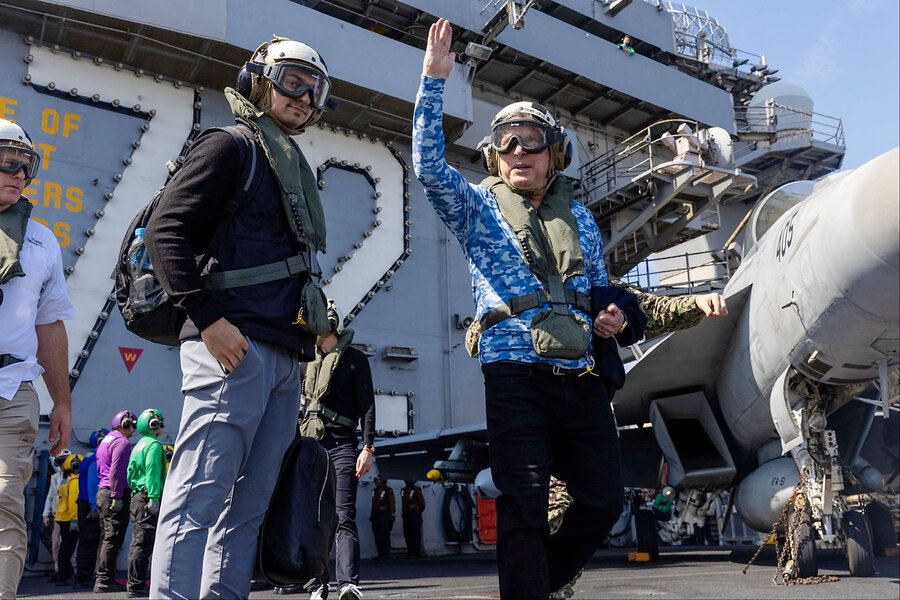
On Feb. 19, Mr. Trump said he would decide whether to attack Iran within 10 to 15 days. Since then, more than 150 aircraft have been placed on standby, and two aircraft carriers have been sent to the region as part of a massive military buildup.
Key Democratic senators Minority Leader Chuck Schumer of New York and Mark Warner of Virginia did not appear satisfied with the administration’s position after a classified briefing Tuesday, just hours before Mr. Trump’s speech. In the meeting, Secretary of State Marco Rubio had briefed the “Gang of Eight,” a group of eight congressional leaders authorized to receive sensitive intelligence, including Senators Schumer and Warner.
Senator Warner told the Monitor on Wednesday that Mr. Trump’s comments on Iran during the State of the Union didn’t match his understanding of the situation. He called the president’s statement Tuesday night that the United States had “obliterated” Iran’s nuclear weapons program a mischaracterization.
“We’ve got a huge amount of forces amassed … and if we’re going to take action, I think he owes it to the American people to lay out the case of what his goals are,” Senator Warner said.
Many members of Congress want to go a step further: They say that Mr. Trump lacks the unilateral authority to authorize an attack on Iran. Democratic Rep. Ro Khanna said that he and Republican Rep. Thomas Massie are confident they can soon introduce a bipartisan resolution to block U.S. hostilities against Iran unless Congress signs off on the action or there is an imminent attack on the U.S.
Representative Khanna said that Mr. Trump’s Tuesday night address, which touched on Iran only briefly, highlighted the need for congressional engagement and transparency about the president’s aims there.
“He didn’t give any rationale,” Representative Khanna said in an interview Wednesday, referring to Mr. Trump’s speech. “He didn’t give any clear guidelines. … So if anything, it stiffened my resolve to make sure that we put Congress on record.”
Democratic Sen. Tim Kaine of Virginia, meanwhile, told reporters that he plans to bring up a Senate counterpart resolution, one that he and Republican Sen. Rand Paul of Kentucky have co-sponsored, “very soon.”
Not all Democrats support a vote on a war powers resolution like the one Representatives Khanna and Massie propose. On Feb. 20, two other members of Congress, Democrat Josh Gottheimer and Republican Mike Lawler, issued a joint statement opposing the Kaine-Rand resolution. “This resolution would restrict the flexibility needed to respond to real and evolving threats and risks, signaling weakness at a dangerous moment,” they wrote.

As it stands, the proposed resolution has a slim chance of success. Even if every other House Democrat supported it, it’s unclear where the representatives would find the Republican votes needed to pass it in the House. The proposal would then have to make it through the majority-Republican Senate.
Even then, it would not carry the force of law.
Democratic Rep. Gregory Meeks, the ranking member on the House Committee on Foreign Affairs, who was not at the Gang of Eight meeting, said Wednesday that the Trump administration hadn’t provided evidence to support its claims that Iran is rebuilding nuclear weapons.
“It seems as though the only ones who know anything … are [Steve] Witkoff and [Jared] Kushner,” he said later in an interview, referring to Mr. Trump’s special envoys leading talks with Iran.
Representative Meeks said he supports the Khanna-Massie resolution.
Congressional war powers authority
As the president has invoked executive authority to carry out strikes against Iran and to remove an authoritarian leader in Venezuela, many lawmakers – mainly Democrats – worry that Congress’ constitutional authority to declare war is being undermined.
In 1973, amid the Vietnam War, Congress passed the War Powers Resolution to reassert its authority. That joint resolution, which functions as law, requires the president to notify Congress within 48 hours of military action and bars the deployment of armed forces for more than 60 days without congressional permission.

When the U.S. conducted strikes on Iranian nuclear sites last June, and then captured Venezuelan President Nicolás Maduro in January, members introduced more specific resolutions demanding the president halt military action in those places and await congressional sign-off. These resolutions gained scant Republican support. Neither has passed.
Prominent Republicans, including Mr. Trump and House Speaker Mike Johnson, have called the original 1973 law, which forms the basis of many of these resolutions, an unconstitutional infringement on presidential powers.
On Tuesday, before Mr. Trump’s speech, Republican Sen. Chuck Grassley of Iowa said the Constitution gives a president “a very wide area to operate as commander in chief.” Democratic Sen. Peter Welch of Vermont countered, saying that such power comes with an obligation to be clear about plans and objectives.
“This is a discretionary action,” Senator Welch said in an interview Tuesday evening. “There’s not an emergency here. This is a massive buildup over time with an underlying policy objective.”
Before Mr. Trump’s speech, Republican Sen. Susan Collins of Maine said lawmakers need more information on how to move forward.
“If it is a long engagement or boots on the ground [in Iran], then consistent with the War Powers Act, we would need congressional approval,” she said.