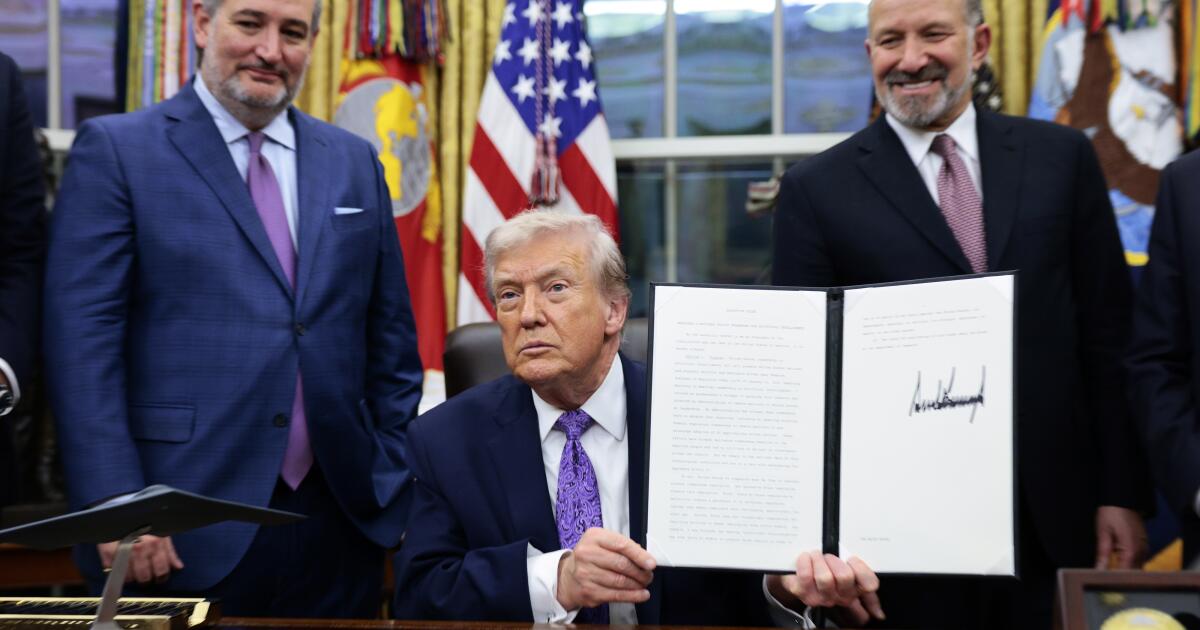
The battle between California and the White House escalated as President Trump signed an executive order to block state laws regulating artificial intelligence.
The president’s power move to try to take over control of the regulation of the technology behind ChatGPT through an executive order Thursday was applauded by his allies in Silicon Valley, who have been warning that many layers of heavy-handed rules and regulations were holding them back and could put the U.S. behind in the battle to benefit most from AI.
The order directs the attorney general to create a task force to challenge some state AI laws. States with “onerous AI laws” could lose federal funding from a broadband deployment program and other grants, the order said.
The Trump administration said the order will help U.S. companies win the AI race against countries such as China by removing “cumbersome regulation.” It also pushes for a “minimally burdensome” national standard rather than a patchwork of laws across 50 states that the administration said makes compliance challenging, especially for startups.
“You have to have a central source of approval when they need approval. So things have to come to one source. They can’t go to California, New York and various other places,” Trump told reporters at the Oval Office on Thursday.
California Gov. Gavin Newsom pushed back against the order, stating it “advances corruption, not innovation.”
“They’re running a con. And every day, they push the limits to see how far they can take it,” Newsom said in a statement. “California is working on behalf of Americans by building the strongest innovation economy in the nation while implementing commonsense safeguards and leading the way forward.”
The dueling remarks between Newsom and Trump underscore how the tech industry’s influence over regulation has increased tensions between the federal government and state lawmakers trying to place more guardrails around AI.
While AI chatbots can help people quickly find answers to questions and generate text, code, and images, the increasing role the technology plays in people’s daily lives has also sparked greater anxiety about job displacement, equity, and mental health harms.
The order heavily impacts California, home to some of the world’s largest tech companies such as OpenAI, Google, Nvidia and Meta. It also jeopardizes the $1.8 billion in federal funding California has received to expand high-speed internet throughout the state.
Some analysts said Trump’s order is a win for tech giants that have vowed to invest trillions of dollars to build data centers and in research and development.
“We believe that more organizations are expected to head down the AI roadmap through strategic deployments over time, but this executive order takes away more questions around future AI buildouts and removes a major overhang moving forward,” said Wedbush analyst Dan Ives in a statement.
Facing lobbying from tech companies, Newsom has vetoed some AI legislation while signing others into law this year.
One new law requires platforms to display labels for minors that warn about social media’s mental health harms. Another aims to make AI developers more transparent about safety risks and offers more whistleblower protections.
He also signed a bill that requires chatbot operators to have procedures to prevent the production of suicide or self-harm content, though child safety groups removed support for that legislation because they said the tech industry successfully pushed for changes that weakened protections.
States and consumer advocacy groups are expected to legally challenge Trump’s order.
“Trump is not our king and he cannot simply wave a pen to unilaterally invalidate state law,” said state Sen. Steve Padilla (D-Chula Vista), who introduced the chatbot safety legislation that Newsom signed into law.
The order drew both praise and criticism from the tech industry.
Collin McCune, the head of government affairs at venture capital firm Andreessen Horowitz, said on social media site X that the executive order is an “incredibly important first step.”
“But the vacuum for federal AI legislation remains,” he wrote. “Congress needs to come together to create a clear set of rules that protect the millions of Americans using AI and the Little Tech builders driving it forward.”
Omidyar Network Chief Executive Mike Kubzansky said in a statement that he is aware of the risks posed by poorly drafted rules, but the solution isn’t to preempt state and local laws.
“Americans are rightly concerned about AI’s impact on kids, jobs, and the costs imposed on consumers and communities by the rapid development of data centers,” he said. “Ignoring these issues through a blanket moratorium is an abdication of what elected officials owe their constituents — which is why we strongly oppose the Administration’s recent executive action.”
Investors seemed unimpressed with the possible boost the sector could be getting from the White House.
The stock market fell sharply on Friday, led by AI shares.