
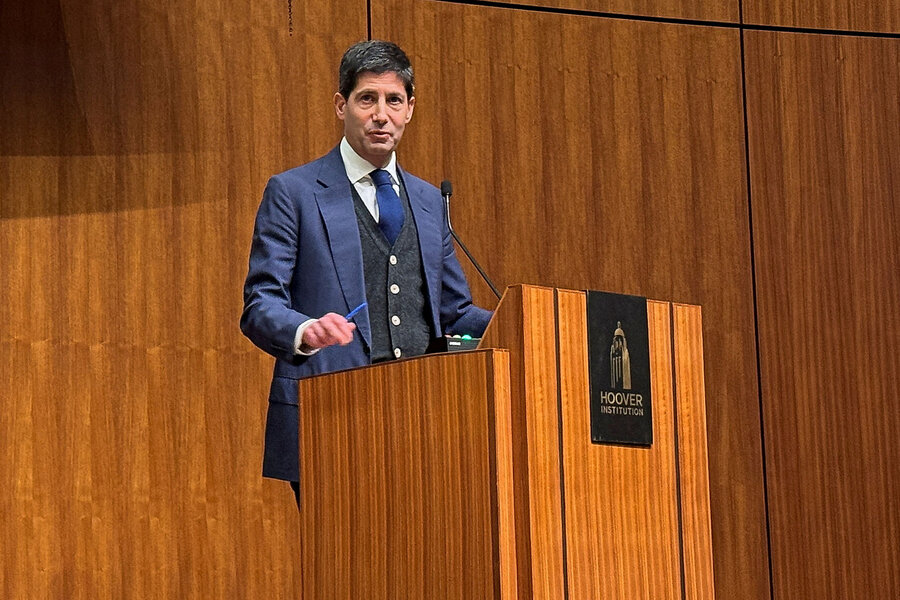
With a falling dollar and soaring gold prices, President Donald Trump stepped in on Friday to calm world markets. He nominated Kevin Warsh to head the Federal Reserve, America’s central bank.
It’s a key appointment, closely watched around the world. For the markets, at least, the move worked. The dollar rebounded, and gold fell as much as 8% to less than $5,000 per ounce in trading on Friday.
The choice of a chairman matters because of the inordinate role he or she plays in shaping Fed policy, whether overseeing banks or setting interest rates for the country. As the world’s most powerful central bank, its moves on interest rates reverberate globally. Mr. Warsh could also set the Fed on a new course.
Why We Wrote This
President Donald Trump’s nomination of Kevin Warsh to head the Federal Reserve calmed markets, but the former member of the board of governors could also set the Fed on a new course.
Traders sighed with relief because Mr. Warsh, a former Fed governor, is seen as more likely to stand up to presidential pressure than Mr. Trump’s other potential nominees, including top presidential adviser Kevin Hassett, once considered the front-runner for the Fed position.
“Kevin Warsh is not as malleable as Kevin Hassett,” says Jeffrey Sonnenfeld, president of the Chief Executive Leadership Institute at Yale University and author of an upcoming book, “Trump’s Ten Commandments.”
A matter of independence and influence
In some ways, Mr. Warsh represents a strange choice for Mr. Trump. For months, the president has publicly pressured the Fed to lower interest rates more quickly to boost growth. Mr. Warsh, often characterized as an inflation hawk, has historically criticized such efforts, preferring to ensure inflation stays in check by keeping rates high.
In a 2010 speech, while a Fed governor, Mr. Warsh emphasized the importance of the central bank’s independence from political influence.
In other ways, however, Mr. Warsh, a New Yorker who graduated from Stanford University and then Harvard Law School, represents the kind of maverick outsider Mr. Trump might appreciate at the Fed. For example, he has recently argued that interest rates could fall further if his visions of big reforms for the Fed are implemented.
He is also skeptical of institutional overreach.
A critic of some Fed moves
As a member of the board of governors during the financial crisis of 2008-09, for example, Mr. Warsh became a valuable aide to Ben Bernanke, then the Fed chair, who made bold and unconventional moves to keep the nation’s banks from collapsing.
But Mr. Warsh grew increasingly critical of those moves, especially the Fed’s large-scale purchases of federal government and agency debt, known as quantitative easing (QE). A few months after the Fed announced a second round of purchases, known as QE2, Mr. Warsh quit the Fed, having served less than half of his 14-year term.
The central bank has been slow to reduce its portfolio of federal debt. In Mr. Warsh’s view, those holdings are distorting the market and should be radically reduced. A key example was his 2010 skepticism toward the second round of quantitative easing, where he warned that large-scale bond purchases risked market distortions.
He has also criticized a much newer policy, called Reserve Management Purchases (RMP), in which the Fed also purchases federal debt. The central bank claims it’s designed to manage liquidity in the financial system, but critics say it also serves as QE.
In Mr. Warsh’s view, all that liquidity overstimulates the economy. If the Fed were to draw down its huge portfolio of federal debt, that stimulus would abate. That would allow the central bank to reduce interest rates without sparking inflation.
The central bank’s policy “has been broken for quite a long time,” he said last year. He criticized the current chairman, Jerome Powell, for allowing inflation to surge in 2021-22, calling it the “greatest mistake in macroeconomic policy in 45 years.”
Mr. Powell’s term ends in May. Mr. Warsh, if approved by the Senate, would succeed him.
Senatorial pushback
The Republican majority usually would make confirmation a shoo-in. But President Trump’s pressure tactics against Mr. Powell, including a Justice Department investigation into Mr. Powell himself, have angered many senators, including Republican Thom Tillis of North Carolina. As part of the committee that handles Fed nominations, he has vowed to oppose any Fed confirmation until the Powell investigation is complete.
Should he be confirmed, Mr. Warsh might face even tougher opposition within the Federal Open Market Committee, the Fed body that sets interest rates. His criticisms have been harsh, and his views are in the minority.
“We think it will be difficult for Warsh to get the FOMC on board with his policy agenda,” Bank of America analysts wrote in a note Friday.