
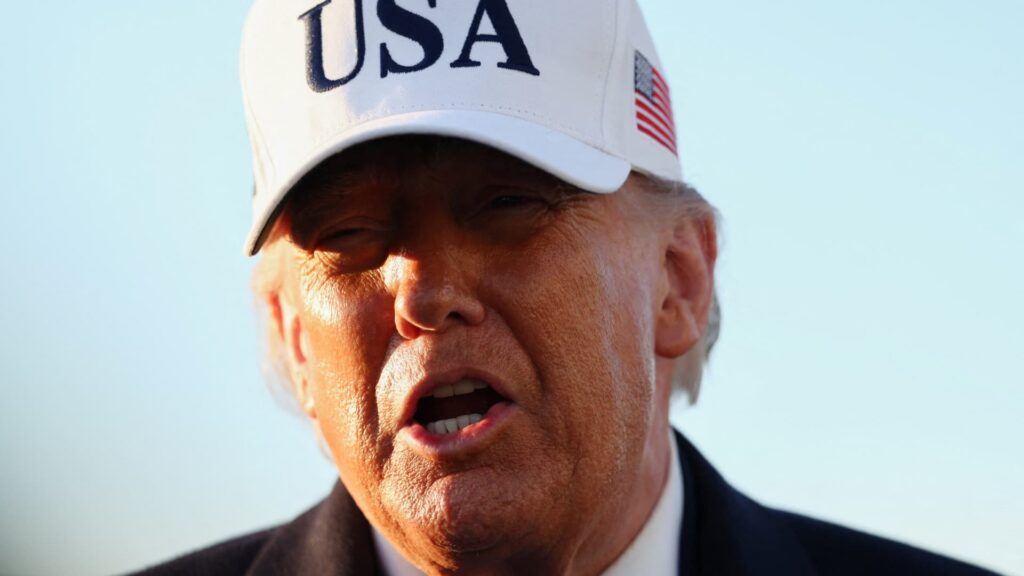
U.S. President Donald Trump speaks to members of the media before boarding Air Force One for travel to Florida, at Joint Base Andrews, Maryland, U.S., March 13, 2026.
Kevin Lamarque | Reuters
U.S. President Donald Trump said Sunday that other countries should help the U.S. secure the Strait of Hormuz, arguing the key shipping route benefits them more than it does Washington.
Speaking with reporters aboard Air Force One, Trump said countries such as China, which rely more heavily on oil shipments passing through the Strait, should contribute to securing it.
“I’m demanding that these countries come in and protect their own territory, because it is their territory. It’s the place from which they get their energy. And they should come and they should help us protect it,” Trump said.
“Why are we maintaining the Hormuz Strait when it’s really there for China and many other countries? Why aren’t they doing it?”
Trump claimed that about 90% of China’s crude imports pass through the strait, while the U.S. only relies on it for “1%, 2%” of its oil. However, analysts say Beijing has spent the past two decades diversifying energy supplies and building strategic reserves to mitigate potential disruptions.
Asked on Monday about Trump’s comments regarding China and the Strait of Hormuz, Chinese foreign ministry spokesperson Lin Jian reiterated Beijing’s stance calling on all parties to immediately halt military operations and to avoid any further escalation of tensions to prevent regional instability from exerting an even greater impact on global economy, news agency Xinhua reported.
Oil prices hovered around the $100 per barrel Monday, with U.S. West Texas Intermediate futures trading at $99.32 a barrel, while global benchmark Brent was at $104.84.
Edward Fishman, a director at the Council on Foreign Relations, said the Trump administration did not consult allies in Europe or Asia before launching military action against Iran.
Those allies are much more dependent on oil imports from the Gulf than the U.S. is, Fishman told CNBC’s “Squawk Box Asia,” raising questions about whether they would expect concessions from Washington in return for assistance.
“Remember, these countries, despite being U.S. allies, have been hit with really steep tariffs by the Trump administration over the last year,” Fishman said.
He added that if the tables were turned, Trump would likely demand something in return for assistance.
Trump’s latest comments followed earlier remarks on Truth Social, where he claimed Saturday that “Many Countries, especially those who are affected by Iran’s attempted closure of the Hormuz Strait, will be sending War Ships, in conjunction with the United States of America, to keep the Strait open and safe.”
Whether we get support or not, I can say this, and I said it to them: we will remember.
Donald Trump
U.S. President
No plans for now
Several commercial ships plying the narrow strait have been damaged ever since the U.S. and Israel attacked Iran last month.
No country has publicly announced plans to deploy warships to the strait. Notably, the U.S. Navy has also not been escorting ships through the waterway.
Reuters reported last week that the U.S. Navy has refused “near-daily” requests from the shipping industry to escort ships, citing three shipping industry sources familiar with the matter. The report said the risk of attacks was too high for now.
Japan’s prime minister Sanae Takaichi reportedly said Monday that there were no plans to dispatch naval vessels to escort vessels in the Middle East, while Australia’s transport minister Catherine King told ABC in a radio interview that Canberra will not be sending ships.
New Zealand’s finance minister Nicola Willis also told CNBC’s “Squawk Box Asia” that the country has not received such a request.


Trump said Sunday that the U.S. was talking to about seven countries, although he declined to name them. He also criticized the NATO alliance.
“We’re always there for NATO. We’re helping them with Ukraine. It’s got an ocean in between us. Doesn’t affect us, but we’ve helped them. And it’ll be interesting to see what country wouldn’t help us with a very small endeavour, which is just keeping the strait open.”
Trump also said Iran was defeated and had very little firepower left. However, Iranian attacks in the region have continued. Drone and missile strikes were reported in Dubai and Israel on Monday Asia time.
Europe deliberates
Vessel traffic on the Strait of Hormuz, which carries a fifth of global oil and liquefied natural gas supplies, has effectively come to a standstill.
Several European nations, including France and the United Kingdom, have discussed plans that could allow commercial shipping to resume in the strait.
The European Union is expected to discuss expanding the Aspides mission on Monday, although the talks are not expected to expand its operations to the Strait of Hormuz.
The Aspides mission, established in 2024 to protect ships against Houthi attacks in the Red Sea, currently has three naval units under its command.
All member states would have to agree on expanding the Aspides mission, EU foreign policy chief Kaja Kallas said Monday, adding: “If the member states say that we are not doing anything with this, then of course it’s their decision, but we have to discuss how we help to keep the Strait of Hormuz open.”
Kallas also said that she had discussed with the United Nations the idea of replicating the ‘Black Sea Initiative’ that has allowed grain to be exported out of Ukraine during its war with Russia.
“It is in our interest to keep the Strait of Hormuz open and that’s why we are also discussing what we can do in this regard from the European side,” she told reporters Monday as she arrived at a meeting of EU foreign ministers in Brussels.
Trump said Sunday that British Prime Minister Kier Starmer had offered to deploy aircraft carriers to the region, which Trump said should have been sent “before we start the war [with Iran].”
“Whether we get support or not, I can say this, and I said it to them: we will remember,” Trump added.
For his part, Starmer told reporters Monday that the Strait of Hormuz must be reopened to “ensure stability in the market” but said this “is not a simple task.”
“So we’re working with all of our allies, including our European partners, to bring together a viable collective plan that can restore freedom of navigation in the region as quickly as possible,” he said in a press briefing.
(COMBO) This combination of file photos created on March 3, 2026 shows US President Donald Trump (L) speaks during a press conference in the Brady Press Briefing Room of the White House in Washington, DC on February 20, 2026; and Britain’s Prime Minister Keir Starmer (R) speaking during a Q&A session as he visits a railway depot in Cardiff, South Wales on February 18, 2026.
Matthew Horwood, Mandel Ngan | Afp | Getty Images
Starmer alluded to the U.K. being willing to provide further help but said while the country would look to take the “necessary action to defend ourselves and our allies,” Britain would “not be drawn into the wider war.”
The U.K. wanted to see a swift end to the conflict because “the longer it goes on, the more dangerous the situation becomes,” he warned.
Europe has significant vested interest in the Strait of Hormuz reopening as it becomes increasingly concerned over its energy supplies amid EU efforts to ban and phase out all oil and gas imports from its neighbor Russia since the invasion of Ukraine.
The Kremlin told CNBC on Monday that “the Europeans themselves suffer primarily from this decision of the EU. They have to pay much more for gas,” Kremlin Press Secretary Dmitry Peskov said in emailed comments.
“They always complained about dependence on Russia. Now they have complete dependence on the United States. Let’s see what they like best,” he added.