The slogans are emphatic: “No forever wars” and “America First.”
President Donald Trump promised both in his 2024 campaign, and they remain core tenets for the MAGA base that fueled his election and continues to empower him.
But his dramatic Jan. 3 invasion of Venezuela and capture of President Nicolás Maduro, who appeared in court on Monday in New York on charges of narco-terrorism, pushes those promises into new territory.
Why We Wrote This
Donald Trump campaigned on “No forever wars” and “America First,” and these remain core tenets for many in his MAGA base. His administration’s intervention in Venezuela could test those promises.
Will Mr. Trump’s supporters stick with him as he navigates U.S. involvement in a South American nation over alleged international drug trafficking, anti-democratic practices – and a desire to reclaim oil reserves he says were stolen years ago from major U.S. companies?
The answer could affect November’s midterm elections, in which Democrats stand an excellent chance of retaking control of at least the House and checking Mr. Trump’s dominance of Washington. Much will depend on how long and costly the U.S. engagement in Venezuela winds up being. Is the president serious about “running” Venezuela, as he said after Mr. Maduro’s arrest, or will the United States simply be enforcing an existing oil blockade, as Secretary of State Marco Rubio maintained over the weekend? Either way, the administration acted without congressional approval, so Mr. Trump will “own” the outcome.
Polls show Americans are divided over Mr. Trump’s handling of Venezuela, with 39% of Americans approving and 46% disapproving, according to a Jan. 4 YouGov poll. Another survey, by the Washington Post, showed a 40%-42% split.
How those numbers evolve over time will hinge, in great part, on how Mr. Trump proceeds. The few Republicans in Congress to raise concerns so far have been predictable – Rep. Marjorie Taylor Greene of Georgia, whose last day in Congress was Jan. 5; Rep. Don Bacon of Nebraska, who is not running for reelection; and Rep. Thomas Massie of Kentucky, who faces a Trump-backed primary opponent this year.
But analysts don’t see Mr. Trump’s support cratering over Venezuela anytime soon.
“The calculation Donald Trump is making is, ‘I can do what I want. Who is going to stop me?’ And so far, the answer is no one.” says Chris Edelson, a political scientist at American University in Washington, noting that that could change.
Months ago, Mr. Trump had already broadened the definition of “America First,” when he told the Atlantic that it stands for whatever he wants it to.
But the president’s ability to keep enough of the public – or at least his core supporters – with him can only go so far. In last November’s off-year elections, Democrats swept the major races, perhaps a hint of the GOP challenge ahead in this year’s midterms, when Mr. Trump won’t be on the ballot.
If the affordability challenges that fueled Democratic successes last year persist, contributing to GOP losses this November, Mr. Trump’s ability to pass major legislation in the final two years of his presidency could be severely constricted.
That’s where “America First” and “No forever wars” could matter.
“Americans have long been skeptical of democracy-building,” writes Karlyn Bowman, an expert on polling at the American Enterprise Institute, in an email.
If Mr. Trump is perceived as focusing too much on Venezuela – or Ukraine or Iran or Israel – frustration within his MAGA base could hurt him come November, even if it just means a decline in voter participation. His vague assertions that the U.S. would “run” Venezuela until there’s a transition of power summoned memories of yearslong U.S. military operations in Iraq and Afghanistan.
Another element in the battle for public opinion comes from the podcasting world, high-profile voices such as Trump ally Steve Bannon. Mr. Bannon, who skews more isolationist than the president, wondered on his “War Room” podcast whether the Venezuela operation was “harkening back to our fiasco in Iraq under [President George W.] Bush.”

Among Democrats, the responses have been largely negative – though most begin by noting that Mr. Maduro is a bad actor who wasn’t duly elected, and cheering the fact that the Venezuelan people are rid of him. Democratic lawmakers decry the fact that Mr. Trump did not gain the consent of Congress before launching the incursion into Venezuela, which they say likely violated international law. Many Democrats have said the move could provide justification for similar actions by China or Russia.
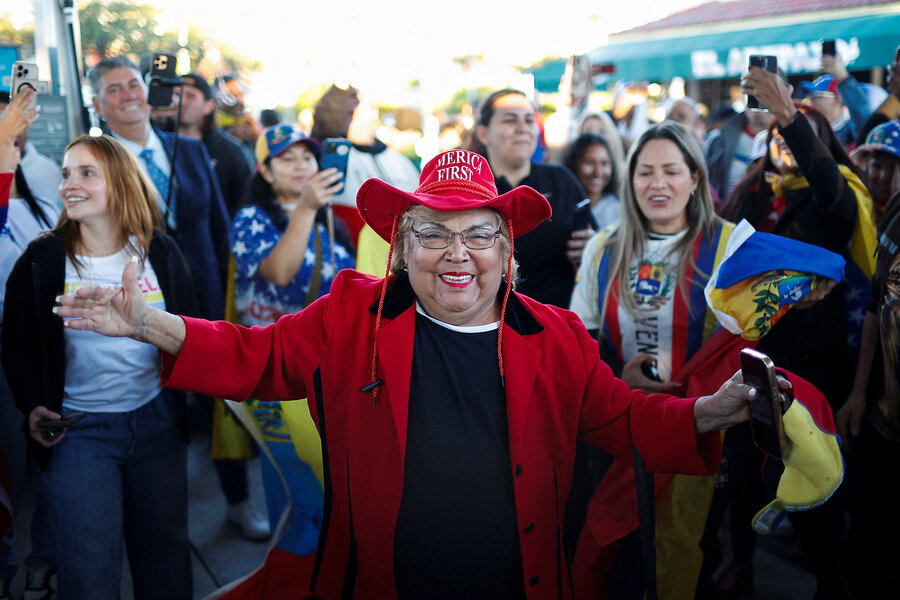
One prominent Florida Democrat with a sizable constituency of Venezuelan exiles made clear in her statement that she was not defending Mr. Maduro in any way. But she also delivered a message that Republicans would surely be leery of: a pitch for nation-building.
“The capture of the brutal, illegitimate ruler of Venezuela, Nicolás Maduro, who oppressed Venezuela’s people is welcome news for my friends and neighbors who fled his violent, lawless, and disastrous rule,” said Rep. Debbie Wasserman Schultz, co-chair of the House Democratic Steering and Policy Committee and former chair of the Democratic National Committee. “However, cutting off the head of a snake is fruitless if it just regrows. Venezuelans deserve the promise of democracy and the rule of law, not a state of endless violence and spiraling disorder.”
Staff writer Victoria Hoffmann contributed from Boston.