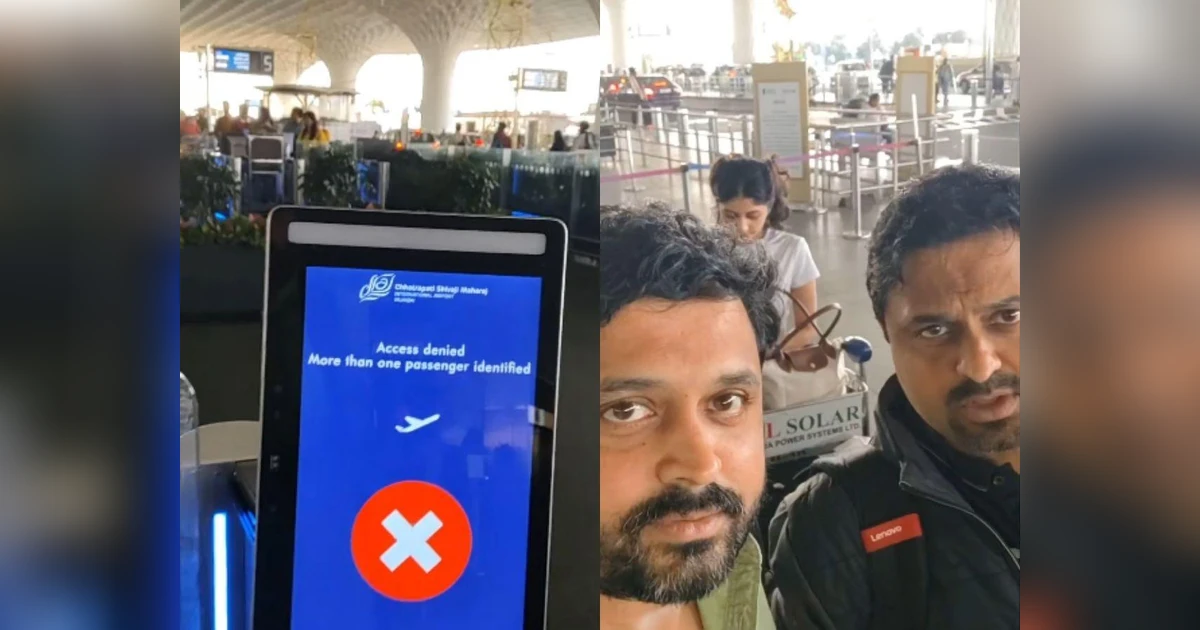
Two identical twin brothers faced an unusual delay at Chhatrapati Shivaji Maharaj International Airport, Mumbai, when the Digi Yatra facial-recognition system blocked them from entering the terminal. The system repeatedly displayed “access denied,” recognising both twins as a single individual, despite each having registered separately.
The incident forced the brothers to join the conventional security queue, bypassing the touchless entry system intended to reduce wait time and simplify the processes at the airport.
A viral video shows one of the twins saying the Digi Yatra gate flashed an “access denied” message after detecting more than one person.
Why the system failed
Facial-recognition technology is designed to prevent false matches and identity misuse. In cases where facial features are nearly identical, as with identical twins, the system may deny access as a safety precaution. According to several studies, including the University of Notre Dame’s “Biometric Identification of Identical Twins: A Survey”, such edge cases are a well-documented limitation of biometric verification systems worldwide, even as these technologies are increasingly deployed at airports and other secure facilities.
Digi Yatra reaches out
Following the video gaining attention online, Digi Yatra officials reached out to the passengers to offer clarification and assistance. While the platform confirmed that support was provided, it did not indicate whether adjustments will be made to accommodate identical twins or other similar cases in the future.
Limitations of facial recognition AI
The incident highlights the challenges of relying entirely on biometric systems for airport entry. While facial-recognition technology can enhance convenience and reduce queues, it may fail in certain scenarios, including:
-
Identical twins or closely related individuals -
Changes in appearance, lighting, or facial expressions -
Passengers wearing accessories like glasses or masks
Passengers in such cases still need to go through manual checks, highlighting the need for backup procedures alongside digital systems.
What can be done going forward?
Digi Yatra is India’s flagship touchless airport travel programme, now active at several major airports and expected to expand nationwide. Millions of passengers have already registered, and authorities hope biometric systems will eventually streamline airport processes significantly.
However, incidents like the Mumbai twins case underscore the need for continued refinement of facial-recognition algorithms, particularly to handle some cases without inconveniencing passengers.
To prevent similar problems, biometric systems like Digi Yatra could be improved in several ways:
-
Refine the algorithms: Update facial-recognition software to better differentiate -
Introduce optional identifiers: Allow passengers to use additional verification features such as QR codes, PINs, or ID scans if facial recognition fails -
Clear passenger guidance can also help.