
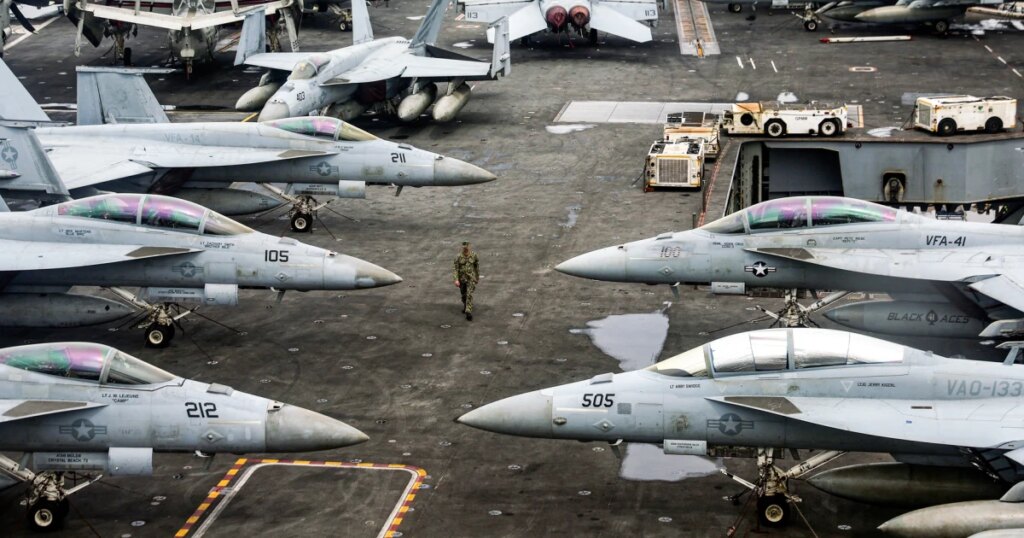
WASHINGTON — The Pentagon is sending a slew of additional weaponry to the Middle East, including more warships, air defenses and submarines, in preparation for a possible military strike on Iran if President Donald Trump makes that decision, according to U.S. officials and information from public tracking.
The build-up of military hardware comes as the U.S. and Iran are still pursuing diplomatic talks which could help avert a conflict. Iranian Foreign Minister Abbas Araghchi noted “good progress” after indirect talks with Trump’s special envoy, Steve Witkoff, and son-in-law Jared Kushner in Geneva on Tuesday. White House Press Secretary Karoline Leavitt said Wednesday that “there was some progress made” in the talks but “there are still a lot of details to discuss.”
The prospect of a breakthrough looked remote with both sides far apart on fundamental issues. The Trump administration has insisted that Iran agree to restrictions on its missile program, as well as its nuclear work, which Tehran so far has rejected as out of the question.
Trump’s top national security advisers huddled in the Situation Room on Wednesday to discuss Iran, according to a senior administration official. No final decisions have been made on potential military action, the official said, as the U.S. awaits a written response from Iran that could address some of the outstanding areas of disagreement between the two countries.
Meanwhile, the USS Gerald R. Ford, the second aircraft carrier that Trump is sending to the Middle East, and its accompanying ships are steaming across the Atlantic Ocean into the Mediterranean Sea, according to U.S. officials. It is expected there in coming days, and a nuclear submarine remains in the Mediterranean.
When it does it will join the USS Abraham Lincoln and the attendant ships which form its carrier strike group in the Persian Gulf, according to U.S. officials.
A number of other ships are also in the region, including at least three littoral combat ships, a guided missile destroyer in the Red Sea and two guided missile destroyers in the Persian Gulf near the Strait of Hormuz, according to the ship tracker at the U.S. Naval Institute.
Top Iranian officials have warned many times in recent years that they will militarily block the Strait of Hormuz, a vital shipping lane that handles about 20% of global oil supply, if the country is attacked. Iranian state media reported Tuesday that parts of the Strait of Hormuz would close for a few hours due to “security precautions” while Iran’s elite Revolutionary Guards conduct military drills there.
The aircraft carriers and accompanying warships allow the U.S. to conduct an attack on Iran without having to draw on U.S. aircraft stationed in Arab Gulf states. Those governments, fearing retaliation from Iran’s missile arsenal, have said they will not allow offensive operations launched from their territories.
It is still unclear whether any attack on Iran would involve the U.S. military alone or joint operations with the Israeli military.
Secretary of State Marco Rubio is expected to travel to Israel on Feb. 28 to meet with Prime Minister Benjamin Netanyahu, according to a State Department official.
Netanyahu, who visited Washington last week, is nervous about the status of the ongoing Iran negotiations and Rubio is going to provide him an update, a second State Department official said. Israel opposed the 2015 Iran nuclear deal, and Trump withdrew the U.S. from the agreement during his first term.
At the height of street protests against the Iranian regime in January, Trump promised protesters that “help is on its way.” But no U.S. intervention materialized, and Iranian security forces gunned down thousands of unarmed demonstrators across the country. The U.S.-based Human Rights Activists News Agency (HRANA) said in a report on Sunday that 7,015 people have been killed since the protests began in late December.
Trump said publicly that he had tabled the idea of taking military action because Iran had halted its deadly crackdown on protesters. He has since pursued diplomatic talks.
The U.S. military build-up in the region is similar to what preceded an aerial attack in June that Trump ordered against three nuclear sites in Iran, when two carriers were deployed to the Arabian Sea.
The June strikes marked the first time the U.S. launched air strikes on Iranian soil. Operation Midnight Hammer lasted less than 30 minutes, according to the Pentagon. This time, a U.S. air attack on Iran could last longer, particularly if the Trump tries to inflict lasting — or fatal — damage on the regime.
If the talks with Iran fail, Trump has a range of options before him, which include an all-out attack on Iran to knock out the regime, limited strikes to prevent Iran from rebuilding its nuclear facilities and possibly take out ballistic missile sites, or doing nothing at all. NBC News has reported that Israeli officials told Trump in December they want to strike Iran’s ballistic missile sites.
The U.S. likely has enough military capability in the region to carry out limited strikes, depending on the objectives, according to a senior retired defense official.
Depending on what the president decides, the targets could include Iran’s air defense systems, which were already damaged in the June war between Israel and Iran, ballistic missile depots and launchers, drone manufacturing plants, and bases used by the Revolutionary Guards and Basij militia, which both played a leading role in the lethal crackdown against anti-regime protests last month that left thousands dead.
If Trump tries to topple the regime, he could order an array of covert action as well as “decapitation” strikes aimed at killing the country’s leadership, including the highest authority in the country, Supreme Leader Ayatollah Ali Khamenei.
Any strikes on nuclear sites would likely include an attack on Kuh-e Kolang Gaz La, or Pickaxe Mountain, an underground site dug into the side of a mountain that was not targeted in the June air war, former officials and experts said. Since June, Iran has renewed construction work at the site, which is located near another nuclear facility, Natanz, according to commercial satellite imagery and experts.
“My sense of the administration is that they’re going to run a policy of maximum weakening, or regime weakening, and if the inevitable consequence of that is regime change, then great,” said Mark Dubowitz, CEO of the Foundation for Defense of Democracies, a think tank that has called for imposing tougher sanctions and other measures against Iran.
Some Middle East experts believe that if Trump decides to pursue military action against Iran with the goal of regime change, he will need more assets in the region than are currently there.
“I don’t think they have enough stuff over there yet,” said a senior retired defense official.
A number of air defense capabilities, including Patriot systems, are not all yet in place, according to a person familiar with the matter and the senior retired defense official.
How Trump decides to proceed on Iran could shape perceptions of America’s power in the world, given his promise to the protesters, and whether a generation of Iranians loses trust in the U.S., regional analysts said.
“American credibility is on the line in a major way,” Dubowitz of FDD said.
Leavitt said Wednesday that Trump is still considering military options but is hoping for a deal with Tehran. “I believe the Iranians are expected to come back to us with some more detail in the next couple of weeks, and so the president will continue to watch how this plays out,” she said.
Leavitt also noted the strikes Trump ordered against nuclear enrichment sites in Iran in June and said the Iranians should make a deal.
“The president has always been very clear, though, with respect to Iran or any country around the world diplomacy is always his first option, and Iran would be very wise to make a deal with President Trump and with this administration,” she said.