
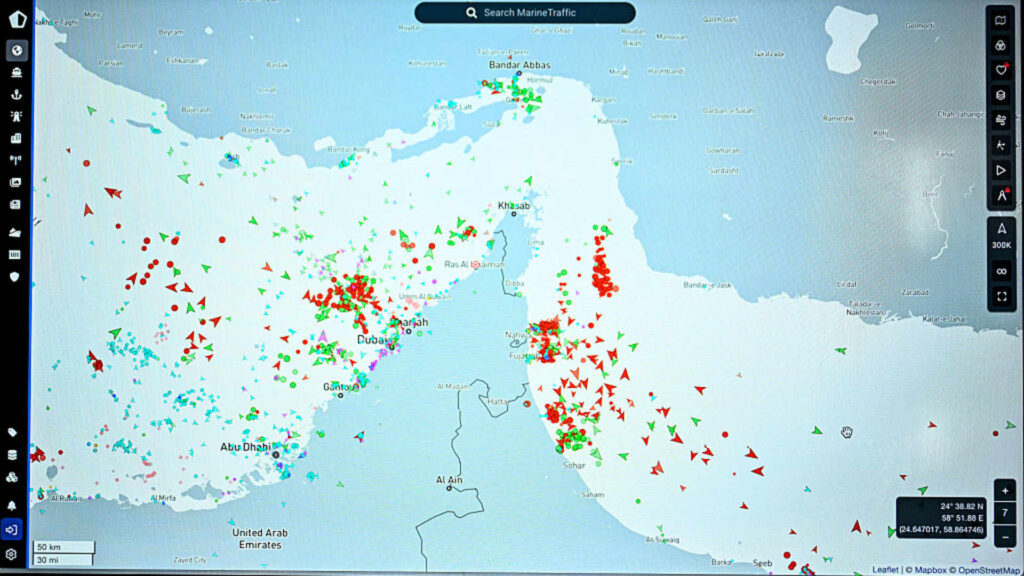
This photograph shows a page on the Marinetraffic website thats shows commercial ship traffic on the edge of the Strait of Hormuz near the Iranian coast on March 4, 2026.
Julien De Rosa | Afp | Getty Images
After slapping 25% “penalty” tariffs on India for buying Russian crude — revoked last month — the U.S. on Thursday issued a 30-day waiver to New Delhi for purchasing crude from Moscow as the Iran war upends global supplies.
The West Texas Intermediate oil surged 8.51%, or $6.35, to close at $81.01 per barrel on Thursday in the biggest single day gain since May 2020. Global benchmark Brent rose 4.93%, or $4.01, to settle at $85.41 per barrel.
The waiver on purchasing Russian oil will help ease supply worries globally, as India is the world’s fourth biggest refiner and and fifth largest exporter of petroleum products. Brent and WTI crude fell over 1% on Friday, and were last trading at $84.42 and $79.92 per barrel, respectively.
New Delhi, also the world’s third largest oil importer, had been replacing Russian oil purchases with supply from Middle East, experts said, but with the conflict affecting energy supplies from the Gulf countries, it is starting to shore up energy from Moscow.
“I’ve heard that Indian refiners have been actively seeking prompt Russian crude supplies since last weekend,” said Muyu Xu, senior research analyst for crude at energy data tracker Kpler, adding that based on “market chatter,” New Delhi is likely to have bought up to 6-8 million barrels of Russian oil over the past 2–3 days.
This “short-term measure will not provide significant financial benefit” to Russia as it only allows transactions of oil already stranded at sea, the U.S. Secretary of the Treasury, Scott Bessant said in a post on X.
The U.S. government is taking steps to curb rising oil prices, including offering political risk insurance for tankers transiting the Gulf. U.S. crude prices have climbed about 20% this week on the back of the escalating conflict in the Middle East.
“Further action to reduce pressure on oil is imminent and … in the long-term, the actions we’re taking will dramatically increase the stability of the region and oil prices,” U.S. President Donald Trump said on Thursday.
“It [the waiver] is a relief valve, in view of the loss of nearly 20 million barrel per day of crude from the Gulf producers,” said Vandana Hari, CEO of energy research firm Vanda Insights, adding that the 30-day waiver was “not nearly enough” and Washington continues to put “band aids on a gunshot wound.”
Hari expects Brent crude to continue “creeping higher than the $80s” as she feels chances of the Hormuz blockade being lifted quickly are “extremely dim.” The traffic in the Strait of Hormuz, the waterway used for 20% of global oil flows, remains at a standstill following Iranian warnings and surging insurance costs for shippers.
“Our data shows that no laden crude tankers have transited the Strait of Hormuz since last weekend, including vessels that may be bound for India,” said Xu.
Impact on India
India currently has “access to about 100 million barrels,” enough to cover up to 45 days of crude demand, Prateek Pandey, head of APAC oil and gas research at energy intelligence firm Rystad Energy, told CNBC’s “Inside India” on Thursday.
Pandey said that Indian refineries will not be impacted over the next three to four weeks, but “there will be concerns,” if the disruption in Middle East continues beyond that.
Sourcing from alternate destinations such as Venezuela poses challenges as these cargoes take almost a month to reach India, he said.


Subscribe now
In August last year, India was hit with a 50% U.S. tariffs, including 25% as punishment for purchasing Russian oil. Last month, the penalty was removed conditional to India cutting back imports from Moscow and buying more American energy. Washington warned it could reinstate the penalty, if India resumed buying Russian oil.
“I have not yet seen any increase in US crude arrivals into India,” said Xu adding that any pickup in New Delhi buying American oil following the trade deal will get reflected in the April or May data.