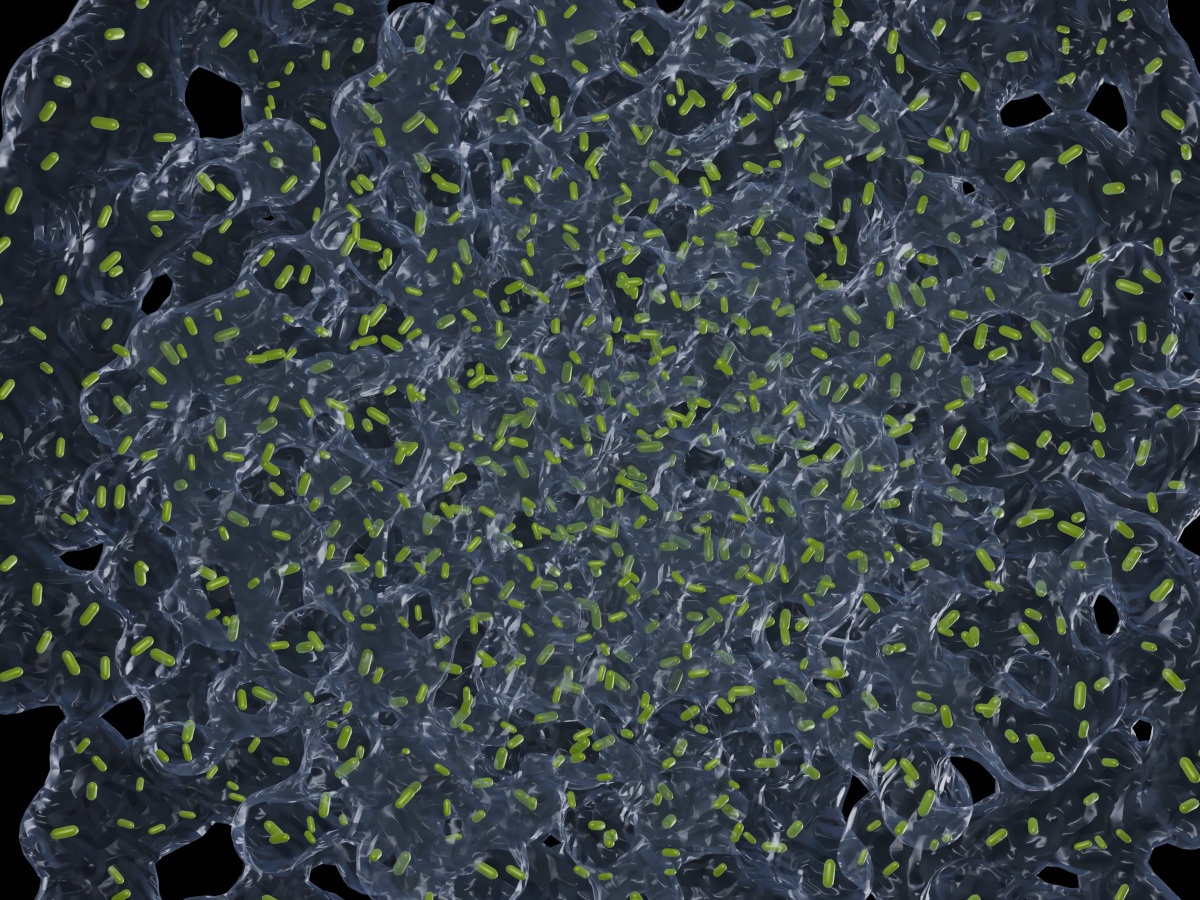
Scientists believe studying biofilms is key to safeguarding health during spaceflights.
A new study led by University College Dublin, Maynooth University and University of Glasgow explores the role of biofilms on human health during long-duration spaceflights.
In simple terms, biofilms are the equivalent of microbial “cities” – a structure around micro-organisms that protect them from external aggressors. They’re found essentially everywhere on Earth and play a key role in enabling human and plant health on the planet.
However, their susceptibility to stressors during spaceflights and disturbances to their function in space is not yet fully understood.
“Biofilms are often considered from an infection viewpoint and treated as a problem to eliminate, but in reality they are the prevailing microbial lifestyle that supports healthy biological systems,” said Dr Katherine J Baxter from the University of Glasgow, the study’s first-author and the coordinator of the UK Space Life and Biomedical Sciences Association.
She explains that space offers an “invaluable testbed” to study biofilm organisation and function, adding that evidence has made it clear that biofilms need to be better understood to safeguard health during spaceflight.
Even spaceflight simulations on Earth can alter biofilm functionalities – including its stress tolerance levels – the researchers say. This has varying effects across microbial species when tested on different platforms.
The team of researchers, who are working within the GeneLab Microbes Analysis Working Group around the NASA Open Science Data Repository, have outlined a roadmap for applying advanced genetics and biochemical approaches – ‘multiomics’ – to hopefully better understand biofilm adaptability in space environments. They have published their findings in the NPJ Biofilms and Microbiomes journal today (22 January).
“Plants will sit at the centre of long-duration spaceflight missions, and plant performance depends on biofilm interactions in and around plant root systems,” said Dr Eszter Sas, a co-author of the study and metabolomics specialist at Maynooth University.
“By combining multispecies genetics and biochemistry, modern multiomics has the exciting capability to reveal new biofilm mechanisms from spaceflight responses, and is starting to fill in major gaps in our understanding of signalling and metabolism at the interface of biofilms and plant roots.”
Prof Nicholas J B Brereton, the study’s senior author, an Ad Astra Fellow and an assistant professor at the UCD School of Biology and Environmental Science, added: “The translation of value runs both ways.
“Spaceflight can reveal new biology under unfamiliar stress, and those insights can tell us a lot about how life might survive in space but also inform approaches for health and agriculture on Earth.”
Don’t miss out on the knowledge you need to succeed. Sign up for the Daily Brief, Silicon Republic’s digest of need-to-know sci-tech news.