‘This is a declaration of intent to deploy forces to Ukraine in event of a peace deal,’ No 10 says
Downing street has said that Britain will “deploy forces to Ukraine in event of a peace deal.” In a statement released after Starmer signed the “declaration of intent” earlier, his office says:
This is a declaration of intent to deploy forces to Ukraine in event of a peace deal. This is a vital part of our iron cast commitment to stand with Ukraine for the long term.
The ‘Multinational Force for Ukraine’ will act as a reassurance force to bolster security guarantees and Ukraine’s ability to return to peace and stability by supporting the regeneration of Ukraine’s own forces.
The signing of the declaration paves the way for the legal framework to be established for French and UK forces to operate on Ukrainian soil, securing Ukraine’s skies and seas and building an armed forces fit for the future.
In today’s discussions we have also gone into greater detail about the mechanics of the deployment of the force on the ground.
Alongside our plans for a coordination cell, post-ceasefire the UK and France will also establish ‘military hubs’ across Ukraine to enable the deployment and build protected facilities for weapons and military equipment to support Ukraine’s defensive needs.”
Key events
President Zelensky has said there has been a ‘substantive’ declaration on Ukraine security guarantees. He said in his statement:
It’s important that today the coalition has substantive documents. These are not just words. There is concrete content: a joint declaration by all the coalition countries and a trilateral declaration by France, Britain, and Ukraine.
‘This is a declaration of intent to deploy forces to Ukraine in event of a peace deal,’ No 10 says
Downing street has said that Britain will “deploy forces to Ukraine in event of a peace deal.” In a statement released after Starmer signed the “declaration of intent” earlier, his office says:
This is a declaration of intent to deploy forces to Ukraine in event of a peace deal. This is a vital part of our iron cast commitment to stand with Ukraine for the long term.
The ‘Multinational Force for Ukraine’ will act as a reassurance force to bolster security guarantees and Ukraine’s ability to return to peace and stability by supporting the regeneration of Ukraine’s own forces.
The signing of the declaration paves the way for the legal framework to be established for French and UK forces to operate on Ukrainian soil, securing Ukraine’s skies and seas and building an armed forces fit for the future.
In today’s discussions we have also gone into greater detail about the mechanics of the deployment of the force on the ground.
Alongside our plans for a coordination cell, post-ceasefire the UK and France will also establish ‘military hubs’ across Ukraine to enable the deployment and build protected facilities for weapons and military equipment to support Ukraine’s defensive needs.”
French president Emmanuel Macron, will continue to support Ukraine’s forces on the frontline and will have 800,000 to ensure that the army can deter and continue to lay the ground to ensure assurance after the ceasefire. In his statement he said:
We will be focusing on Ukraine’s future prosperity with the US and speed up work happening. We will continue to prove support to Ukraine for all the challenges at the moment and the civilians who are continually targeted by the Russians.”
UK prime minster Keir Starmer says he will participate in US led monitoring and verification of any ceasefire. The UK and France will establish military hubs in Ukraine in the event of a peace deal with Russia. In his statement he said:
Putin is not willing to show peace. We will keep the pressure up on Russia, including further measures on oil trades and shadow fleet operators supporting Russia.”
Good evening everyone, the coalition of the willing summit as begun now with leaders commenting their stance and how they will continue to aid Ukraine.
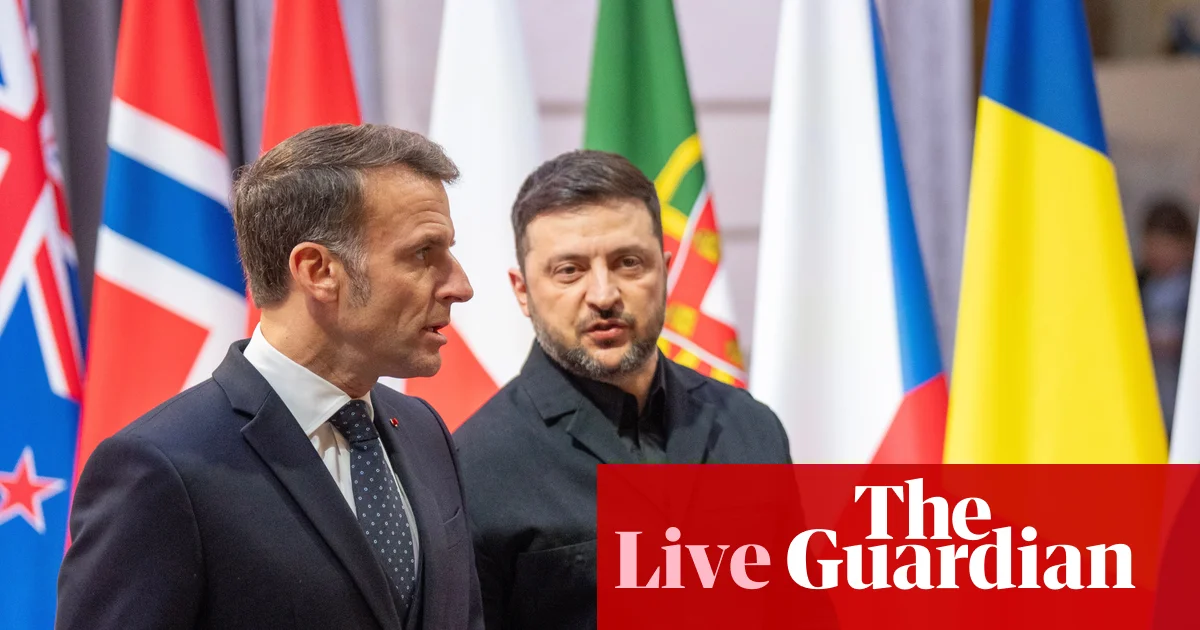
Here’s one of the first “family photos” of the Coalition of Willing summit in Paris today.
Nordic states say Arctic security rests on respect for international law
Here’s the full statement from the foreign ministers of Denmark, Finland, Iceland, Norway and Sweden:
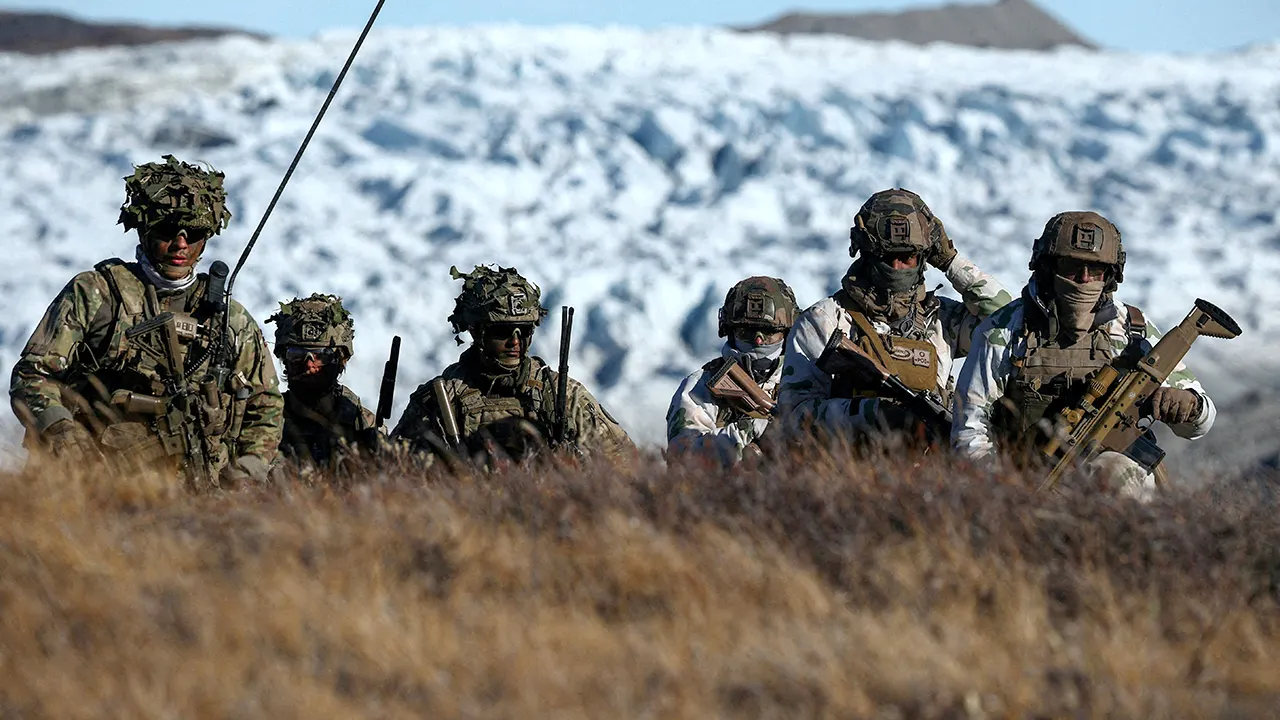
As Nordic countries, Arctic States and NATO allies we are collectively committed to preserving security, stability and co-operation in the Arctic. We have all taken steps to increase deterrence and defence in the region, including through new capabilities, activities, presence and increased situational awareness. We support NATO increasing its presence and vigilance in the region. We have substantially increased our investments in Arctic security and we are ready to do even more in close consultation with the United States and other NATO allies.
Security in the Arctic rests on respect for the fundamental principles of the UN Charter and international law, including the inviolability of borders. The Kingdom of Denmark, including Greenland, is a founding member of NATO, and has historically worked closely with the United States on Arctic Security, including through The Defence Agreement between the US and Denmark from 1951, which offers opportunities for increased security cooperation.
We collectively reiterate that matters concerning Denmark and Greenland are for Denmark and Greenland to decide alone.”
The Nordic states have just issued a statement too saying “matters concerning Denmark and Greenland are for Denmark and Greenland to decide alone”.
That follows the statement issued by Denmark with the UK, France, Germany, Italy, Spain and Poland this morning, defending Denmark and Greenland’s sovereign relationship and saying that they are already doing enough to shore up Arctic security.
That statement said the Arctic was a Nato priority and urged the US to work with other Nato members in ensuring that security.
We’re expecting a press conference soon from Zelenskyy and the Coalition of Willing leaders after their afternoon summit – also attended by US envoys Witkoff and Kushner for the first time.
We’ll have the presser in a stream you can watch at the top of the page when it gets going.
Dan Sabbagh
The US has 1.3m active military personnel, Denmark 13,100
The re-emergence of the territorial lust for Greenland in the aftermath of the capture of Venezuela’s Nicolás Maduro has finally brought Nato itself sharply into focus, with the US explicitly challenging the historical sovereignty of Denmark, a fellow ally.
Nobody would realistically expect any of Nato’s 31 other members to defend Greenland militarily if the US sought to seize it, a point emphasised by Trump’s adviser Stephen Miller overnight. The real world, he said, was “governed by strength, that is governed by force, that is governed by power” – not treaties or mutual support.
Nor would they have any hope of doing so. The US has 1.3m active military personnel, across all its services; Denmark 13,100. Nato figures show the US was expected to spend $845bn on defence in 2025, the other 31 allies a combined $559bn. The ease with which the US was able to capture Maduro and his wife, Cilia Flores, is a demonstration of the scale of sheer American power.
The alliance’s membership may not even change even if the US did take Greenland. There is no clear provision in the Nato treaty for expelling a country. Nevertheless, one member turning on another, even over an Arctic territory with a population of less than 60,000, would undermine the credibility of the 76-year-old military alliance, intended to ensure peace and mutual protection across Europe and the North Atlantic.
“If any European states harbour any illusions they can rely on US security guarantees, then this is the wake-up call we are not returning to that world,” says Marion Messmer, a director at the Chatham House thinktank.
How a US takeover of Greenland would undermine Nato from within

Dan Sabbagh
The idea that one Nato country could attack another – a US invasion of Greenland – is so alien that the most famous article in Nato’s founding treaty does not distinguish clearly what would happen if two of its members were at war.
Article 5, the cornerstone of mutual protection, dictates that “an armed attack against one or more” in Europe or North America shall be considered “an attack against them all”. Simple enough if the military threat comes from Russia, but more complicated when it comes from easily the alliance’s most powerful member.
“If the US chooses to attack another Nato country, everything will stop,” Denmark’s prime minister Mette Fredriksen said on Monday. The military alliance may well continue to exist, but its effectiveness will be called into fundamental question; the obvious beneficiary, an already aggressive Moscow.
So that “Coalition of the Willing” meeting between 35 European leaders in the Elysees Palace has been underway the last few hours. Here are a few pictures of the various state heads arriving.
We can expect a press conference around 17:45 GMT.

Shrai Popat
In comments just now to House Republicans, Donald Trump has characterised the weekend strikes on Venezuela’s capital, Caracas, as “amazing” and “brilliant”.
“It was amazing. And think of it, nobody was killed. And on the other side, a lot of people were killed,” Trump said. “They knew we were coming, and they were protected, and our guys weren’t. You know, our guys are jumping out of helicopters … it was so brilliant.”
The president called the operation “brilliant tactically” and “an incredible thing”. He added that the deposed leader, Nicolás Maduro, is a “violent guy”.
To switch back to Greenland quickly, the territory’s prime minister released comments shortly after the joint statement from seven European countries defending the Danish territory.
Britain, France, Germany, Italy, Poland and Spain joined Denmark in saying they would defend the “universal principles” of “sovereignty, territorial integrity and the inviolability of borders”.
“This support is important at a time when fundamental international principles are being challenged,” Greenland’s prime minister Jens-Frederik Nielsen wrote on social media. “For this support, I wish to express my deepest gratitude.
“At a time when the President of the United States has once again stated that the United States is very serious about Greenland, this support from our allies in Nato is both important and unequivocal.”
He said Washington should seek a respectful dialogue with Greenland via the correct diplomatic and political channels built on existing agreements.
The Russians haven’t moved an inch on their maximalist demands on Ukrainian territory, and Trump has not appeared to exert any significant pressure on Putin to come to a deal.
So while this Coalition of Willing meeting is hashing out European security guarantees for after the war, more needs to be done to get there.
“The Coalition of the Willing has been sustained as an idea and military planning for some time now, to provide to reassurance to Ukraine and a means of demonstrating European investment – ‘skin in the game’ – to a sceptical US,” says Mr Savill from Rusi.
“But it has to start producing more concrete outcomes in terms of US involvement, security guarantees, and European participation, otherwise it will just look like a talking shop.”
US President Donald Trump is now giving remarks at the Kennedy Center in DC so I’ll bring you any lines he mentions on Ukraine, Nato, Greenland, Venezuela and any other issues.
A ceasefire is still needed first
While these details of what support the US and Europe could offer Ukraine post-war are interesting – a European-led defence force supported by Washington, US-led monitoring of a ceasefire – the key thing is that we’re still far from an end to the war, given Russia has shown no sign it’s ready to stop fighting.
So this “reassurance force” of measures is just “what happens after a ceasefire, rather than being a means to getting to one”, points out analyst Matthew Savill, from the London-based Royal United Services Institute defence and security think tank.
“European countries an the US would ideally be increasing support for Ukraine and pressure on Russia to get to a deal, otherwise this post-ceasefire work will only exist on paper,” he tells the Guardian.
Multinational force would ensure ‘regeneration of Ukrainian armed forces’ – draft statement
We have some more of the draft statement – drawn up by Ukraine’s western allies – now. In the event that that end to this war is achieved – it would provide crucial security guarantees to Kyiv to help deter future Russian aggression.
“There will be a continuous, reliable ceasefire monitoring system. This will be led by the US with international participation,” the draft statement said.
The multinational force to be deployed after a ceasefire would provide “reassurance measures in the air, at sea and on land” for Ukraine and ensure the “regeneration of the armed forces of Ukraine”, it added. “These elements will be European-led”.
There would be US participation in the force “including US capabilities such as intelligence and logistics”, and “a US commitment to support the force in case of attack” by Russia, it said.
There would also be “binding commitments to support Ukraine in the case of a future armed attack by Russia in order to restore peace”.
These commitments “may include the use of military capabilities, intelligence and logistical support, diplomatic initiatives, adoption of additional sanctions,” it said.
Russia has repeatedly opposed any Nato boots on the ground in Ukraine to monitor a halt in hostilities.
According to AFP reporting of this draft statement, the US would lead a “ceasefire monitoring and verification mechanism” that would involve the Europeans, in the eventuality of a ceasefire.
In addition, the US would also commit to “support” a European-led multinational force – deployed in Ukraine after an eventual ceasefire – “in case of” a new attack by Russia.
Details about this arrangement are thin at the moment but we will continue to bring you the latest as we get it.