
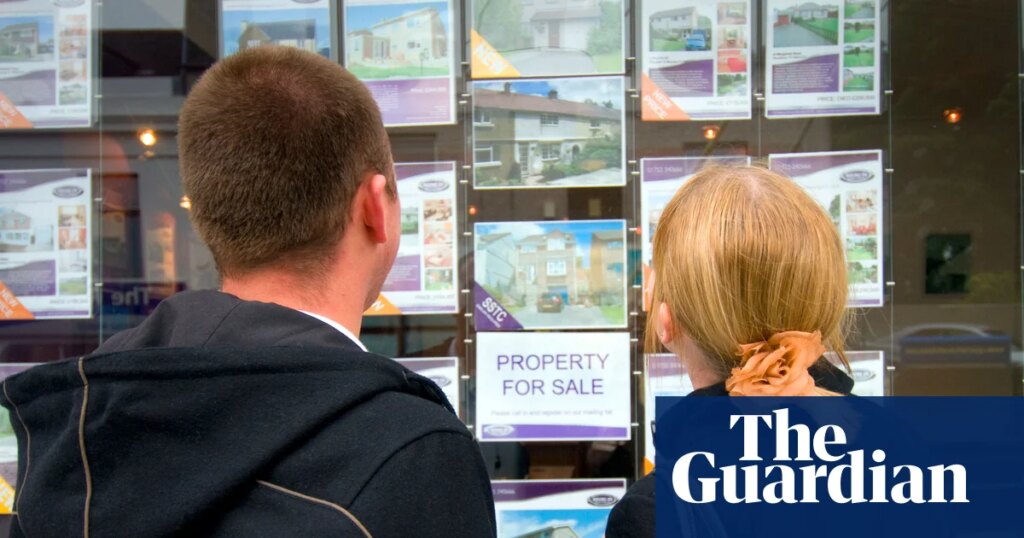
First-time buyers are expected to drive the UK housing market in 2026, with further interest rate cuts likely to improve stretched affordability.
The for-sale market should accelerate moderately, with prices rising by 2% to 4%, while rent rises are likely to slow from the rapid increases of recent years, according to lenders and estate agents.
With mortgage rates falling, earnings growth running ahead of inflation, and house prices rising slowly, monthly mortgage costs for first-time buyers as a share of income are at their lowest level since 2022, according to Halifax.
House prices across the country rose less than expected in 2025, after a stamp duty tax break expired at the end of March and buyer confidence was knocked first by Donald Trump’s tariffs in April, and later by speculation around property tax changes before Rachel Reeves’s budget in late November.
Property values climbed by 1.8% in the year to November, leaving the average home valued at £272,998, according to Nationwide building society. Lenders and estate agents estimate between 1% and 2% house price growth for 2025, less than the 3%-plus rises they predicted a year ago, and below the rate of inflation, now 3.2%.
“Uncertainty around the budget pretty much killed the market in the second half of 2025, so we were kind of just treading water,” said Marcus Dixon, the head of residential research at JLL. When inflation is taken into account, house prices are falling in real terms, “which for affordability, it’s not necessarily a negative”, he added.
The Bank of England, faced with high inflation, has also been slower to cut interest rates than expected.
With inflation cooling, it delivered a pre-Christmas cut, taking borrowing costs to their lowest in almost three years. Economists expect two further cuts in 2026, and lenders have already acted by offering a number of fixed-rate mortgages below 4%, with the best deal at 3.55% for a two-year fix with a 40% deposit, from Santander.
Forecasts for house price rises next year are concentrated at the lower end of between 2% and 4%, followed by 4% growth in 2027 and rises of up to 5.5% in 2028. Predictions come from the leading mortgage lenders Nationwide and Halifax, the estate agents Savills, JLL, Knight Frank and Hamptons, and the property websites Rightmove and Zoopla.
In London, house prices have been falling, and are expected to flatline in 2026. With prices rising strongly in northern England, the north-south divide in property values has narrowed to its smallest since 2013, according to Nationwide.
Mortgage rules have been relaxed, allowing buyers to take out bigger mortgages with smaller deposits, alongside looser affordability stress tests, and the City watchdog has just announced plans to help first-time buyers and self-employed people get on the property ladder.
“Buyers might be able to purchase with a 15% or 10% deposit, and that makes a huge difference, particularly in London and the south-east,” said Emily Williams, a director of residential research at Savills. “That’s certainly knocking two or three years off the amount of time that you need to save for deposits.”
The Nationwide chief economist, Robert Gardner, said that while in 2023, for a typical first-time buyer with a 20% deposit, the mortgage payment was above 38% of pay, it was now 33%, closer to the long-term average of 30%. He expected this ratio to fall further in 2026.
Hamptons said first-time buyers accounted for a third of all purchases in 2025, a record high, and half of all deals in London. Aneisha Beveridge, its head of research, said: “First-time buyers are becoming a real kind of key driving force in the housing market. But that partly reflects the fact that other people aren’t moving as often because stamp duty costs are so high.”
Williams said that as the Renters’ Rights Act gave tenants more safeguards, some landlords were selling up, and a lot of these properties were going to first-time buyers because they tended to be smaller and cheaper.
The budget brought a high-value council tax surcharge – also known as the “mansion tax” – for £2m-plus homes from April 2028, but this was not as sizeable as feared. With the budget out of the way, JLL said its central London sales business was the busiest in 17 months in November.
However, the market remains slow – it takes more than 200 days for a home to sell from listing to exchange, compared with 150 days normally, Dixon said. The unemployment rate has risen to a four-year high of 5.1% and the economic outlook is lacklustre, which will drag on buyer confidence.
For tenants, average rent increases are expected to slow further, to between 2% and 3.5% in 2026. Official figures showed average UK monthly private rents rose by 5% to £1,360 in the year to October.
However, with a shortage of new rental homes and high tenant demand, “even though rental growth will slow, growth is probably going to come down fairly slowly, and that’s certainly what we’ve seen in the last few quarters”, said Gardner.