Key events
Christmas dinner and festive treats up to 70% more expensive, reports Which?
Despite some lower food prices in the official inflation figures, the cost of Christmas dinner and festive treats has gone up, a survey shows.
Shoppers are paying up to 70% more for Christmas chocolate treats compared with last year, while the price of a turkey has jumped by as much as £15, according to the consumer champion Which?.
The group analysed a range of ingredients for a typical Christmas dinner, as well as other typical festive treats including mince pies, sparkling wine and chocolates.
Festive chocolate had the steepest mark-up this year. Among the biggest risers was a Lindt Lindor milk chocolate truffles treat box at Asda up 72% to £1.98 compared with £1.15 last year. At Morrisons, Lindt Milk Chocolate Teddy Christmas tree decorations increased from £3.50 in 2024 to £6 in 2025, up 71%.
There were a few annual declines in food prices:
-
Olive oil -16.2%
-
Flours and other cereals -6.1%
-
Pasta products and couscous -4.2%
-
Sugar -4%
-
Frozen seafood -2.4%
-
Rice -1.7%
-
Jams, marmalades and honey -1%
Most other food prices continued to rise at an annual rate but at a slower pace.
Anna Leach, chief economist at the Institute of Directors, said:
Inflation has fallen back decisively in today’s data, and by more than expected, bringing the rate to its lowest since March. Food price inflation has eased sharply to its lowest rate since April, despite typically rising at this time of year, while services inflation – a key indicator of domestic price pressure – has also edged down. Together, these figures increase the likelihood of a welcome interest rate cut tomorrow.
Recent indicators point to a notable weakening in both the economy and the labour market, with unemployment reaching its highest level since 2015. Today’s inflation outturn has also come in below the Bank of England’s expectations, driven in part by unexpectedly soft food prices. The Bank will also assess the impact of the recent budget on the outlook for inflation. And despite being trailed as actively disinflationary, the budget’s effects are more mixed due to the increase in spending and borrowing over the next two years. But on balance, the case for a rate cut has been made.
The chancellor, Rachel Reeves, made tackling the cost of living a major target of last month’s autumn budget, alongside £26bn of tax increases to help repair the public finances and fund the end of the two-child benefit cap.
“Getting bills down is my top priority,” she said after the inflation figures. “I know families across Britain who are worried about bills will welcome this fall in inflation.”
The pound has fallen against the dollar, as an interest rate cut tomorrow looks more likely.
Sterling has fallen by 0.67% to $13328.
Markets now see a 98.8% chance of a rate reduction at the end of the Bank of England’s meeting at noon tomorrow, from 4% to 3.75%. Before the data, the probability of a rate cut was 90%.
Investors are now betting on 66 basis points of cuts by next December, up from 58bps before the inflation figures.
The TUC is calling for a “sequences of rate cuts” in coming months to ease pressure on households and businesses.
TUC general secretary Paul Nowak said the Bank of England has been “too cautious” this year.
Inflation may be falling, but many working people are still struggling to afford the basics.
The government acted to protect living standards and push back against inflation in last month’s Budget, but more must be done.
The economy is fragile and high interest rates are draining confidence from households and firms. It’s vital that we now boost demand.
The Bank of England has been too cautious this year, and inflation is already lower than they expected only last month. So an interest rate cut this week must be the start of a sequence of reductions over the months ahead. It’s long overdue and it’s the shot in the arm that the economy needs.
Lower rates will give firms the confidence to invest and help get more households spending.
Here’s our full story:
‘Interest rate cut certain’ following inflation drop
An interest rate cut tomorrow is certain following the notable drop in inflation in November, economists say.
Suren Thiru, economics director of the Institute of Chartered Accountants in England and Wales, said:
While the financial squeeze on households and businesses remains severe, these figures offer reassurance that the UK is moving towards a more modest inflation environment, helped by lower food prices.
Softening services and core inflation offer hope that underlying price pressures are becoming less sticky. The growing downward pressure from a loosening labour market and wilting economy should help keep it on a downward path.
UK inflation’s journey back to target should accelerate appreciably in 2026 with lower food and fuel costs alongside the energy bill changes announced in the Budget likely to pull it back to 2% by next summer.
These figures, alongside the recent deluge of downbeat data, mean that an interest rate cut tomorrow looks certain. The vote split could be more dovish than many expect as policymakers will have now assessed the budget’s deflationary impact.
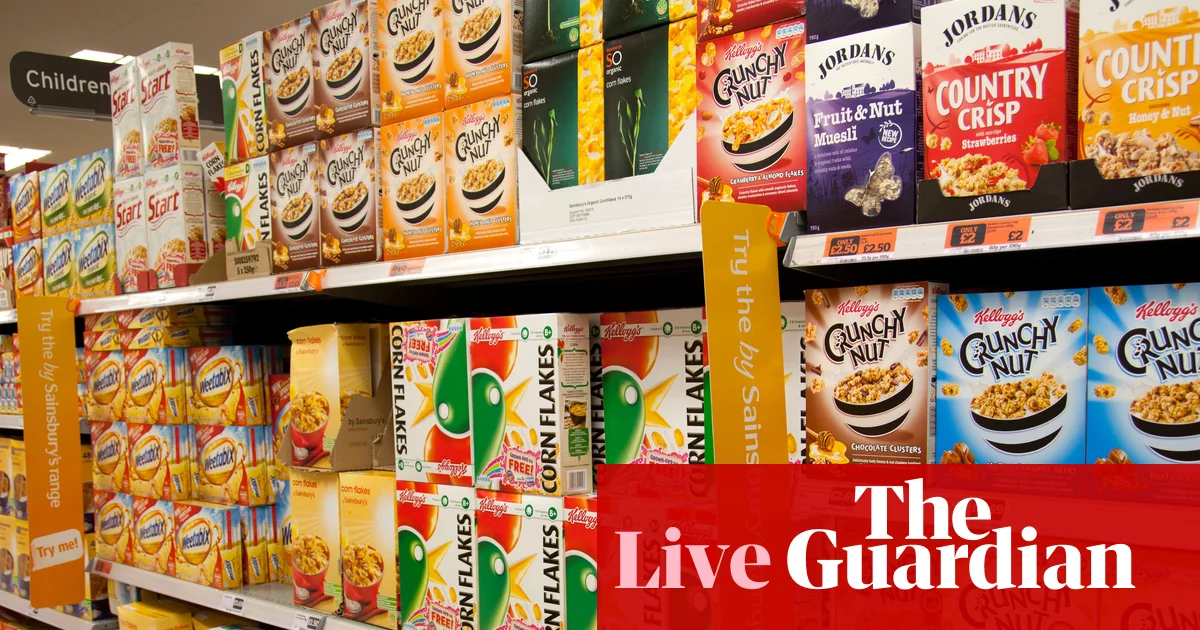
Food and non-alcoholic drink prices rose by 4.2% in the 12 months to November, down from 4.9% in October. Prices of cakes, biscuits and breakfast cereals fell but rose a year ago.
There were other, smaller downward effects on inflation from dairy products and sugar, jam and chocolate.
Tobacco prices also pulled inflation down, with prices in the alcohol and tobacco division rising at an annual rate of 4% in November, down from 5.9% in October, marking the lowest rate since December 2022.
Clothing and footwear prices fell by 0.6% in the 12 months to November, compared with a rise of 0.3% in October. This rate matched the change in February, and was last lower in March 2021.
UK inflation slows sharply to 3.2% as food prices ease – business live
Good morning and welcome to our rolling coverage of business, the financial markets and the world economy.
Inflation in the UK slowed more than expected last month because of easing food prices, marking the third month that inflation has fallen.
Inflation, measured by the consumer prices index, fell to an annual rate of 3.2% in November, from 3.6% in December, according to the Office for National Statistics.
The core rate, which strips out volatile food and energy costs, dropped to 3.2% from 3.4%.
Grant Fitzner, the ONS chief economist, said:
Inflation fell notably in November to its lowest annual rate since March. Lower food prices, which traditionally rise at this time of the year, were the main driver of the fall with decreases seen particularly for cakes, biscuits, and breakfast cereals,
Jim Ratcliffe’s chemicals company Ineos has been granted £120m of government funding to help save the UK’s last ethylene plant at Grangemouth, in a deal expected to protect more than 500 jobs.
The investment in the Scottish plant was necessary to preserve a vital part of the country’s chemicals infrastructure, the UK government said. The ethylene produced there was essential for medical-grade plastics production, water treatment and in aerospace and car-building, it added.
The Agenda
-
9am GMT: Germany Ifo business climate index
-
9.30am GMT: UK House prices
-
11am GMT: UK CBI Industrial trends survey