Zelenskyy welcomes EU decision on funding as ‘signal to Russians’
Zelenskyy also once again talks about the EU’s decision on funding, saying it was clearly helping Ukraine and sending “a signal to the Russians that there is no point in continuing the fight, because we are supported financially” and will be able to continue its resistance against Russia.
That ends the press conference in Warsaw.
Key events
-
‘Scariest thing for Russia is when we are together,’ Zelenskyy tells Poland’s Tusk
-
Belgium’s de Wever greeted as hero by his cat on Instagram
-
EU’s Ukraine loan may have been Plan B, but don’t underestimate its significance to the bloc
-
Highly choreographed Putin’s presser repeats hardline tone on Ukraine
-
Italy’s Meloni, Denmark’s Frederiksen welcome EU decision on Ukraine funds
-
Poland’s Tusk says ‘not fully satisfied’ with Ukraine decision, but ‘better to have something’ than nothing
-
Russia is not going to attack Europe, Putin says
-
Zelenskyy welcomes EU decision on funding as ‘signal to Russians’
-
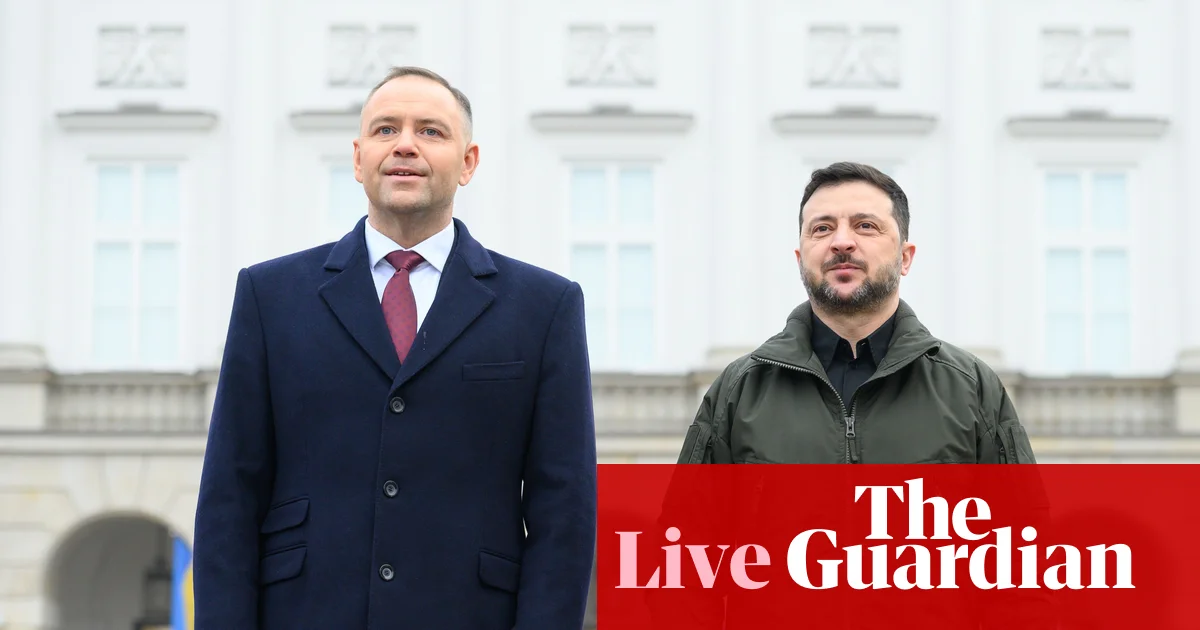
Zelenskyy, Poland’s Nawrocki address media after Warsaw talks
-
Zelenskyy meets Poland’s Nawrocki in Warsaw
-
Putin says ball in west and Ukraine’s court to move on ending war
-
Belgium’s de Wever hails ‘stable, legally robust’ solution on Ukraine funding as he shows frustration with pro-Russian accusations
-
Putin calls EU reparations loan idea ‘robbery’ and warns about consequences
-
EU summit secures money for Ukraine, but politically its outcome is more complicated – snap analysis
-
Putin blames Ukraine for continuing war
-
Russia’s Putin begins annual year-end news conference
-
Hungary’s Orbán calls EU loan for Ukraine ‘extremely bad decision’ and ‘lost money’
-
Ukraine loan turned out ‘exactly as I promised,’ Czech Republic’s Babiš says
-
Spain’s Sánchez backs EU decision on loan as right politically, legally and morally
-
Opening summary
‘Scariest thing for Russia is when we are together,’ Zelenskyy tells Poland’s Tusk
Jakub Krupa
And back to our last agenda item for today, Poland’s Tusk has just welcomed Ukraine’s Zelenskyy, with a few words for the press.
Welcoming his guest, Tusk repeated his earlier line that while he was satisfied, “it could be better,” but added:
“Always something could be better, more efficient, but I am really satisfied (that) at least we delivered what we promised.”
Zelenskyy said in response that Russia was hoping to “cancel” the EU’s funding for Ukraine and “delay everything or even postpone meeting on this topic,” but Europe “showed leadership” as he welcomed the €90bn loan agreed last night.
Tusk also paid personal tribute to Zelenskyy, telling him that “your fight is our common fight,” and adding: “you are a hero not only in Ukraine, but here in Poland [we] also treat you as a hero.”
When Zelenskyy tried to play it down, Tusk added in Polish: “I know what I’m saying.”
In later comments in their own respective languages, Tusk repeated his comment from yesterday that Ukraine’s fight against Russia safeguards Poland’s independence which could come under threat if Russia was allowed to win the war.
Responding, Zelenskyy struck the same tone saying:
“The scariest thing for Russia is if we are together. Because they definitely cannot defeat the two of us [together].”

Jakub Krupa
Look, I know that our Europe Live coverage can sometimes wander in mysterious directions, but I have to admit that I didn’t have
-
someone proposing during Putin’s live press conference (13:50) and
-
the Russian president discussing aliens (11:57) and
-
the feeling of being in love (15:03) as well as
-
De Wever’s ‘dacha in St Petersburg’ jibe (11:51) and
-
his cat’s public display of affection on Instagram
on my bingo card for today’s blog.
Belgium’s de Wever greeted as hero by his cat on Instagram

Jennifer Rankin
in Brussels
Following the EU summit in Brussels where Belgium fought off a plan for a reparations loan, prime minister Bart De Wever is greeted as a hero by… his cat on Instagram.
Maximus is a popular Instagram account with tongue-in-cheek observations on life in the prime minister’s residence from the point of view of his cat.
The entry posted on Friday shows Maximus the cat congratulating the prime minister, telling him he is a hero.
De Wever thanks the cat and says he did his best. The joke is that the cat is thinking that flattering De Wever will earn him more food and petting.
The post does not reference the EU summit or Ukraine. But it is not too hard to guess that De Wever is pretty pleased with the outcome. The posts are put up by his team and reflect his deadpan humour.
After the summit ended last night, he used cats as a metaphor to explain why he saw the agreement as a good one.
”Ukraine has its money. Maybe not the way they wanted it. Maybe not the way they were pushing for…. You should not complain about the colour of the cat. If it can catch a mouse, it is fine.”
EU’s Ukraine loan may have been Plan B, but don’t underestimate its significance to the bloc

Jon Henley
Europe correspondent
The EU’s failure to agree a “reparations loan” to Ukraine backed by frozen Russian assets was a political blow to the bloc’s big beasts, but the last-gasp alternative it devised will do the job – and marks a potentially significant first.
After a marathon 16 hours of talks, EU leaders early on Friday agreed to fund Ukraine, which risked running out of money by next April, with a much-needed €90bn (£79bn) loan. But the solution they came up with was not the one most had wanted.
More than two months ago, the European Commission floated a plan to provide a loan to Kyiv secured against some of the €210bn of Russian central bank assets frozen in Europe, most of which are held at the Euroclear clearing house in Belgium.
It looked neat, it was – EU lawyers argued – legally watertight, and appealed for two main reasons: it involved no new common borrowing, and there was a certain moral satisfaction in seeing Russian money help Ukraine fight off Russian aggression.
There was an obstacle, however. The Belgian prime minister, Bart De Wever, argued that Moscow, which saw the plan as theft, would retaliate, and that courts in Russia-friendly jurisdictions, such as China, could order Belgian assets to be seized.
For weeks, De Wever held out, resisting heavy pressure in particular from the commission chief, Ursula von der Leyen, and her compatriot Friedrich Merz, the German chancellor, for whom the “reparations loan” was Plan A, with no Plan B.
The alternative – joint borrowing – may have appealed to some southern EU countries but was strongly opposed by Berlin and its frugal northern European allies, who did not fancy underwriting more debt for already overburdened fellow member states.
Up until the start of Thursday’s EU summit, leaders and diplomats were convinced De Wever – whose popularity has soared at home – would cave. Instead, he demanded unlimited cash support from every EU member in the event of any Russian claim.
That was too much. And so, backed principally by Italy’s Giorgia Meloni but also increasingly by the French president, Emmanuel Macron, Plan B – using unallocated funds in the EU budget as collateral for a collective loan for Ukraine – won the day.
Objections that a eurobonds alternative required unanimity were overcome, in a historic and potentially far-reaching move, by securing the backing of Eurosceptic Hungary, Slovakia and the Czech Republic in exchange for exemption.
The result was first and foremost hugely important for Ukraine, which will also get its much-needed cash sooner than under Plan A. It was a political loss for von der Leyen and Merz – although the German chancellor expressed delight with the deal.
They can go home and boast to their populist bases that the taxpayers of, respectively, Hungary, the Czech Republic and Slovakia will not be asked to stump up anything for Ukraine’s defence.
Friday’s deal once again laid bare the deep divisions that so often hobble the EU’s decision-making, and underlined how far it still has to go to create a fully united Europe that can can act effectively and decisively in a hostile world.
But the bloc did manage to pull together an agreement for an existentially important end. It may even, analysts suggested, have found a new path forward. This was a “huge deal for EU”, said Guntram Wolff, of the Bruegel economic thinktank.
“If you want to do EU foreign policy, you need EU resources and debt. The European Council delivered,” he said, adding that the summit also marked, significantly, the first time that a decision on new EU debt had been reached without unanimity.
Highly choreographed Putin’s presser repeats hardline tone on Ukraine

Pjotr Sauer
Russian affairs reporter
Vladimir Putin’s annual end-of-year press conference has ended, with the Russian president announcing little that was new despite the event stretching on for more than four hours.
The carefully choreographed event, a fixture of Russia’s political calendar, allows journalists and hand-picked members of the public to put questions directly to the president, projecting an image of openness while the agenda remains tightly controlled.
Putin struck his familiar hardline tone on the war in Ukraine, reiterating the Kremlin’s determination to continue fighting until all of its conditions are met. He offered few details on what those conditions might be, instead referring back to a speech he delivered in June of 2024, in which he demanded that Ukraine withdraw from the entirety of the Donetsk, Luhansk, Kherson and Zaporizhzhia regions – a non-starter for Kyiv and not a proposal currently under discussion with Washington.
As in recent months, Putin also used the appearance to court favour with Donald Trump, praising the US for a new security strategy that excludes Russia as a threat and agreeing with the US president’s decision to sue the BBC.
Domestically, the conference also serves as a pressure valve, with questions often touching on living standards and social benefits. But such concerns are typically reframed as temporary hardships on the road to victory.
When one questioner asked why food prices – “even buns in the cafeteria” – were rising while their parents’ wages were not, Putin responded by insisting inflation was already easing. “Prices are not just slowing,” he said. “They have fallen – I don’t recall the exact figure, but by more than 10%, almost 16%.”
True to tradition, the call-in show was also used by Kremlin political technologists to present a more human side of the Russian leader.
Asked whether he was collecting material for future memoirs, Putin replied that he was not, adding that his faith lay “in God, who is with us and who will never abandon Russia”.
Moments later, when asked whether he was in love, Putin smiled and said that he was.
Ukraine says it has attacked a Russian “shadow fleet” tanker with aerial drones 1,250 miles (2,000km) from its borders, in the first such strike in the Mediterranean Sea since Moscow’s full-scale invasion nearly four years ago.
Friday’s strike off the coast of Libya, which reportedly caused critical damage, took place on the day of Vladimir Putin’s annual end of year press conference.
It came amid an escalating maritime conflict over the shadow fleet, a term used to describe vessels used by Russia, Iran and Venezuela to evade sanctions with deceptive practices.
The reportedly critical drone strike is the first in the Mediterranean since the full-scale invasion began as maritime conflict grows. Read more here:
Czech president Petr Pavel said on Friday it was important that European Union leaders found agreement on financial help for Ukraine as it fights against Russia, calling it essential for Ukraine’s survival.
Pavel has urged the new Czech government led by prime minister Andrej Babiš to keep up support for Ukraine, although Babiš joined Slovakia and Hungary’s leaders on Friday in gaining an opt-out from the financial costs of the EU plan.
Jakub Krupa
I’m still keeping an eye on Putin’s presser, but nothing particularly important to tell you about.
Although there was this guy who proposed to his girlfriend as part of his question, so there is always that.
Italy’s Meloni, Denmark’s Frederiksen welcome EU decision on Ukraine funds
Let’s bring you some more reactions from EU leaders to last night’s decision on Ukraine, via Reuters.
Italian prime minister Giorgia Meloni said that she was glad “that common sense prevailed,” and “we managed to secure the necessary resources with a solution that has a solid legal and financial basis.”
Striking a similar tone to Merz earlier (11:20), she added that “the most important decision on this matter was already taken a few days ago when we immobilized them, ensuring they would not be returned.”
Denmark’s Mette Frederiksen said it was “a good example that when something is necessary, then we are able to deliver.”
But she added:
“But at the same time we have to say that many governments and leaders are under a growing pressure in their national political discussions, parliaments and so on.
It is changing in Europe, unfortunately, and I have to say, this is what Putin is hoping for, the combination of some kind of war fatigue with a hybrid war that brings a lot of uncertainty and insecurity into our societies.”
Poland’s Tusk says ‘not fully satisfied’ with Ukraine decision, but ‘better to have something’ than nothing
Sticking with Poland for a second, the country’s prime minister Donald Tusk said he wasn’t fully satisfied with last night’s decisions in Brussels, but it was still a move in the right direction as “it is always better to have a piece of something than all of nothing”.
In a social media post in English, he said:
“Despite excessive caution of some leaders, Europe took the decision to finance Ukraine. The possibility of using immobilized Russian assets is still on. Am I fully satisfied? Of course not. But it is always better to have a piece of something than all of nothing.”
Tusk, fresh back from Brussels, will also briefly meet Zelenskyy in Warsaw later today.
Russia is not going to attack Europe, Putin says
Meanwhile, Vladimir Putin is still speaking in Moscow, repeating his claims that Russia is not going to attack Europe.
He pointedly noted that the new US security strategy “does not mention Russia as a main threat,” somewhat blaming Nato for any tensions with Moscow.
He also claims that Russia is ready to stop the conflict “if we get security guarantees.”
Obviously the key part here is what they mean as security guarantees, because so far they were linked with extensive and maximalist demands on Ukraine, eastern Nato countries, and the alliance more broadly.
Separately, Putin also backed Trump’s legal challenge against the BBC.
Zelenskyy welcomes EU decision on funding as ‘signal to Russians’
Zelenskyy also once again talks about the EU’s decision on funding, saying it was clearly helping Ukraine and sending “a signal to the Russians that there is no point in continuing the fight, because we are supported financially” and will be able to continue its resistance against Russia.
That ends the press conference in Warsaw.
Jakub Krupa
Zelenskyy gets asked about Poland’s sense of being excluded from some of the recent talks on the Ukraine peace deal, and he explains the differences between various formats in which these talks are held, which sometimes change who is at the table – and says he doesn’t share the impression that Poland is being excluded.
He’s handled it well given it’s a very tricky and sensitive topic in Poland, and one that is at heart of Nawrocki’s continuing political disagreements with prime minister Tusk over who represents Poland where and in which format.
Zelenskyy also welcomes the EU deal on funding Ukraine, saying the funds will be used to help with its defence against Russia, and if the war ends, on Ukraine’s reconstruction.
He says it’s critical that Russian assets in Europe remain frozen, and Russia doesn’t get to benefit from its war of aggression.
He also invites Polish companies to participate in the reconstruction effort.
He also acknowledges some “difficult” episodes in Polish-Ukrainian history that Nawrocki talked about, and says Ukraine is ready to work through these issues together.
Zelenskyy says he thought the talks were positive, and stresses the importance of Poland and Ukraine in the region as two important elements of security system guaranteeing of freedom in this part of Europe “without Moscow.”
“Without our independence, Moscow will inevitably come for Poland. That’s why it’s important that we exist, it’s important that you exist, it’s very important that Ukraine and Poland exist, and it’s important that we stand together,” he said.
He says they also talked about the latest on the war and diplomatic efforts to end the war, pointedly thanking Poland and the Polish nation for its continued support “from the start of the war.”
He says Ukraine has lots to share with Poland drawing on its experience of the war with Russia, including security advice on how to deal with Russian drones after September’s large scale incursion into Polish airspace.
He says he also invited Nawrocki to visit Ukraine in return.
Poland’s Nawrocki then talks about various bilateral issues – including on history – and economy.
He also pointedly praises Trump, saying he is the only leader capable of making Putin move on Ukraine to achieve a peace settlement in the war.
Over to Zelenskyy now.
Nawrocki also says the two leaders share their views that Russia is a “neoimperial, post-Soviet” power that poses danger to the region.
But he then highlights the importance of Poland’s ongoing support for Ukraine, with past aid from Poland and 90% of the broader European aid for Ukraine coming through the country.
He says the two countries are fully aligned on strategic issues, but says that there is a sense that Poland’s support weren’t properly appreciated by Ukraine, and he raised this in his talks with Zelenskyy.
Zelenskyy, Poland’s Nawrocki address media after Warsaw talks
Jakub Krupa
Poland’s Nawrocki and Ukraine’s Zelenskyy are now speaking to the media.
Nawrocki says that Zelenskyy’s visit is “bad news for Moscow”, as shows the unity of thinking on security and defence between Warsaw, Kyiv and other partners in the region.
He makes it very clear what he thinks of Russia, as he says it seeks to “disrupt the international order” and destabilise political systems, with “hybrid” attacks taking place on an “almost daily basis.”
He reiterates Poland’s support for strict sanctions against Russia.
I will bring you more lines here.