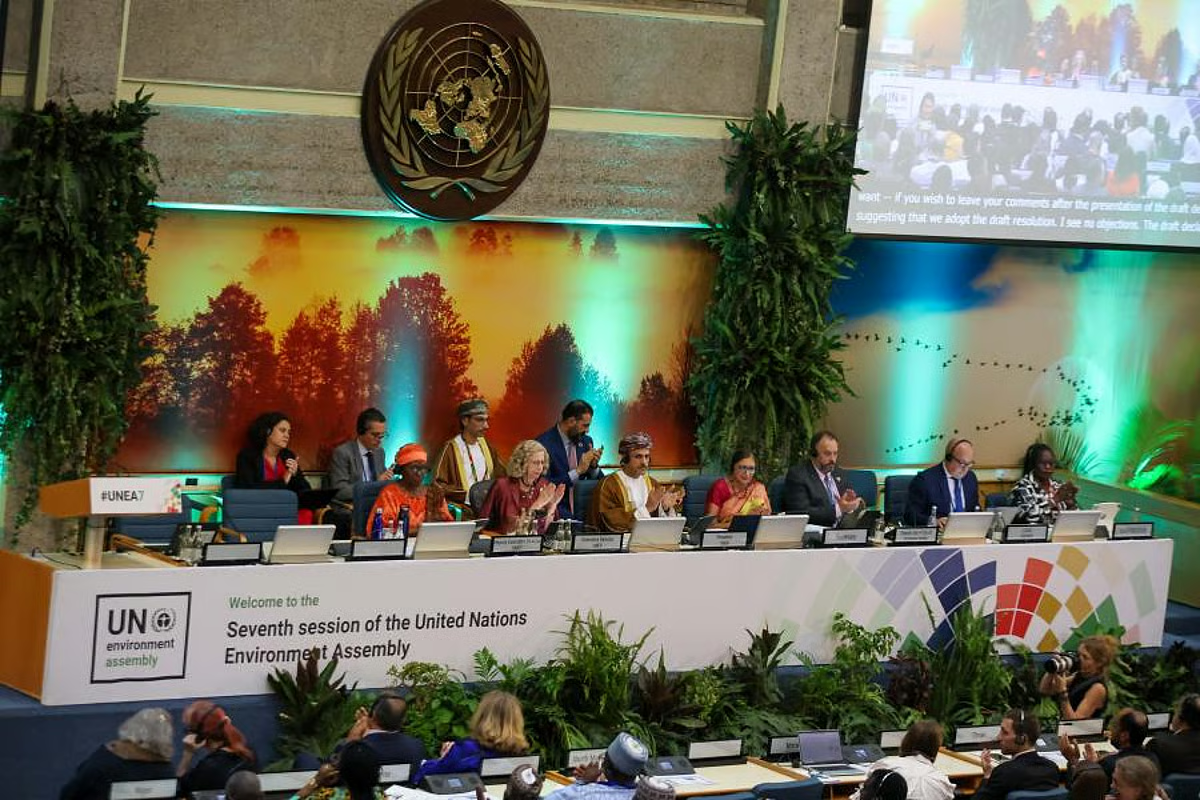
The seventh session of the United Nations Environment Assembly (UNEA-7) has dropped a draft resolution aimed at strengthening the role of the United Nations Environment Programme (UNEP) headquarters in Nairobi, Kenya, without providing an explanation — a move that some delegates say undermines UNEP’s mandate as the steward of global environmental policy. Governments had gathered in Nairobi for the seventh session of the United Nations Environment Assembly (UNEA-7), which took place December 8 to December 12, 2025.
Draft Resolution 14, which had been included among the initially slated for debate during the week-long assembly, disappeared from the official agenda on Wednesday. Some delegates described the move as further resistance to enhancing UNEP’s role as the custodian of global environmental multilateralism.
Although the draft remained visible on the UNEP website until the final day of deliberations on Friday, it was missing from official documents and the agenda circulated to delegates on Thursday, prompting concern among civil society groups. Many activists have long argued for greater coordination of (MEA), whose secretariats are currently spread across several cities worldwide, under UNEP’s ambit.
Before it was quietly dropped, the resolution had been regarded by many delegates from developing countries as one of the most significant proposals before the assembly. Supporters argued that empowering UNEP — the only UN body headquartered in a developing country — by bringing MEA secretariats under its coordination would strengthen global environmental governance.
Resolution 14 sought to “strengthen the role of the United Nations Environment Programme headquarters in Nairobi to address environmental challenges and enhance multilateral cooperation for effective environmental governance”.
It invited member states to consider establishing the secretariats of future multilateral environmental agreements in Nairobi and to hold their meetings and negotiations there. The aim, the text said, was to improve coherence and synergies while strengthening Nairobi as a global hub within the international environmental architecture and enhancing the visibility and effectiveness of multilateral environmental governance.
It invited member states to consider establishing the secretariats of future multilateral environmental agreements in Nairobi and to hold their meetings and negotiations there. The aim, the text said, was to improve coherence and synergies while strengthening Nairobi as a global hub within the international environmental architecture and enhancing the visibility and effectiveness of multilateral environmental governance.
The draft also requested UNEP’s Executive Director to present a report on steps taken to implement the resolution for consideration by the Committee of Permanent Representatives and by the Environment Assembly at its eighth session, scheduled for December 2026. In addition, it proposed including the issue on the agenda of the Committee of Permanent Representatives to UNEP.
Ken Mwathe, Policy, Climate and Communications Coordinator at BirdLife International-Africa, said the decision was disappointing but not entirely unexpected, adding that the issue was likely to return at future assemblies.
“This is not the end of the quest to have this resolution passed,” he said. “As the global agency for environmental policy, UNEP needs to be strengthened, and that is why many people from developing countries and small island states are disappointed by this move.”
Mwathe acknowledged that the draft resolution was both political and ambitious, but said consolidating MEA secretariats in Nairobi would have clear advantages, including more efficient resource allocation, reduced carbon emissions from international travel, and improved administrative coordination.
“Moving these scattered secretariats would improve efficiency, streamline coordination and save money on many fronts,” he said.
Currently, UNEP administers or provides secretariat functions for several multilateral environmental agreements, but only a small number are based at the UN complex in Nairobi. Many others, including the Convention on International Trade in Endangered Species of Wild Fauna and Flora (CITES), are headquartered in Geneva or elsewhere in Switzerland.
Other major agreements include the Convention on the Conservation of Migratory Species of Wild Animals; the Agreement on the Conservation of African-Eurasian Migratory Waterbirds; and the Agreement on the Conservation of Gorillas and Their Habitats.
Also included are the Basel Convention on the Control of Transboundary Movements of Hazardous Wastes and Their Disposal, the Rotterdam Convention on the Prior Informed Consent Procedure for Certain Hazardous Chemicals and Pesticides in International Trade, and the Stockholm Convention on Persistent Organic Pollutants.
The Minamata Convention on Mercury, the Vienna Convention for the Protection of the Ozone Layer and its Montreal Protocol on Substances that Deplete the Ozone Layer are also administered under the broader UNEP framework, alongside regional treaties such as the , which restricts the import of hazardous waste into Africa.
Mwathe said African countries should continue their tradition of adopting common positions in international negotiations and maintain collective engagement on environmental agreements.
However, he added that there was an urgent need to further build the capacity of the African Group of Negotiators to strengthen its influence in multilateral discussions.
“While the group has done well so far in ensuring the African voice is heard, there is a need to empower a new generation of young negotiators in line with evolving global dynamics,” he said.