
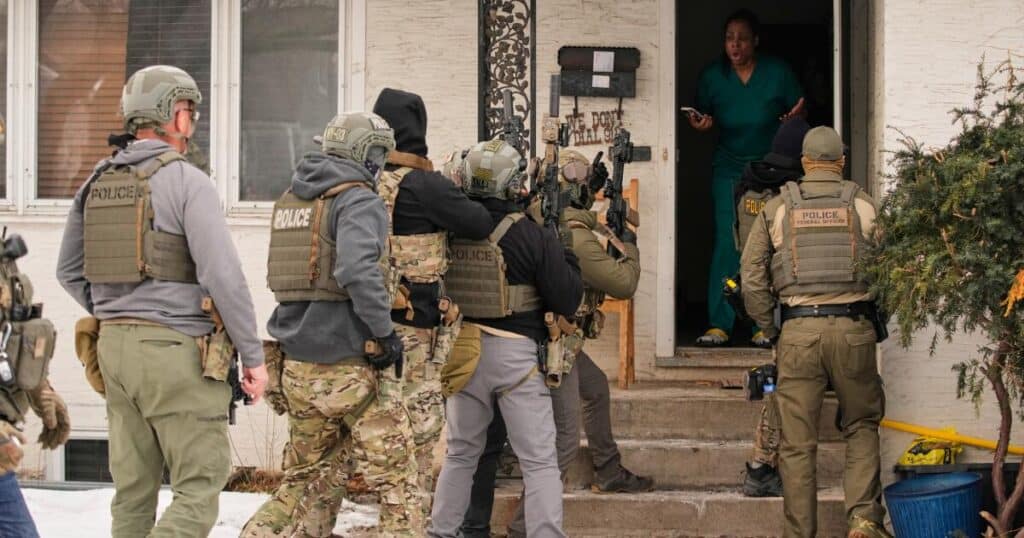
WASHINGTON — Democratic lawmakers and constitutional rights experts expressed outrage after reports that U.S. Immigration and Customs Enforcement officials had written a memo stating that deportation agents are allowed to enter immigrants’ homes — by force, if necessary — without a judicial arrest warrant.
The internal memo authorizes ICE agents to forcibly enter a residence to arrest someone as long as the agents have an administrative warrant with a final deportation order.
Administrative warrants are internal documents issued by immigration authorities and are not signed by judges. Arrest warrants are court orders based on probable cause that a crime has been committed.
Government critics say the memo, first obtained by the Associated Press, represents a reversal of longstanding guidance that aimed to adhere to constitutional limits on government searches. Immigrants have long been advised not to open their doors to agents unless they see a warrant signed by a judge.
Sen. Richard Blumenthal (D-Conn.), a member of the Senate Judiciary Committe, demanded an investigation into the new policy, which he said should “appall every American.”
Blumenthal, expressing his concerns in a letter Wednesday to Homeland Security Secretary Kristi Noem and acting ICE Director Todd Lyons, said the guidance constituted a “flagrant disregard for the lawful protections that have safeguarded the American public and our democracy for the last 250 years.”
Trump administration officials, including Vice President JD Vance, on Thursday defended the guidance as appropriate and legal.
WhistleblowerAid.org, an advocacy group, submitted a complaint to the U.S. Senate over the memo’s guidance this week and released a copy of the May 12, 2025, memo. The memo appeared to be signed by Lyons, though his signature could not be independently verified.
The whistleblower group’s complaint was based on information provided by two government officials, who say the policy violates the 4th Amendment’s guarantees against unreasonable search and seizure.
The whistleblowers alleged that the memo wasn’t widely distributed, but that some agents were verbally briefed on the contents; others were allowed to see the memo but not keep a copy. New ICE hires are being trained on the memo’s guidance, the whistleblowers said in their complaint.
Tricia McLaughlin, assistant secretary for public affairs at the Department of Homeland Security, responded to the Associated Press report in a statement on X, saying, “In every case that DHS uses an Administrative warrant to enter a residence, an illegal alien has already had their full due process and a final order of removal by a federal immigration judge. The officer also has probable cause.”
Immigration judges are employees of the Justice Department and cannot issue judicial warrants.
An earlier post on X by the Homeland Security account stated that if an immigrant with a final deportation order refuses to leave, “they are a fugitive from justice.”
WhistleblowerAid.org special counsel David Kligerman said no court has found that ICE agents can enter homes without a judicial warrant. He believes the agency kept it hidden because it won’t withstand legal challenges.
“It’s a fundamental 180 degrees from where DHS has been under a lot of administrations,” he said in an interview. “But the guidance has been clear and unwavering: you need a judicial warrant to enter a home, period.”
Kligerman pointed to remarks Thursday by Vance, who said Thursday in Minneapolis that “our understanding is that you can enforce the immigration laws of the country under an administrative order if you have an administrative warrant…That’s our best faith attempt to understand the law.”
Vance, appearing to expect a legal challenge to the new policy, added that “if the courts say no, we would follow that law.”
Kligerman said Vance’s comments were troubling, and that he worries the ICE memo is part of a broader push to strip immigrants of their constitutional rights.
The ICE directive comes as the Trump administration has drastically scaled up immigration arrests across the country and sent thousands of officers to cities such as Minneapolis. Tensions there have flared particularly in the wake of the shooting death this month by an ICE agent of 37-year-old Renee Good, a U.S. citizen.
On Sunday, ICE agents broke down the door of naturalized U.S. citizen ChongLy “Scott” Thao, 56, with guns drawn and forced him outside into the snow barely clothed with a blanket covering his shoulders. Homeland Security said the agents were investigating sex offenders at Thao’s address, but they didn’t live there.
The memo states that ICE agents must knock and announce their identity and purpose, then give the residents a reasonable chance to act lawfully, before using “only a necessary and reasonable amount of force to enter the alien’s residence.”
“Although the U.S. Department of Homeland Security [DHS] has not historically relied on administrative warrants alone to arrest aliens subject to final orders of removal in their place of residence, the DHS Office of the General Counsel has recently determined that the U.S. Constitution, the Immigration and Nationality Act, and the immigration regulations do not prohibit relying on administrative warrants for this purpose,” the memo says.
Some Democrats reacted swiftly to the memo, using it as justification for voting against a bill to fund the department. The bill passed in the House 220-207 on Thursday, with seven Democrats breaking with their party to vote in favor of it.
On X, Rep. Juan Vargas (D-San Diego) wrote in response to the Associated Press article that ICE “is so beyond control,” and Rep. Doris Matsui (D-Sacramento) wrote “this is as unconstitutional and cruel as it gets.”
“I do profoundly disagree with their interpretation of the Constitution here,” said Kerry Doyle, who was a top attorney at ICE and Homeland Security under the Biden administration. “To take a legal interpretation that has been the foundation of the law in this area for decades and to turn it on its head like this I think is really problematic, both from a legal perspective but also just from a practical perspective. It isn’t something I would support or would have signed off on personally.”
Marcos Charles, ICE’s executive assistant director of Enforcement and Removal Operations, said during a press briefing Thursday in Minneapolis that agents “don’t break into anybody’s homes. We make entry from either a hot pursuit with a criminal arrest warrant or an administrative arrest warrant.”