- India’s climate transition is constrained by global and domestic financing gaps, as the recent Economic Survey highlights.
- The book, Financing Climate Action, shows how India’s climate action so far has relied largely on self-financing, policy incentives, and state-level initiatives, offering important lessons for future actions.
- It argues that meeting India’s long-term climate goals will require moving beyond traditional approaches. It offers several ideas, such as strengthening innovation, adaptation, and community institutions, among others.
- The views in this book review are that of the author.
In November 2024, I was in Baku to cover COP29, often called the “finance COP.” Countries were expected to negotiate climate finance, the flow of money from developed to developing nations. Several estimates were circulating. The largest developing-country bloc, the G-77 and China, had demanded $1.3 trillion annually. Developed countries, however, remained largely silent.
When I asked an observer about this approach, he said it was a strategy. Developed countries, he explained, would reveal their number at the last moment, leaving developing nations with little choice but to accept or reject it. With Donald Trump returning to the position of the President in the U.S., he added, the scope for ambitious climate action had anyway narrowed.
That is exactly what happened. On the final day of COP29, developed countries put forward a figure of $300 billion, which developing nations rejected. Negotiations ran beyond schedule, and the final decision was gavelled through in a manner that several countries questioned. India was vocal in the final plenary, citing unfair procedures in the adoption of the outcome.
Since then, India has raised the issue of climate finance on several occasions, including in the 2025 and 2026 Economic Surveys. The latest one, released on January 29, notes that “the current levels of climate finance fall short of the requirements of developing countries to meet their climate ambitions.” Highlighting the gap, it said the problem does not arise from a lack of capital, but from the disparity between where capital is concentrated and where sustainable development investments are most urgently needed. In 2023, global climate finance totalled $1.9 trillion, of which nearly $1.3 trillion came from private sources. More than half of this flowed to advanced economies, with China attracting another 30%, while developing countries, excluding China, received only about 15%, according to the survey.
These repeated concerns reflect the complex position India finds itself in. The country stands at a crucial junction. It aspires to become a developed country by 2047, which requires improving the living standards of billions of people. Its immediate priorities include infrastructure, poverty eradication, healthcare, and education.
At the same time, this transition must follow a path few countries have attempted before: shifting to a low-carbon economic model. India, with its billion-plus population, is central to the global effort against climate change. It is the world’s third-largest carbon emitter, even though its per capita emissions remain relatively low.
The journey is bound to be complex. For policymakers, the biggest puzzle is how to finance it. In this context, a recently published book, Financing Climate Action: India in a Global Context, offers ideas, practical experiences, and estimates that help readers understand how the financial architecture around climate action is evolving.

Edited by Mritiunjoy Mohanty, a retired professor of economics at the Indian Institute of Management (IIM) Kolkata, and Runa Sarkar, a professor at IIM, the book brings together 27 articles by domain experts, organised into six broad themes, spanning 439 pages. Published by Routledge, the book defines climate finance broadly as the flow of funds to activities that address climate change through mitigation, adaptation, and loss and damage, across sectors and regions. “Catalysing such (climate) action would require economic and societal adjustments, beginning with additional resource mobilisation, capital reallocation, and financing structures supported by state intervention, given that climate change is probably the biggest market failure the world has seen in a century…,” the editors write.
Insights from India’s transition
In 2021, India accounted for 6.8% of global carbon dioxide emissions, while its per capita emissions stood at 1.6 tonnes of CO₂, the book says. The country has committed to reducing the emissions intensity of its GDP by 45% from 2005 levels and to meeting 50% of its installed power capacity from non-fossil fuel sources by 2030. However, India is yet to submit its updated Nationally Determined Contribution (NDC) and is among the few countries that have missed the 2025 deadline. It has nevertheless announced its target of achieving net-zero emissions by 2070.
In the transition, every sector needs transformation. Saon Ray and others throw light on five key sectors, including energy, transport, industry, urban development, and agriculture, as central to India’s net-zero transition. The country will require cumulative investments of about $10 trillion by 2070 to meet its climate goals, as per a chapter by Kalpesh Gada and Neha Khanna.
So far, India’s climate action efforts are largely self-financed, Shivika Solanki and her colleagues write. “While global as well as domestic funds exist, challenging them effectively at the local levels remains a challenge. At the end of the day, climate action is inherently local…,” they note.
Several chapters in the book examine the scope of climate action at the local level and the fiscal constraints it faces. Solanki’s chapter, for instance, discusses Uttar Pradesh’s initiatives on climate-smart gram panchayats.
Another chapter by Pranav Prakhyat Garimell and others discusses the experience with State Action Plans on Climate Change (SAPCCs). In the first round, 25 states introduced SAPCCs, of which 13 alone required $71.4 billion. Six states have since revised their plans, with adaptation interventions in these states estimated to need around $5.5 billion between 2021 and 2030. One chapter, focusing on Maharashtra, also examines climate budgeting and tagging practices so far.
A chapter by Ajay Shankar explains the growth of renewable energy in India. He writes that between 2004 and 2014, the wind sector expanded at a compound annual growth rate of 24%, primarily driven by tax incentives. When the National Solar Mission began, tariffs stood at ₹17.91 per kWh in 2010-11. Competitive bidding later enabled India to benefit from the global decline in solar manufacturing costs.

Another chapter, by Swasti Raizada, examines how fossil-fuel subsidy reforms and tax policies have supported the growth of renewable energy. She writes that, through gradual reform of the fiscal subsidy on petrol and diesel and an incremental tax increase, India was able to create fiscal space to support the green sector. However, the coal cess (a tax on coal production and imports), which was partially channelled to a National Clean Energy and Environment Fund, was later subsumed into the GST compensation cess in 2017 and used to bridge state budget deficits. During the Covid-19 period, it was also used to repay central government loans, highlighting how well-designed climate finance instruments can be diverted to other pressing needs during fiscal stress.
Similarly, a chapter by Shantanu Srivastava and Vibhuti Garg highlights the challenges of energy efficiency for MSMEs. They wrote that India is home to 63 million micro, small, and medium enterprises (MSMEs), and that MSMEs account for 20-25% of the country’s energy consumption compared with large industries. They highlighted a credit gap of ₹20-25 trillion for MSMEs in India. The chapter highlights what has worked for MSMEs so far and suggests the need to create programmes that cater to their unique needs.
Together, these chapters show how India has advanced in climate action, while also revealing the limitations of existing approaches. The examples discussed here offer only a glimpse. The book goes deeper, equipping readers with fresh data, analysis, and perspectives on India’s transition journey.
New thinking on climate finance
Beyond offering a unique perspective on historical facts, the book’s chapters explore several dimensions of climate finance, including governance, financial instruments and mechanisms, carbon markets, green investment banks, innovation, and many others. It examines how these elements can help mobilise the scale of finance required for climate action.
For instance, a chapter by Shailesh Vickram Singh highlights the role of innovation. He questions large financial estimates, arguing that they often do more harm than good. “These enormous estimates often make climate finance discussions seem infeasible, which in turn stifles investment in emerging climate technologies, eliminating the possibility of allocating resources to innovation and alternative solutions that could effectively address climate change,” he writes. To support his argument, he cites the expansion of telephony and banking services in India. Both appeared unrealistic in the 1980s, but technological innovation led to paradigm shifts that exceeded even the most ambitious expectations. He makes a case for building ecosystems that support innovation.

Similarly, Vijaya Mahajan focuses on adaptation and resilience and argues that India’s share of global climate finance will remain far below its actual investment needs. He suggests that corporations and governments have limited capacity in this area, and that civil society institutions will play a crucial role. He calls for strengthening local social institutions and self-governance systems. His chapter highlights the contribution of households, farmers, and non-farm micro-entrepreneurs to adaptation, regeneration of natural commons, and water conservation. “In this model, aggregated microcredits for carbon sequestration and emission reduction, or AMSERs, will be able to help mobilise finance needed for the adaptation and resilience efforts,” he writes.
Many other chapters offer similar insights, providing readers with multiple entry points to understand the nuances of climate finance and to view their surroundings through a climate lens. Together, they create a rich and layered perspective on the subject. At the same time, the book primarily addresses readers who are already seeking a deeper understanding of climate finance. A general reader may find it difficult due to its technical nature and analytical style.
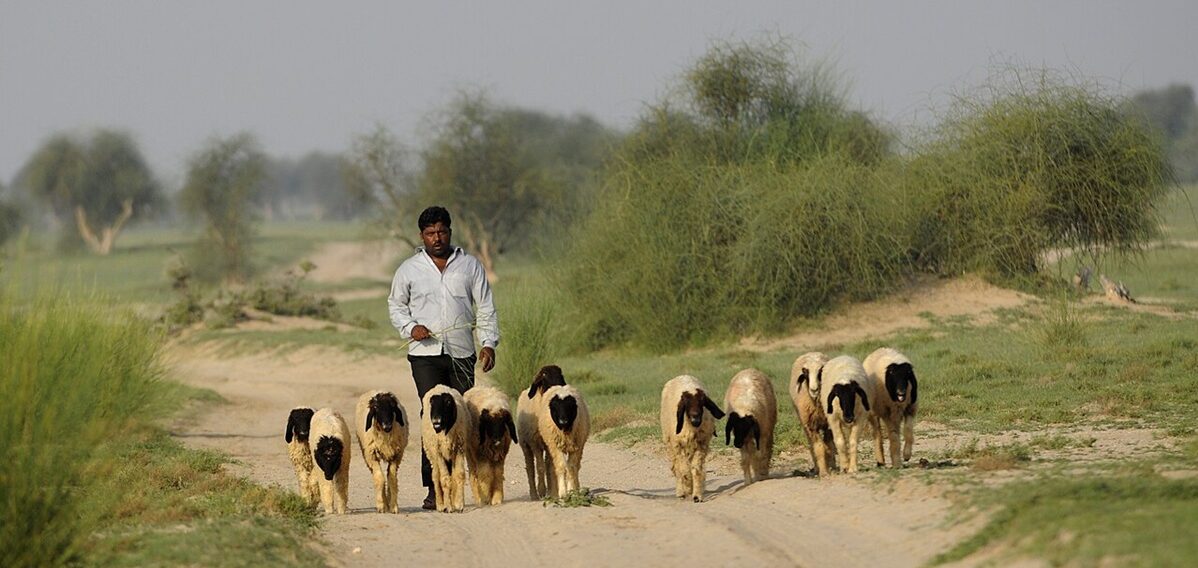
Banner image: Shepherd leading his flock in Desert National Park, Rajasthan. The Economic Survey highlights that adaptation, along with other crucial areas, remains underfunded. Image by T. R. Shankar Raman via Wikimedia Commons (CC-BY-SA-4.0).