
- As climate extremes intensify in India’s cities, migrant workers remain largely invisible in climate and social protection policies, deepening their vulnerability.
- While climate change is widely discussed as a driver of migration, its consequences for migrants at the destination, remain poorly understood or addressed.
- India has extensive social protection schemes, but gaps in portability, awareness and implementation mean migrants often cannot access them.
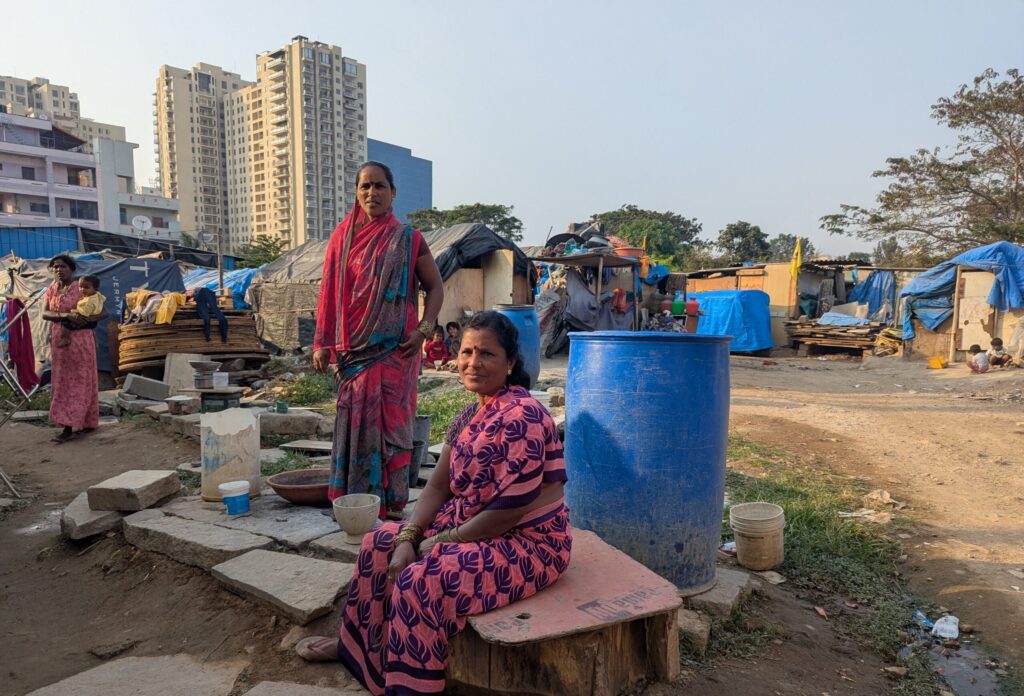
Sisters Rekha, 40, and Ratnamma. T, 50, left their village in Raichur, Karnataka, over a decade ago with their three children each. They had no work back at home. They were confident they would find something to do in Bengaluru, which registered a population growth of 40% between 2001 and 2011 to 8.5 million people. Today, an estimated 14.8 million people live in the city.
They became domestic workers and found a house in Maruti Layout on the banks of Anchepalya Lake in Jakkur, north Bengaluru. The dwelling, roughly 8×8 feet, has three brick walls and a roof made of materials including tarpaulin, metal boards, and corrugated cement sheets.
Similar houses surround their densely packed neighbourhood. Neither sister is fond of the nip in the air or the monsoons. The winters are too cold, and the summers too hot. When heavy rains arrive, the water from Anchepalya Lake pours over into the dusty pathways of the low-lying Maruti Layout. Freshwater, sewage and sludge mix. Mosquitoes breed. Infections and diseases follow.
Karnataka State Action Plan on Climate Change states that climate change means Bengaluru will have hotter summers, heavier rainfall, and more frequent drought.
Ratnamma is already feeling these effects. “In the summer, we can’t sleep. We sit out until midnight, hoping that a little breeze will cool us down. And during the rain, we can’t sleep because there’s water and mosquitoes everywhere,” she says.
“We are all migrants,” says Siji Chacko, Climate Innovations, Migrants Resilience Collaborative (MRC). “But what separates us is the vulnerabilities.” MRC is a grassroots initiative that works in the intersection of migration and climate resilience. A 2024 study by People’s Courage International (PCI) reveals that heat (77%) and excess rain (59%) are the primary weather extremes faced by India’s internal migrant workers at destination locations.
Migrants drive India’s development but are often missing from programmes meant to prevent climate-induced shocks, notes a report published in October 2025 by the International Institute for Environment and Development (IIED). In cities, migrants lack social safety nets to help improve their ability to adapt to adverse weather. Experts told Mongabay-India that efforts to understand how climate change affects migrants at the destination is still in its infancy.
Despite living for a decade in the city, Rekha says, “We don’t count among Bengalureans, do we? No one hears our issues.”
More than cash transfers
Ritu Bharadwaj, Director, Climate Resilience, Finance and Loss and Damage at IIED, notes that governments should “first acknowledge that migrants come to the city and they are very useful contributors to the urban economy. Cities can’t do without them.”
Data shows internal migrants make up 43% of the population in the city of Delhi, 42% of Bengaluru and 43% of Mumbai. In Bengaluru and Mumbai, most internal migrants are from within the same states. “From gig economy workers to household help, drivers, guards, everyone — cities cannot function without migrant workers. But they are never fully integrated into the city and live on the margins,” Bharadwaj says.
“Policies generally don’t mention migrants,” adds Aditi Apparaju, a researcher at the Indian Institute for Human Settlements (IIHS). “And if they mention migrants, they don’t mention climate. Where the two are mentioned together are very rare.” Apparaju co-authored a report that reviewed interventions at the national, state, and city levels for their social protection and adaptive capacities. The analysis examined policies and programmes in Karnataka and Kerala, including Bengaluru and Kochi. Out of 94 policies and schemes focusing on development, labour, and climate change, only five explicitly addressed both climate and migration. A few policies addressed the needs of internal migrants and helped build their adaptive capacities, the report published in August 2025 found.
Odisha is actively working to include climate-induced migration in its policy and Kerala has specific programmes for migrant workers. Karnataka, Tamil Nadu, and West Bengal also have cash transfer schemes aimed at covering vulnerable groups.
Cash transfers can help at the time of extreme weather events, explains Ameena Kidwai, leading research at Migrants Resilience Collaborative (MRC). For instance, Karnataka’s Anna Bhagya Yojna (additional ration) and the Griha Lakshmi scheme (cash transfers to female heads of poor households) can help migrant families tide over extreme weather events. “By enhancing and creating climate-responsive schemes, migrant communities have the capacity to deal with crises escalated by climate impacts,” Apparaju highlights.
Experts Mongabay-India spoke to said climate-responsive integration into social safety nets means reworking existing welfare and social protection programmes to recognise climate shocks such as heatwaves, floods, droughts and disease outbreaks as routine livelihood risks rather than occasional disasters.
This approach builds protection into everyday governance by triggering support when climate thresholds are crossed, ensuring benefits are portable for migrants. Bharadwaj explains that there are two ways to ensure social protection: longer-term resilience building and immediate support when a crisis hits: “Social protection is not just cash transfers: it is education, health, nutrition, housing, dignity.”
In a village, the rural household gets access to free mid-day meals, child care and nutrition, healthcare, and rural employment guarantee, among other benefits, from the government. However, once a person leaves the village in search of employment opportunities, these social safety nets vanish. The portability of these schemes is a major concern.

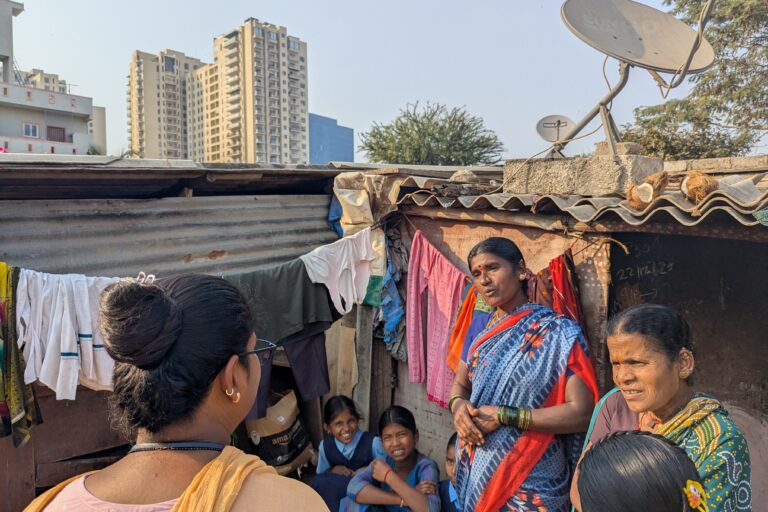
Kidwai says India has several social protection schemes meant to cover a substantial portion of the population. So, the idea is to add a climate lens to the existing schemes and ensure enhanced last mile delivery. While those like Rekha and Ratnamma who migrate within the state, continue to be eligible for several policies, those who cross state borders are not.
Benoy Peter, the Executive Director of Kochi-based Centre for Migration and Inclusive Development (CMID), gave the case of migrant workers in Kerala after the 2018 floods.
Kerala is a major destination for these workers because of relatively high wages in the informal sector. The state also offers several programmes and schemes for their welfare. Yet during the 2018 Kerala floods, they faced acute exclusion, for reasons that went beyond the mere existence of schemes.
Many relief camps discriminated against them; access to food, shelter, transport, and information was limited; and many workers were unable to return home due to a lack of money, documentation, or communication about transport options, shares Peter. Workers lost unpaid wages, were excluded from cash relief due to bureaucratic and documentation barriers, and received little support for safe clean-up, health protection, or disease prevention, he adds.
Peter, who co-authored the report Leaving No One Behind: Lessons From Kerala Disasters, says lessons that emerged from disasters that struck Kerala were — 1) initiating migrant-sensitive and inclusive disaster preparedness and response; 2) establishing dedicated institutional mechanisms for their social protection; 3) ensuring universal and portable access to social security measures, creating migrant-responsive grievance redressal systems; 4) actively partnering with civil society organisations to reach migrants where they live and work; and 5) developing multilingual, accessible communication strategies tailored to migrants’ languages, literacy levels, and mobility.
The IIHS report also called for transformative social protection, which moves away from the policies focused on assistance to those that address societal power imbalances using a rights-based approach, among other features. This is made possible through legislative change for “decent work, policy and regulatory controls on work timings or climate insurance,” which accounted for barely 6% of policies analysed.
Apparaju observes, “The thinking around social protection itself has not really evolved from something preventative to something transformative… It’s more about just responding to shocks right now.”

Constructing climate resilience
Poor wages and uneven availability of work pushed Kanabai. B, 40, to move to Bengaluru a decade ago. Back home in the Yadgir district of Karnataka, she earned around ₹100-200 a day, but in Bengaluru, she earns ₹500 per day as a labourer on construction sites. Her husband is a labourer, too. The construction sector employs an estimated 40 million migrant workers.
She lives with her three children. Like Rekha, she traded her living conditions for better wages. At the construction site, she gets an hour’s lunch break for her meal and rest. For the other six to eight hours she lifts heavy loads come rain or sunshine. “Yes, it is hotter in my village,” she said. “But here I feel exhausted in the summer. My body and head hurts.” There’s no time for leisure.
A 2025 study by researchers at Indian Institute of Technology, Gandhinagar and other international institutions, found that migrant workers are moving to urban centers in northern, eastern, and southern India which are witnessing increasing heat. The authors found that indoor and outdoor heat impacts workers’ productivity in these centres. This rise in heat stress has made it harder for workers to do their jobs, leading to a roughly 10% drop in their ability to work effectively. The authors called for urgent adaptation initiatives to protect migrant workers from the growing risks of heat stress as India’s cities continue to expand, and temperatures rise.
Construction workers in Karnataka are eligible for over 18 welfare schemes under the Building and Other Construction Workers (BOCW) Act, covering critical needs like healthcare, accident insurance, and scholarships for their children. While the Act doesn’t particularly mention climate, the schemes can help workers build resilience, explains Chacko of MRC. However, over 98% of workers are not enrolled in the BOCW, a 2021 study found.
Field workers like Heena Khouser with MRC, play a critical role in raising awareness and enhancing enrolments in such schemes. MRC has developed a mobile application called Resilience Connect, which enables field team members to register vulnerable households, assess their eligibility for social security schemes, and track their application status, Chacko explains. Through the app, the field officer can view some of the schemes which a particular individual an internal migrant is eligible for, Chacko says. Close to 7.5 million migrant workers have been assisted to access social security schemes.
When Khouser met Kanabai as part of her field work, she asked her if she or her husband had work place insurance. Kanabai was not sure. Khouser pulled out her phone, logged into the app, uploaded Kanabai’s details, and in a matter of minutes showed her the schemes she’s eligible for and those she was availing.
After a point the state (also) has limitations, Peter explains: “Employers are primarily responsible for the welfare of migrant workers, since they benefit most from the availability of labour.” Yet most don’t step in.
Field officers fill in the gap left by employers, and also help identify gaps in documentation and help the migrant workers with obtaining records, submitting applications and so on.
It turned out Kanabai and her husband were registered for schemes under BOCW but hadn’t used many of them, including possible scholarships for their children.
Apparaju says non-profits generally have the most holistic interventions with climate and portability considerations for migrant workers. They are able to make the cross-sectoral and inter departmental connections that are needed when working with migrant workers. But otherwise the most vulnerable are left out by government interventions. She says there’s a gap at the policy and ground level. But climate action and migrants’ adaptive capacity is non-negotiable in cities.
The author is a resident fellow at the Climate Change Media Hub, Asian College of Journalism.
Read more: A rural jobs law without a guarantee
Banner image: Rekha (left) and Ratnamma. T (right), are sisters and domestic workers who live in a low-lying migrant neighbourhood in Bengaluru. When it rains heavily, the nearby lake floods. Image by Mahima Jain.

