
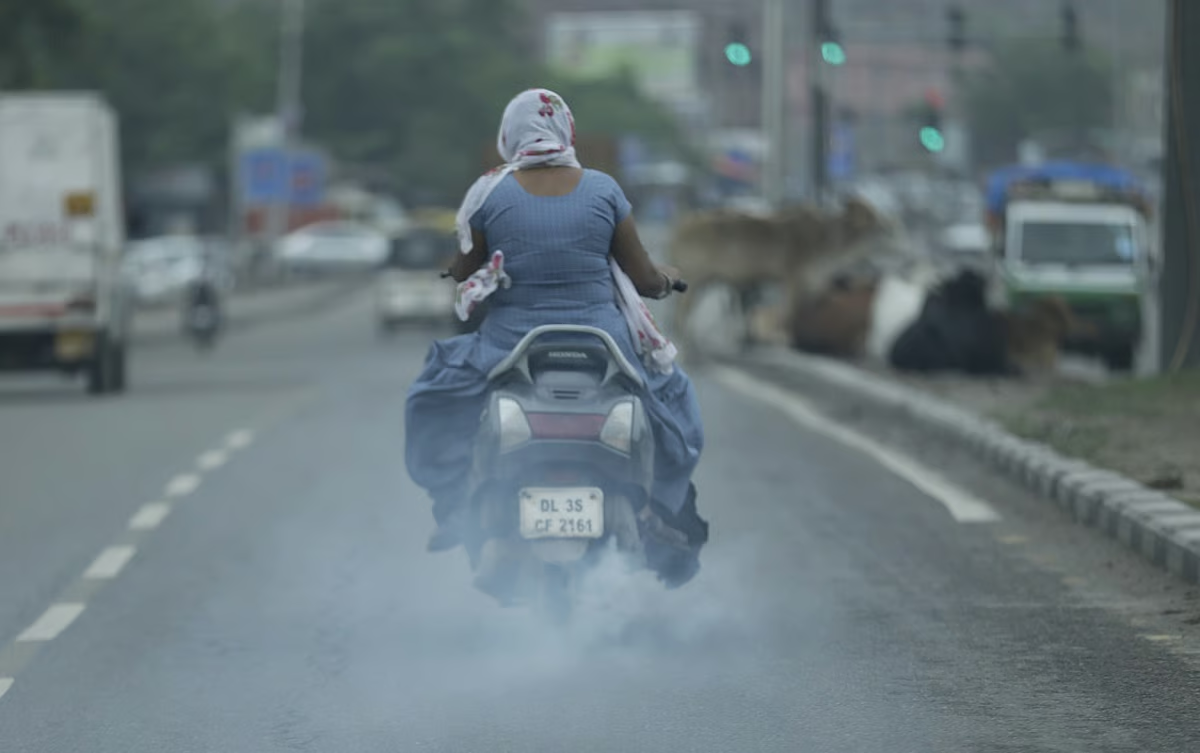
Delhi’s air quality discourse has long been dominated by seasonal explanations such as farm fires, unfavourable meteorology, and pollution blowing in from outside the city. While these factors do influence short-term air quality, emerging evidence increasingly shows that Delhi’s pollution burden is now largely self-driven, with local sources playing a growing and persistent role. Among these, vehicles are a dominant source of pollution, particularly during winter, when air quality is worst.
This shift has important implications for how Delhi frames its response. Episodic measures triggered during severe pollution episodes are insufficient when the problem is rooted in everyday mobility choices, vehicle growth, congestion, and fossil-fuel dependence. The data now points to a clear conclusion: Delhi’s air quality challenge is no longer episodic — it is systemic.
What real-time data tells us about local sources
One of the most important advances in recent years has been the availability of dynamic, real-time source contribution data through the Decision Support System (DSS) for Air Quality Management, developed by the Indian Institute of Tropical Meteorology (IITM). This system estimates the relative contributions of 29 pollution sources to daily PM2.5 levels in Delhi, distinguishing between local sources within Delhi and external contributions from the surrounding region.
CSE’s analysis of this real-time DSS data for the winter period from November 10 to 20 for three consecutive years, 2023-25, shows a striking pattern. When only Delhi’s local sources are considered — excluding pollution transported from outside — vehicles alone contribute more than half of the PM2.5 pollution, averaging 51-53 per cent of local emissions. This period was selected to study the peaks of stubble burning and to align with comparable data from three consecutive years.
This means that, even before accounting for regional inflows, Delhi’s pollution profile is overwhelmingly shaped by transport emissions. During winter, when dispersion is poor and the mixing height is lower, the impact of these emissions intensifies— especially during peak traffic hours.
Why DSS data matters — and what it does not replace
The DSS is not a substitute for detailed source apportionment studies, but it plays a crucial complementary role. Unlike one-time studies, the DSS provides continuous insight into trends, helping policymakers understand how different sources behave, especially during winters with unfavourable meteorological conditions.
What source apportionment and emission inventories have already established
Long before real-time DSS data became available, multiple source apportionment and emission inventory studies had already identified transport as one of Delhi’s most significant pollution sources.
Studies conducted by IIT-Kanpur (2015), TERI-ARAI (2018), and SAFAR-IITM (2018) estimate the transport sector’s contribution to the PM2.5 emission inventory at 20 per cent, 39 per cent, and 41 per cent, respectively. Across these assessments, vehicles consistently emerge as the largest combustion-related source and the second-largest overall contributor, after dust.
Notably, the IIT-Kanpur source apportionment study shows that during winter, when the city experiences its most severe pollution episodes, the relative contribution of vehicles increases further, as dust declines and combustion sources dominate.
Together, these studies leave little room for ambiguity: vehicles do not marginally contribute to spikes — they persist as a year-round source of pollution, with amplified impacts during winter.
CSE’s latest analysis: Delhi’s pollution is becoming more local
CSE’s analysis of DSS data for November 10-20 across 2023, 2024 and 2025 reveals a worrying trend. Delhi’s pollution burden is becoming increasingly local, even as regional inflow fluctuates.
In 2025, local sources contributed nearly 35 per cent of PM2.5, up from 27.3 per cent in 2024. At the same time, the contribution from surrounding National Capital Region districts declined from 36 per cent in 2023 to about 25.8 per cent in 2025. This indicates that Delhi can no longer rely on reductions in regional pollution to offset its own emissions.
Stubble burning, often blamed for winter smog, varies sharply year to year — rising in 2024 but falling in 2025. Notably, the increase in local pollution in 2025 occurred even though stubble burning contributions during this period were comparable to those in 2023. This trend confirms that farm fires act as a seasonal stressor rather than a consistent or dominant force shaping Delhi’s air quality.
What remains consistent is transport. Across years, vehicles contribute roughly 51-53 per cent of Delhi’s local pollution, making transport the single largest local source. In absolute terms, vehicular contribution peaked again in 2025, reversing the temporary dip seen in 2024.
Other local sources are also creeping up — residential emissions, construction activity, and waste burning show little improvement — but none rival the scale or persistence of transport emissions.