I could be imagining it, but there’s a mineral taste in the air as I wait on the platform below a blackened, tumorous slag heap – the remains of what was once the most lucrative mine in the world.
I’m trying not to think about the gruesome deaths of the 800 miners commemorated in a memorial at the top of Broken Hill’s Line of Lode – “Asphyxiated, Dynamite Fumes”, “Scalded”, “Crushed by Wagon” – some of them entombed in the mound, their bodies never recovered.
It’s 7.15am and I have arrived early for fear the scheduled departure on my ticket – 7.45am – is in Australian eastern daylight time.
Although Broken Hill is in New South Wales, it is so far west that it runs on South Australian time, half an hour behind the rest of the state.
The train, the 13-and-a-half hour Outback Xplorer to Sydney, is not one I can afford to miss, as it only runs once a week.
Although it turns out I am half an hour early, I’m not alone. There’s a woman sitting in the shade of the waiting train with a wheel-able display of Christian books and pamphlets, and a sign offering a free Bible study course.
“You’ve got to pick a warmer spot,” jokes one of the train attendants as they walk past (it is 12C).
“It was warm until the train pulled up,” she protests.
I’m in Broken Hill as a tourist, partly because of my love for the 1971 film Wake in Fright, based on Kenneth Cook’s 1961 novel and filmed here. At the start of the summer holidays, schoolteacher John Grant finds himself physically – and psychically – stuck in an outback town based on Broken Hill after losing his savings, including the cost of a Sydney air fare, in an illegal two-up game.
It’s a film about the dark side of the Australian national character but also, I would argue, about a lack of affordable regional transport.
The cost of air travel from Broken Hill, population 17,500, remains prohibitive, often hundreds of dollars for a one-way trip.
To drive to Sydney without stopping would take 13 hours. There’s a daily bus to Dubbo for $50, which offers a rail connection to Sydney, but it leaves at 3.45am. The more civilised Outback Xplorer costs $70 and lets you take in the sweep of NSW on the way.
It is the longest continuous route inside the state, spanning more than 1,100km. The $4,500 Indian Pacific service, Australia’s longest train journey, follows the same route on its way to and from Perth, but the Outback Xplorer is no-frills.
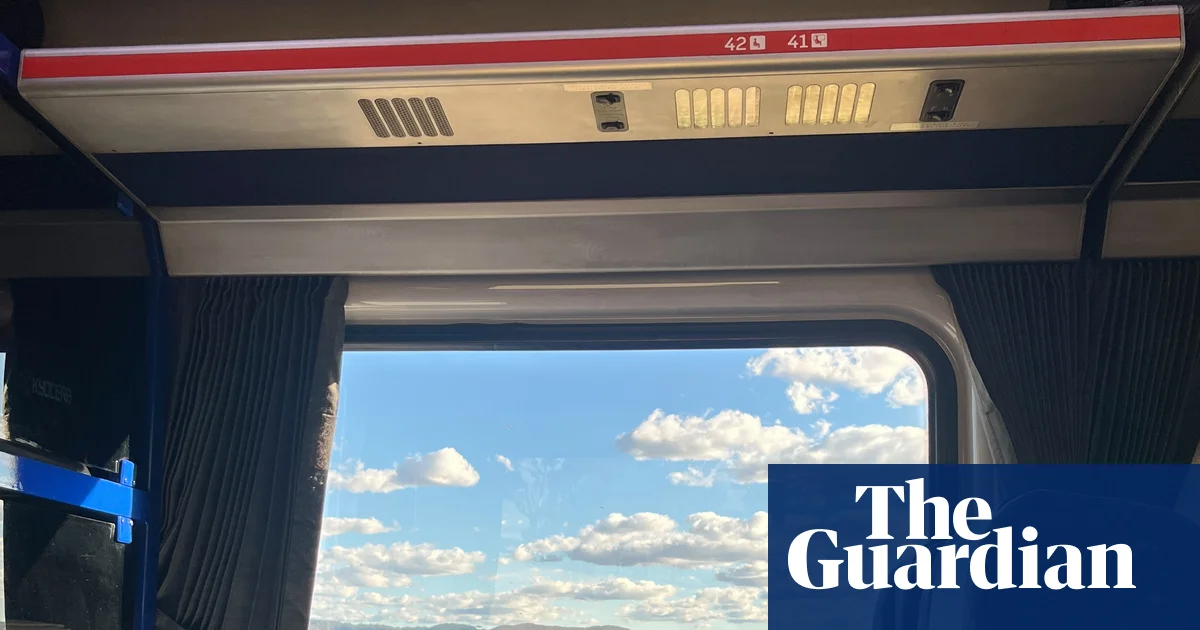
The carriages, due to be replaced from 2027, date from the 1990s. There are no charging outlets or onboard internet, and phone reception is limited. Armed with a portable charger, two apples and two bananas, and waved off by the woman with the Bible course, I depart.
Beauty … and boredom
The train brings passengers from Sydney into Broken Hill on a Monday night, before returning the next morning. The average occupancy for the service in the last financial year was 39% heading towards Sydney, and 48% in the other direction. The prospect of either a week in Broken Hill or a swift overnight turnaround for those who want to travel by rail in both directions seems like a hard sell.
It’s a situation Christine Adams, a former deputy mayor of Broken Hill and the curator of its excellent railway museum, describes as “absolutely ridiculous”.
In Wake in Fright, John Grant plans to spend a single night in the fictional town of Bundanyabba, or “the Yabba”.
Left without enough money for the train – which Cook’s novel says runs once a week, as now – and in an increasing cycle of drunken degradation, he makes a last-ditch attempt to hitchhike the thousands of kilometres to Sydney.
It is not the best advertisement for Broken Hill, which is undeniably worth a few days’ visit. For a start, you can now play two-up legally at the Palace Hotel, a location in another iconic film, The Adventures of Priscilla, Queen of the Desert.
The Silver City, the birthplace of the mining giant BHP, has attractions honouring its time as a boom town, with museums and ghost town tours, and its artistic credentials, with galleries, a desert sculpture park and Australia’s only Mad Max museum.
The council has unsuccessfully lobbied for a second weekly rail service.
“Pensioners could come out on Monday night and go out on Thursday morning,” Adams says. “It would be such a bonus to tourism.”
Nevertheless, an announcement on board welcomes back “frequent flyers” from yesterday’s service from Sydney, who have been in Broken Hill for less time than it took to get there.
An attendant explains that many travellers take the train for the view during the journey rather than the destination.
But locals also use the train, including my nearest onboard neighbour. Her children live in Melbourne, Sydney and on the NSW Central Coast. She says flights to Sydney and even to Adelaide (only 500km from Broken Hill) can cost from $300 to $400 one-way.
As we roll out of Broken Hill, an attendant who enjoys advising about the “rubbish receptacles at the end of the vestibules” a little too much, announces the menu in a transatlantic accent: “meat pies, plain and curry” and “sausage rolls, of course plain”.
There are several hot options, from $9.50 for the Moroccan chickpea curry to $13.50 for the roast pork with Diane sauce.
I settle for the safety of something heated up in cellophane: a plain sausage roll.
Apart from the odd miner or artistic-looking tourist, the demographic of my fellow travellers definitely skews older, as evidenced by a minor bomb scare when someone’s travel alarm clock goes off from the direction of the luggage rack.
While this light farce plays out, scenes of incredible wonder can be seen through the train’s dirt-streaked windows.
Sheep and wild goats flee from our path across a wide, shimmering plain. A red twister cuts through the desert. I see an emu that appears to be chasing a kangaroo, although they may just be running in the same direction.
There are brief opportunities to stretch legs, first at the romantically but inappropriately named Ivanhoe, where passengers are told not to wander off.
There are moments of intense beauty but also intense boredom. By the time we reach Condobolin in the central west at 12.30pm, having already traversed half the state, the first bars of reception in hours wash over me like a cool glass of beer.
I am ready to get off
The self-styled “Dubbo crew”, who stayed with the train overnight in Broken Hill, makes way for the “Sydney crew” at Parkes, the midpoint of the journey.
The landscape has already shifted subtly, as rough tracks became gravel and then asphalt roads, and red dirt is replaced by ploughed fields.
As the train winds gently through the hills and fertile valleys of the central tablelands, there are lush green pastures with highland cows.
At an unexplained pause outside Bathurst, a red fox retreats from beside the train to a creek, crouching in the long grass to watch until we pass.
For these moments alone, the trip is worth it, but maybe only once. About 10 hours in, I realise I am ready to get off and never get back on.
The Sydney crew are less colourful in their announcements and cooler in their manner. An attendant argues with a man who has moved seats.
My portable charger turns out to be dead, so I am subject to a second, self-imposed phone detox to conserve battery as the sun sets over the Blue Mountains. I turn to a book I haven’t been able to shift for almost a year, which I do not finish.
When I finally arrive at Sydney’s Central station on schedule at 9.30pm, the escalators take me down through shafts and tunnels cut into the rock for the new metro line.
Whisked away into the night at high speed, I’m struck by the contrast with the previous leg of my journey.
Tens of billions of dollars have been invested in making this final city stretch convenient – in 2024-25 the entire operational budget for the regional network, TrainLink, was $400m.
The transport department tells me limited rolling stock means a second weekly service is not currently being considered.
So if you’re travelling to Broken Hill, as in Wake in Fright, you may have to stay a while.