- Bengaluru pilots India’s first ward-level climate action plans, a core component of which has been public consultations and identifying projects that improve liveability.
- The pilot aims to translate high-level science-based climate action plans to co-created actions that citizens can own and that can be implemented by municipalities.
- Mainstreaming a climate lens into all infrastructure improves implementation, accountability and the possibility of funding for such projects, researchers note.
On a February morning earlier this year, residents of Jakkur ward in north Bengaluru, Karnataka, trickled in at the open-air podium outside the Jakkur Post Office. The residents — young, old, students, retired professionals, informal workers, building representatives — paused at maps mounted on easels and walls, and interactive audio-visual displays. The standees, videos and other signage at the venue announced: “Bengaluru Climate Action and Resilience Plan”.
This gathering was for one of the five public consultations for climate action at five different wards under the Greater Bengaluru Authority (GBA), the apex body responsible for coordinating and planning the city’s overall development and activities.
The climate action plan is being led by the Bengaluru Climate Action Cell (CAC), established in 2024, with support from C40 Cities, a network that assists cities in advancing climate action, and WRI India. It is also supported by several nonprofits, think-tanks, residents associations and consultancies as collaborators and technical partners.
Bengaluru started preparing a climate action plan as a part of its membership in the C40 Cities network. Bengaluru Climate Action Plan (BCAP) was launched in 2023, making it one of the first few Indian cities to have a plan compliant with the Global Protocol for Community-Scale Greenhouse Gas Emission Inventories (GPC). The BCAP follows a global standard. “Essentially, a city-level climate action plan is a top-level view of the city. It provides a robust evidence base comparable with peer cities and helps to set goals based on that evidence,” explained Shrimoyee Bhattacharya, the program head for Urban Development at WRI India.
However, launching a city climate action plan (CCAP) doesn’t always result in implementation. Chandra Bhushan, CEO of iFOREST, a non-profit that works on sustainability, said “CCAPs should be built through a ward-level action plan”, but this isn’t yet standard practice. While nearly 130 Indian cities are drafting heat action plans (HAPs) under National Disaster Management Authority (NDMA) guidelines, a 2023 review by the Centre for Policy Research found that only a few address community vulnerabilities or set localised thresholds.
CCAPs still remain broad. In 2025, the GBA became the first Indian municipality to pioneer the working of ward-level Climate Action Plans (WCAP). Besides gathering evidence from the ground-up, a core component of the Bengaluru WCAP pilot has been public consultations and identifying projects that improve liveability in the city. One ward from each zone was selected for the pilot: Shantinagar (Central), Jakkur (North), Begur (South), Vijinapura (East), and Nalwadi Krishnaraja Wadiyar (West) and the public consultation has been completed for all five wards.
The Bengaluru WCAP experiment unfolds as the city faces a major governance transition and impending municipal elections later this year. The city’s older administrative body had allocated ₹28 crores for climate action. But in 2025 there was delimitation of the wards and formation of the GBA with five zones. The new zone-wise budgets are yet to be released.
How ward-level management climate action works
BCAP is broad and has 33 action tracks and 266 actions across seven sectors including waste management, water and sustainable transport. The action tracks work as strategy baskets. For example, the sustainable transport sector includes the enhancement of non-motorised transport and walkability, the adoption of cleaner fuels, and making the transportation system more resilient to climate shocks.
The ward-level pilot aims to translate high-level science-based CAPs to “co-created actions that common citizens can own and understand and that can be implemented by municipalities. So, this is the bridge [that was needed] and that is how ward-level [action] emerged,” Bhattacharya said.
However, hyper local planning also throws up the challenge of establishing new methodologies and data collection at the lowest feasible city unit.

First, the CAC and partner organisations collected ward-level data such as local heat maps, flooding zones and air pollution numbers from various government departments as well as satellite data and GIS. Where possible, the data was combined with on-ground validation through field visits. There was a greater need for zooming into neighbourhoods and understanding their issues. This is where public consultations were introduced to address this gap.
Bhattacharya said that the ward level initiative seeks to also leverage lived experiences to validate top-down data. “When the local people participated, they visualised it from their lived experiences and validated or enhanced our understanding,” Bhattacharya added.
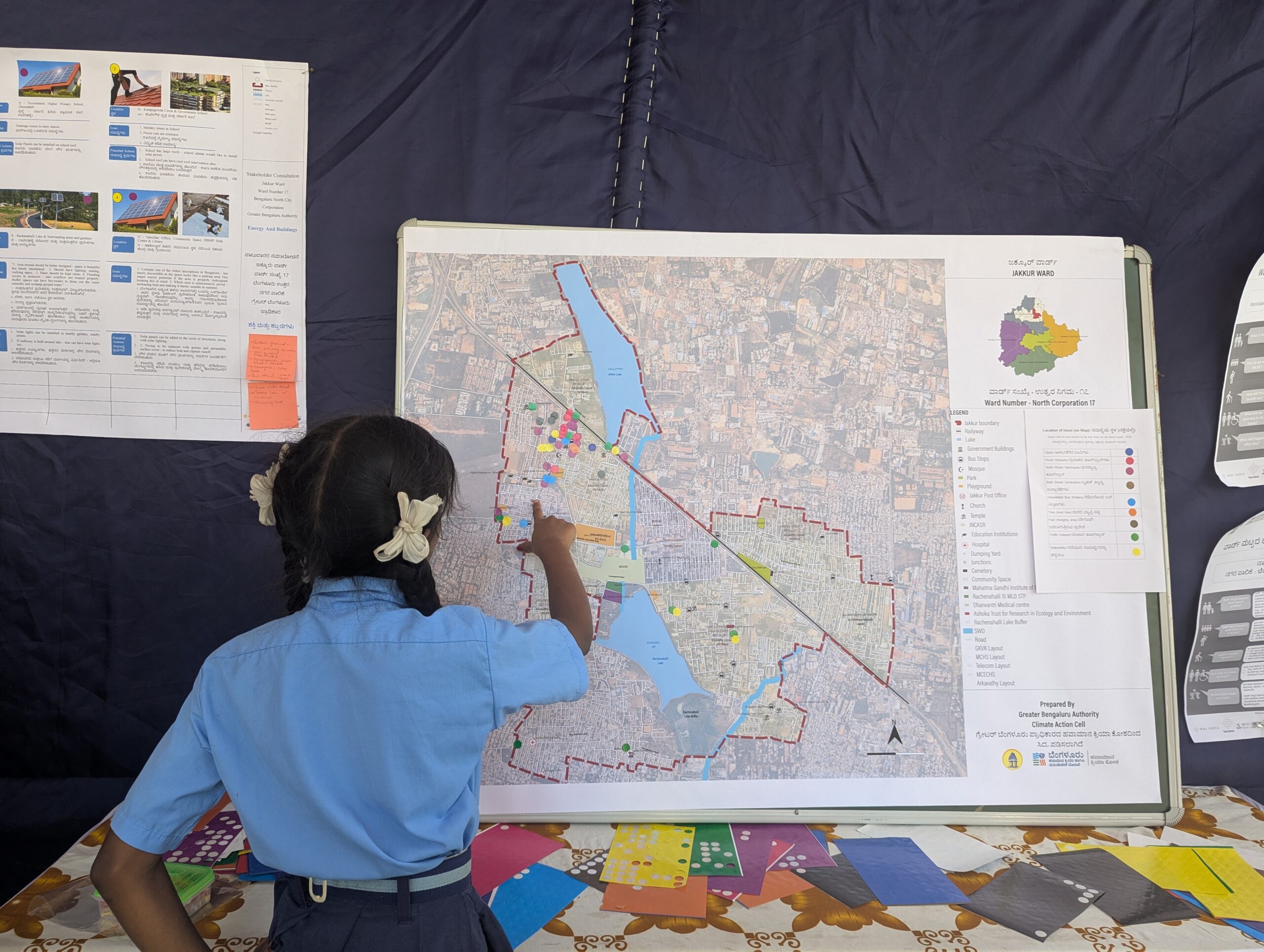
During the public consultation in Jakkur, the residents were shown large-scale city and ward maps. There was a ward map for each of the core sectors identified under the Bengaluru’s CCAP: energy and buildings, sustainable transport, waste management, water (potable water, wastewater and stormwater), urban greening and biodiversity, air quality, and disaster management. Relevant sector-experts asked questions and noted people’s responses to questions ranging from identification of their homes, streets, nearest bus stops, puddles and flood-prone patches, unlit streets, garbage dumps, sewage leaks, nearest water sources, public parks and more. Each response, including grievances, was turned into a data point.
NGOs and think-tanks working with CAC, found that citizens’ lived experiences became a corrective and grounding mechanism for technical data. “For common citizens or for the local body, any of the seven sectors are necessarily about liveability. Now, the WCAP essentially anchors the basic liveability issues and challenges with a lens of climate change,” Bhattacharya noted.
Citizens from marginalised and vulnerable groups – such as migrants, waste pickers, daily wage workers – were more concerned with day-to-day needs such as access to water, improved sanitation and transport systems, since their neighbourhoods lacked basic infrastructure.

Bouquet of actions
In an email interview with Mongabay-India, Ramachandran R, the special commissioner of finance, environment and climate change at GBA, after drafting a ward-level plan, has recommended that the CAC will become a nodal technical agency, supported by a Project Preparation Cell. This cell will maintain a “ready shelf of climate-responsive projects” that are technically vetted and ready for execution as soon as funding becomes available.
One of the central projects will be to “create blue-green urus” (blue-green towns). As part of this initiative, a combination of blue elements such as lakes, rivers, streams and other natural and constructed drainage channels, and green elements such as gardens, urban forests, and green roofs will serve as a buffer to climate change shocks.
Solarisation of municipal buildings is a start off point. Experts from the think-tank Center for Study of Science, Technology and Policy (CSTEP), anchoring the energy sector for the WCAP, identified that 80 GBA-owned government and municipal buildings consume 90% of electricity used by Bengaluru’s municipality. They can produce their own power through large-scale rooftop solar, offering significant potential for energy savings with zero upfront cost. Their estimated rooftop solar potential is approximately 6.2 megawatts.
Suhas Sathyakiran, an analyst at CSTEP, explained that buildings with massive roof spans, such as corporation head offices, ward offices, or for example the bus depot in Shantinagar, are ideal sites for implementation. Under current building bylaws in Karnataka, up to 70% of available roof space can be utilised for solar installations.
He strongly recommended the Renewable Energy Service Company (RESCO) model for government buildings. “In this setup, private developers invest in, install and maintain rooftop solar, meaning the government has zero capital expenditure,” he said. This model has been adopted by the municipalities of Delhi, Pune, Mumbai and Hyderabad.

The water problem
The water sector is complicated to tackle given Bengaluru’s paradoxical situation of excess runoff during monsoon alongside significant ground water depletion leading to recurring water scarcity in summer, pointed out Anam Husain, a programme associate for Urban Water at WELL Labs, a technical partner for BCAP. Flooding intensity varies across the city and is influenced not only by urban density but also by local geography and hydrology.
Jakkur, a rapidly growing suburb with relatively flat terrain and interconnected lakes, may experience less severe flooding than central areas such as Shantinagar. Shantinagar is a dense urban ward, but its vulnerability to flooding is linked to its geographical location. It is in a downstream valley zone. Hydrological analysis of the area conducted by Well Labs and Bengaluru CAC found that floodwaters originate beyond the ward, which also faces a critical shortage of green space, Husain shared.
Addressing flooding in Shantinagar requires a broader watershed perspective and coordination across multiple wards. “Nature-based solutions can play an important role in managing such hyperlocal flooding through decentralised interventions such as rain gardens, bioswales, permeable surfaces, and small retention systems that slow runoff and improve infiltration,” Husain added.
Similarly, ensuring potable water supply requires both short- and long-term strategies. While immediate needs can be met through tanker supply, long-term resilience depends on incorporating nature-based solutions for groundwater recharge, along with incentivising wastewater reuse and stormwater reuse, Husain said.

Challenges in accountability and funding
CCAPs and HAPs are generally advisory and technical documents, and not statutory plans. While not having statutory status gives these plans flexibility, it also creates ambiguity about how government systems deal with it, Bhattacharya pointed out.
A 2025 discussion paper on urban climate action published by the Ministry of Housing and Urban Affairs, noted the need for clearer institutional structures and better financing. Only eight cities out of the 13 reviewed, have established structures to monitor their CCAPs. Ramachandran noted that the next step is to translate priorities into “implementable and funded actions” by preparing ward level budget estimates that can be incorporated into municipal budgets.
Bhattacharya noted that a ward-level approach may or may not fit the needs of smaller municipalities that don’t have resources. “All cities should use localised methods to create implementable plans at sub-city level,” he said.
Bhushan added that development “should no longer follow” outdated rules. “While some actions focus purely on adaptation, others are simply better designed development projects.” Mainstreaming a climate lens into all infrastructure improves implementation, accountability and the possibility of funding, he added.
The author is a resident fellow at the Climate Change Media Hub, Asian College of Journalism.
Banner image: A student identifies her neighbourhood in Jakkur at the public consultations for the Ward-level Climate Action Plan in Bengaluru. Image by Mahima Jain.