
Simon Jack,Business editorand
Jonah Fisher,Climate correspondent
 Getty Images
Inspections without notice, regular MOT-style checks and compulsory water efficiency labels on appliances are among the key measures in the government’s overhaul of the water industry.
The government is describing the measures as the biggest overhaul of the water industry in England and Wales since privatisation.
Environment Secretary Emma Reynolds said there would be “nowhere to hide” for poor performing water companies.
The proposed changes come after widespread public anger at increasing numbers of pollution incidents, leaks and water outages that have affected thousands of customers across England and Wales in recent years.
“We’ve had a system whereby water companies are marking their own homework,” Reynolds told the BBC.
“This has been a whole system failure,” she said. “A failure of regulation, a failure of regulators, of the water companies themselves.”
The Water White Paper promises to set up company-specific teams to monitor, supervise and support individual firms and their particular issues rather than rely on a “desk based, one size fits all” approach.
Smart meters and mandatory water efficiency labels on appliances including dishwashers and washing machines will also help households monitor their usage and costs, the government said.
It is also creating a chief engineer role at the regulator that will be set up to replace Ofwat.
Government officials have told the BBC that the establishment of a new regulator may take a year or more and water companies say it will take time for the benefits of new investments to be felt.
The government’s reforms come after a review by Sir Jon Cunliffe, who issued 88 recommendations to improve the industry.
However, he was asked not to consider whether to nationalise the sector, which was privatised in the late 1980s.
Campaigners said the proposed reforms did not go far enough.
River Action chief executive James Wallace said the measures showed the government “recognises the scale of the freshwater emergency, but lacks the urgency and bold reform to tackle it”.
The new regulator must be “truly independent” and properly funded, he warned, and said major gaps remain.
“None of these reforms will make a meaningful difference unless the failed privatised model is confronted head on. Pollution for profit is the root cause of this crisis,” Wallace said.
Surfers Against Sewage chief executive Giles Bristow said the government’s proposed changes were “frankly insulting” and fell short of much needed structural reform.
“The truth is glaringly obvious to everyone except this government. As long as the industry is structured to prioritise profit, the public will keep paying the price through soaring bills and polluted water,” he said.
Sir Dieter Helm, professor of economic policy at Oxford University, said the government had not wanted to explore nationalisation because its self-imposed spending rules have already been stretched to the limits.
“In addition to that, I think there’s a very sensible view around government that the government probably isn’t competent and capable to run these businesses,” he said.
“The government should think really quite carefully about this, because if they’re supervising the companies, and something goes wrong, whose fault is it?”
Problems in the beleaguered sector have been thrown into focus recently after tens of thousands of South East Water customers were cut off for several days both before and after Christmas.
Mike Keil, chief executive of the Consumer Council for Water (CCW), said the “miserable disruption” underlined the importance of “meaningful change” in water regulation.
A new, powerful ombudsman service would also be welcome, Keil said, given CCW has had a 50% increase in customers asking for help with complaints relating to their water provider.
“One of our key asks of the Independent Water Commission was to make our existing voluntary ombudsman service mandatory, as this is vital to giving customers robust protection,” he said.
A spokesperson for Water UK welcomed the government’s white paper, and added “the focus must now shift from diagnosis to delivery.”
The spokesperson continued: “Our country will not have the environment it wants or the economic growth it needs until a new water regulator is established. Interim leadership should be appointed as soon as possible. We cannot afford for any more long-term decisions to be taken by a system everyone knows has failed.”
‘Proof in the river’

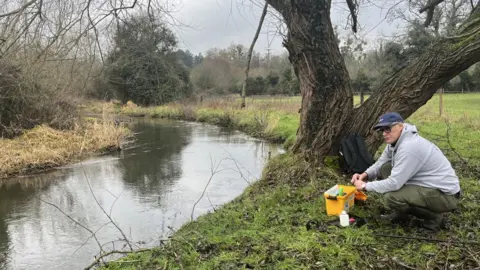
The River Pang in Berkshire is regarded by some as one of the inspirations for Kenneth Grahame’s Wind in the Willows classics. Its environmental status has deteriorated from “good” in 2015 to “poor” now, with campaigners blaming regular sewage discharges.
On the banks of the Pang, Pete Devery from the Angling Trust told the BBC he was sceptical of the government’s plans.
“I won’t hold my breath,” he said.
“The proof will be in the river. Do the rivers across the country improve? That’s the end result. Doesn’t matter what you call that regulator. It doesn’t matter how many regulators there are. If the difference isn’t made in the rivers, they will have failed.”
In 2024, water companies released raw sewage into England’s rivers and seas for a record 3.61 million hours, a slight increase on 2023.
Ageing infrastructure, wetter winters and drier springs and farming runoff into rivers and lakes have all contributed to poor water service and quality.
Ofwat is currently the water industry’s economic regulator for both England and Wales. In October 2025 the Welsh government said that when Ofwat is abolished it plans to form its own stand-alone economic regulator to replace it.
In 2025, water supply interruptions across England and Wales rose by 8% and pollution incidents by 27%, while customer satisfaction fell by 9%.
Average water bills rose by 26%, or £123 a year, from last April after years of below-inflation increases that some have blamed, along with high executive pay and shareholder dividends, on under-investment in the sector.
The sharp rise in bills is meant to address that under-investment by funding spending of £104bn over the next five years, more than 40% of which is earmarked for new infrastructure.