Ten years ago, I walked the route of HS2, the 140-mile railway proposed to run from London to Birmingham, to discover what lay in its path. Nothing had actually been constructed of this, supposedly the first phase of a high-speed line going north. The only trace was the furtive ecological consultants mapping newts and bats and the train’s looming presence in the minds of those who lived along the route. For many, it was a Westminster vanity project, symbolising a country run against the interests of the many to line the pockets of the few. People whose homes were under threat of demolition were petitioning parliament, campaigning for more tunnels or hoping the project would collapse before their farms, paddocks and ancient woodlands were wiped out.
The line, we were told a decade ago, would be completed by 2026. Like many of the early claims about the longest railway to be built in Britain since the Victorian era, that fact no longer stands. The fast train is running – very – late. The official finish date of 2033 was recently revised upwards. “The best guess is that it will begin with a ‘4’ when you can catch a train,” one well-informed observer told me. There’s similar uncertainty about its cost, but one thing is sure: it is catastrophically over budget. When complete, HS2 will almost certainly be the most expensive railway in the world. Nearly 20 years ago, HS1, the line from the Channel tunnel to St Pancras, was completed on time and on budget for £51m per mile (£87m in today’s prices). It was criticised for being twice as expensive as a high-speed route constructed in France. HS2 may cost almost £1bn per mile.
In 2020, construction formally began at last. The line is being built by HS2 Ltd, a government-owned company funded entirely by taxpayers’ money. A decade after my first walk, I retraced my steps beside the line. I wanted to find out what had changed for the landscape and its inhabitants, and see if this reshaping of middle England was better than people had expected, or even worse.
Day one: West Ruislip to the Colne valley, six miles
Since the line begins with 13 miles of tunnel from Euston, I started my walk where trains will emerge, beside West Ruislip tube station on the western edge of London. Over the next eight days of walking, I discovered that HS2 is the most beneficent railway in the world. What other company would lay on a minibus so schoolchildren can get to their summer jobs? Scatter rock-salt on cycle tracks so cyclists don’t slip over in winter? Buy a Christmas tree every year for a village bisected by the line? Build holts for otters? Add top-class catering facilities to a village hall that even the villagers didn’t ask for?
And yet some of those directly affected by the line, whose homes have been blighted or farms sliced in half, tell of the meanness of HS2 Ltd. Its negotiators are said to refuse to pay market rates for properties, or haven’t promptly or fully compensated small businesses. (HS2 said it aimed to offer “fair and timely compensation” for property, while considering cost to the taxpayer.) Just as HS2 cuts through the middle of England, so it may be a gauge of English politics and business today: democratic and remote, profligate and parsimonious, controlling and inefficient.
I followed the first of many “footpath diversion” signs out of West Ruislip, weaving through the now-derelict golf course borrowed by HS2 for various works. (The company has bought some land but taken “temporary possession” of much more. In HS2-world, temporary is a long time.) Clank-clank-clank. Jugga-jugga-jugga. Beep-beep-beep. The people living beside HS2 have endured more than half a decade of construction work.
Building a railway is not easy, especially somewhere as densely populated as England. Building a high-speed railway is even harder, because the route must be as straight as possible. Complex engineering solutions are needed to navigate the intricate lacework of southern England, its roads, rivers, railways, tracks, footpaths, woodlands and wetlands. After tortuous parliamentary approval, “enabling works” were permitted to remove trees and hedgerows and reroute roads and utilities. So many roads are being rerouted that one engineer described HS2 as “a road project with a train in the middle of it”.
The line includes 52 major viaducts and five tunnels, totalling more than 40 miles. These expensive feats of civil engineering are being undertaken by four consortiums, combining British building giants with European companies that have high-speed rail experience. By the end of 2025, the earthworks will be nearly 70% complete. Once the “civils” are finished, which HS2 does not expect for another four years, different firms must build the track, electrics, signalling and communications, and then trial the trains. Even testing a new railway takes years.
The only people I encountered on the first morning of my walk were HS2 contractors in orange PPE: sentries at access gates or strimming this or that. Employees are instructed not to talk to passersby. I passed a posse of yellow diggers, here to excavate a basin where flood water can collect. Several drivers were asleep in their cabs. It was midday.
An hour’s walk north-west, South Harefield village looked tired and dusty, its roads busy with tippers and other construction traffic. It was a relief to reach the green towpath of the Grand Union canal and Colne valley regional park, a broad mosaic of woodland, lakes and farmland which is the first significant green space west of London. Five years ago, campaigners built treehouses to try to stop HS2 from destroying a swath of the park. Back then, I visited their jolly, idealistic camp, but they were eventually evicted and pursued through the courts. Trees were cleared and construction began.
When I reached the pewter swoosh of the viaduct – 2.1 miles of concrete columns stretching high above the lakes of the Colne valley – I was surprised by its grace and slenderness. A paradox of HS2 is that its twin-track width is not much wider than a single-carriageway A-road but its construction gobbles up a much broader swath of land. The viaduct, the longest rail bridge built in Britain since the 1887 Tay Bridge in Scotland, had only been finished the previous week and its pale concrete was untarnished by graffiti. (The only graffito I saw that day was on a noticeboard beside a footpath. “Fuck the HS2,” it said. “The” is significant: for many, HS2 is the Man, the system, the establishment.)
This viaduct looked as fine in reality as it did in the artistic impressions of a futuristic railway that sold the original vision. Conceived in the final months of the last Labour government, HS2 was designed to sweep commuters between London and Birmingham in 49 minutes and on to Leeds (one leg of a Y-shape) or Manchester (the other leg) at 250mph – faster than any high-speed train in Europe, where the quickest operating speeds are just under 200mph. This vision, first proposed by Labour transport minister Andrew Adonis in 2010, was enthusiastically embraced by the incoming Conservative PM David Cameron. But later, as the bill became longer, the route got shorter, despite a government-commissioned review concluding it only made financial sense if built in full. The Leeds leg was axed in 2021; the Birmingham-Manchester leg scrapped in 2023. High speeds – and HS2’s potential track speed has been revised down to about 225mph and may drop further – become pointless over short distances so HS2’s rationale has changed: henceforth it will boost capacity and ease overcrowding on the rail network.
Miraculously, HS2 has retained cross-party backing throughout its troubled history, despite polls suggesting that public support has always been low. During my eight-day walk, I could not find a single person living near the line with a positive point of view. “Criminals. They’re all criminals,” said Sarah Turner, a resident in Buckinghamshire. “We hate it. It’s desecration,” said Christy Shrimp in Northamptonshire. “It’s a disaster and who is going to use it?” said Kyn Aizlewood in Warwickshire. “There are no green credentials. The distances aren’t big enough.”
After an easy two-hour walk across the park, I reached the South Portal tunnel entrance, where HS2 dives beneath the Chilterns, sparing 10 miles of this area of outstanding natural beauty (AONB). Here, I entered a vast construction site, overlooked by a multi-storey block of temporary cabins, and met Alice Williams, environmental manager, and Luke Craner, landscape clerk of works.
Three million tonnes of chalk from the now-completed Chilterns tunnel has been spread over arable fields, which has relieved thousands of lorries from trundling chalk around and created a 127-hectare chalk grassland with ponds in the hollows. They showed me around the slopes which, they told me, are alive with skylarks in spring and marbled white butterflies in summer. A new woodland of 30,000 trees planted in 2017, linking two ancient woods, had already grown elegantly tall.
Beside the River Colne, Williams and Craner showed me 14 ponds HS2 had dug alongside a strip of new wet grassland. These little ponds were already home to wading birds, dragonflies, mayflies and purple loosestrife and water-plantain. They were surrounded by “basking banks” for grass snakes, special two-tiered “water vole breeding banks” and five “kingfisher banks” of steep soil containing nesting tubes. Craner had set up a camera trap here; within one day, a kingfisher was seen perching on the edge of a tube. We also admired a huge square pile of sticks almost as big as a Mini – an artificial otter holt with drainage tubes leading into the river.
HS2 can’t win. It’s criticised for the extravagance of its environmental mitigations and also for the modesty of its “no net loss of biodiversity” target (most construction is committed to “net gain”). Craner argued the work beside the Colne showed it was going further for nature than it was legally obliged to do. “All the structures we’ve put in here are not compensation or mitigation, they are enhancements,” he said, pointing out mature trees that were earmarked for removal but were retained when the builders realised they didn’t need to take them down. “I feel lucky to work on this site.”
Days two and three: Potter Row to Waddesdon, 16 miles
The railway’s route bursts out of the tunnel into the Chilterns’ AONB by a long lane called Potter Row, and heads north to the pretty town of Wendover. It bypasses the town in a “green tunnel”, where the railway is cut deep into the ground and covered over with concrete hoops and earth. On my first visit, I’d met local resident Jacky Statham here, walking her norfolk terriers along a footpath. This time, the path was closed because of the construction work, so she gave me a tour of the Misbourne valley in her car. Ten years ago, she said, people feared the whoosh of high-speed trains. Now they can’t wait for the building work to cease. It’s thousands of lorries on local roads; floodlights illuminating once-dark rural skies; endless roadworks, traffic lights, diversions. “It brings out all the wrong emotions,” said Statham. “You see a man with HS2 on his back in the Co-op and you feel like hitting them.”
It is difficult, living with such upheaval. Clank-clank-clank. Jugga-jugga-jugga. Beep-beep-beep. I heard it walking through the Chiltern beechwoods and I heard it across the Vale of Aylesbury, where the chalk turns to mudstone.
Trudging in the rain, repeatedly diverted where footpaths were closed because of this epic, linear building site, was no fun until I found the Waddesdon Greenway, a four-mile cycle and footpath constructed from Aylesbury Vale Parkway railway station (on the existing London-Birmingham Chilterns line) to the National Trust property Waddesdon Manor in 2018. Even on a wet Wednesday there were joggers, coffee-clutching walkers, a rider on an e-scooter.
At the outset of HS2, a cycling and walking path running alongside the whole of the route was suggested. John Grimshaw, a civil engineer who has built hundreds of miles of cycleways, was commissioned to produce a report for the Department for Transport in 2013, identifying cycling routes from London to Manchester and Leeds. A works access road has been built alongside much of HS2 to enable contractors to reach work sites. It is six metres wide and “of very high quality”, said Grimshaw. He knows because he cycled along it – chased by HS2 security. “It’s the best road in Bucks. If it had been built just 10 metres to either side, it could’ve been turned into an end-to-end cycle path.” Instead the road, which he estimates has cost £200m-300m, will have to be dug up once the line is built. More millions “completely wasted”, said Grimshaw.
Day four: Bernwood Forest to Brackley, 19 miles
Ten years ago I met Christopher Prideaux, who described how HS2 would take 40 hectares of his land, divide his farms and swish past his very beautiful Grade II* Elizabethan manor house. Christopher died two years ago, still fighting HS2. His son David lives in their ancestral home in a rural corner of Buckinghamshire that was once the royal hunting forest of Bernwood. The ancient hedges here were as big as a train but they did not protect David, his mother, his wife and his children from a noisy building site.
David said HS2 were “very responsible about honouring rights of way. We in Britain are very respectful. We obey laws. If there’s a footpath there, you respect people who want to go on it even if there’s only two of them and it will cost £20m to put a bridge across it. Those two walkers will have their bridge.” He described the HS2 staff he dealt with as sincere. They were doing their best. “We are all just endlessly rolling with the punches,” he said. He was trying to count his blessings, which included: the worst will soon be over, passing trains will be mostly behind a bank of earth. And at least it is not a motorway.
David does not wish he’d sold up and left. “The house has been under single family ownership for 500 years. We’re not going to move out on the basis of a tricky couple of years.” But he did wish that the sacrifices he and his family were forced to endure were not for a massively truncated railway. “It should’ve gone from London to Edinburgh. High-speed rail is a great idea. The shorter it gets, the dafter it is.”
Walking close to HS2 proved impossible through the ancient forest of Bernwood, so I got a lift with Caroline Thomson-Smith to a farmyard where we could join a footpath to Sheephouse Wood, site of the infamous bat tunnel. Thomson-Smith was “a middle-aged, middle-class housewife-cum-hairdresser” before she was radicalised, in 2019, when she heard about a campaign by residents of Steeple Claydon to stop HS2 removing trees. “I was shocked and horrified by what I was hearing – not just the disregard that HS2 had for the law, the audacity, but the way the residents were being impacted: homes taken under compulsory purchase, land taken under ‘temporary possession’. They were powerless. They were downtrodden, depressed, stressed.”
Soon afterwards, in December 2019, contractors for HS2 entered Calvert Jubilee nature reserve and, without permission, removed trees that contained roosting bats. Thomson-Smith joined direct action campaigners. “We’d have family protests. We’d have children with us, and banners.” HS2 security wore balaclavas, which was “completely unnecessary”. In places such as Poor’s Piece, a fragment of ancient woodland close to where HS2 crosses the new East West Rail line, she believes direct action helped save some trees from the chop.
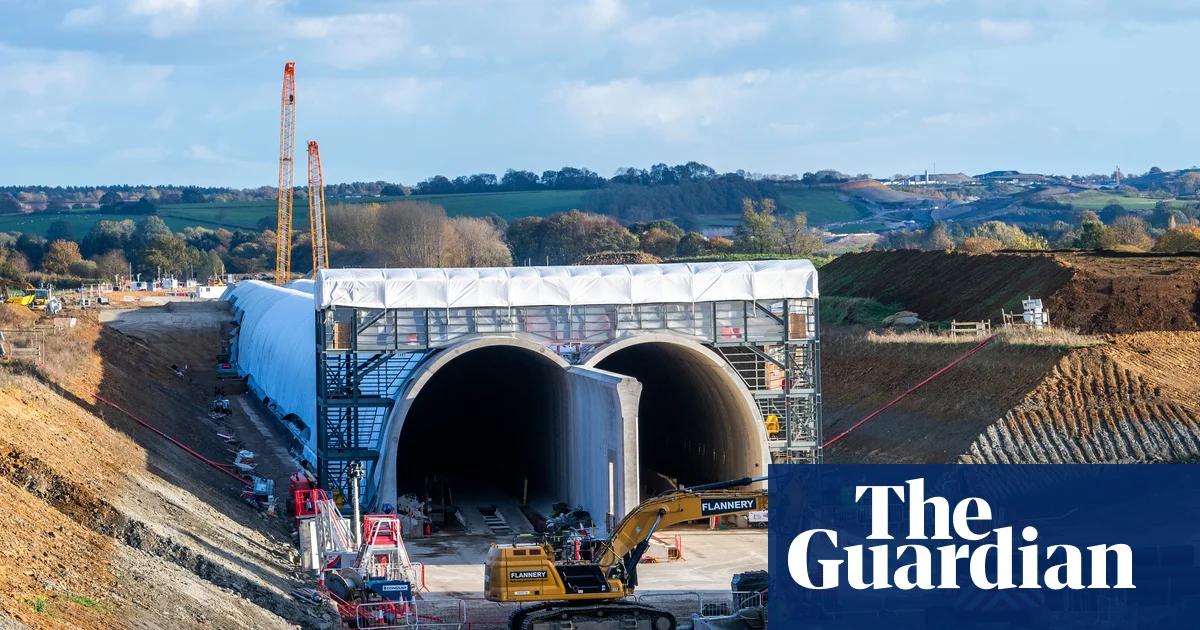
We walked through Sheephouse Wood to where the railway brushes its edge. Clank-clank-clank. Jugga-jugga-jugga. Beep-beep-beep. The wood has been designated a site of special scientific interest, a nationally important site, because its ancient trees are home to colonies of rare barbastelle bats. The high-speed trains will block foraging routes, which is why the railway is being covered as it passes Sheephouse. This bat tunnel was cited by Keir Starmer as an example of how environmental protections can hamper development. On the day I visited, curved concrete sections of the tunnel were being lowered into place by six cranes. The construction had left the edge of the wood a mess.
Mark Wild, HS2’s chief executive, has defended the tunnel, telling MPs that it was “not the case that the engineers have gone away with the fairies. These are engineering responses in some of the most sensitive bits of the country.” They couldn’t be avoided, he said, because of high-speed’s requirement for arrow-straight alignment. Yet the tunnel has even frustrated environmental campaigners. “They cut down bat roosts to build the bat tunnel,” Thomson-Smith said. “It’s maddening the way politicians talk as if it’s environmentalists that are causing money to be wasted.”
Supporters as well as detractors mostly agree on the causes of HS2’s spiralling cost. Wild himself believes the build began too early: HS2 should have spent much longer surveying and planning and then there would have been less muddle, revision and delay during the build. The initial “costs plus” contracts for construction were disastrous: a budget was agreed for each section, but rather than the standard penalties or agreements to split costs of unanticipated complexities, the government guaranteed it would pay almost all unforeseen expenditure. This didn’t simply remove the incentive for contractors to reduce costs – it incentivised overspending.
HS2 is now undergoing a “reset” under Wild, who did a similar troubleshoot on London’s Crossrail before its successful opening as the Elizabeth line. It is cutting more than 300 permanent corporate roles to become “a simplified, more cost-effective company” and is “relentlessly” focusing on “improving productivity, without compromising on safety”. A spokesperson said it was also “aiming to secure a better commercial deal with suppliers” that will reduce costs and increase productivity.
Many argue HS2 is proving so expensive because of its original aspiration to be faster than other European high-speed railways. This led to its very straight alignment, requiring expensive engineering – tunnels, cuttings and earth mounds – where it met villages or ancient woodlands.
The human costs of HS2 are also mounting up. As well as homes being demolished (including several hundred flats in Camden, north London), hundreds of farms have been divided by the line. Farm tracks have been closed for months or even years while replacement bridges are built. Near Sheephouse, I bumped into a cattle farmer of 54 years who said the HS2 construction work had displaced badgers living further down the valley. New badgers had moved on to his land and introduced TB to his cows. He lost a prize bull and a long bloodline of good cattle.
Close to where HS2 crosses East West Rail, I met Maggie Higgins, owner of Rosehill Farm, which, with its ancient wooden barns and orchard, must be the most scenic dog kennels in England. Higgins won a small victory in the summer of 2024. HS2 said a newly completed road bridge over the railway linking the farm to their local village of Steeple Claydon wasn’t ready to be opened, and the six-mile diversion could not be cycled by the schoolchildren who were working at the kennels over the summer holidays. Higgins asked if HS2 security staff could usher the kids on their bikes over the bridge at an appointed hour but HS2 said no. Eventually, it provided a minibus for the kids and other villagers, who could pre-book it to get around the diversion. “Sometimes the driver did nothing else all day,” said Higgins. “Isn’t that a waste of money?” (An HS2 spokesperson said: “That’s not a waste of money – that’s evidence of how seriously we took the impact of the closure on the local community.”)
Days five and six: Radstone to Southam, 20 miles
Beyond Buckinghamshire, the line flashed briefly into Oxfordshire and then through Northamptonshire, where the countryside became rolling fields of wheat and copses. I fell in love with this region when I walked through it a decade ago. Back then, I pre-emptively mourned the loss of peace I imagined that HS2 would bring.
This time, after my sixth day of walking, I spent a night in a converted stables on the farm near Chipping Warden in Northamptonshire belonging to Jazzy Banister, who farms with her father and mother. “Time is the main stress,” said Banister. “There’s a whole wall of HS2 paperwork in my office. They send you thousands of letters and there are meetings and you need an agent to help. There’s not enough time in the day to sort it all out.”
The Banisters’ farm has been severely affected by HS2 – the best land taken, fields divided, flooding, faff, constant disruption. And yet the wider landscape still looked beautiful as dusk fell. To the east, no houses or lights were visible, just fields, hedgerows and woods. To the west, HS2 glittered on the horizon like the vast encampment of an invading army. This place represented the miracle of much English countryside: there was still such beauty and tranquillity so close to major towns, roads, industry. Descending Frog Lane and crossing the boggy valley where HS2 will thunder into Warwickshire, I stumbled across a family of weasels, squeaking as they bounced into a hedge.
Day seven: Southam to Kenilworth, 12 miles
In leafy Warwickshire, HS2 tunnelled beneath Long Itchington Wood but refused to spare another ancient wood, Cubbington, which has been bisected by the line. I was taken on a tour by HS2 ecologist James Segar of the mitigation woods planted next to the line, and saw the miraculous survival of the stump of the translocated Cubbington pear, believed to be the second-oldest pear tree in the country. Its leaves were burnished with autumnal oranges and reds just as they were when I admired the original tree 10 years ago. Most Cubbington locals I spoke to still grieved the lost section of wood, but one spoke of her delight in finding bluebells and wood anemones blooming again in the soils that HS2 moved from the ancient wood. Translocating ancient woodland soil is dismissed by some conservationists as tokenistic but, in some landscapes, HS2’s scars are starting to heal.
Clank-clank-clank. Jugga-jugga-jugga. Beep-beep-beep. Ten years ago, north of Cubbington, I stumbled across Bob Edwards’ magnificent birds of prey in an aviary behind a cottage on busy Leicester Lane. He was a falconer with a smooth, deep voice like a radio DJ, and he feared the railway would prevent him from taking clients and his raptors on to surrounding farmland to hunt rabbits. He was now 80 and living, literally, in the shadow of HS2. A vast crane loomed over his cottage. Behind the cottage was a huge bank of earth for the rerouted Leicester Lane.
Edwards was one of hundreds of HS2-affected residents to petition parliament, standing before a select committee of MPs in 2016 to explain how his livelihood would be affected. The committee specifically asked HS2 to solve his problems. “In principle, I won my case,” he said. MPs told HS2 to “pay this man for what he is claiming and do it swiftly”, Edwards remembers. “There is no time limit on ‘swiftly’. They just did precisely nothing.”
As directed by the MPs, HS2 bought his home in 2019, and he now rents it from them. He stayed, initially, because he was still flying his birds. But HS2 taking over surrounding farmland has meant the rabbits disappeared and he could no longer practice falconry. His birds have died of old age, but he hasn’t been able to move house because his wife is seriously ill. “It would be a catastrophe to move her. It would kill her,” he said. HS2 offered him £16,000 for “loss of business” over 15 years, which Edwards said is far below his genuine losses. They haven’t managed to agree a final compensation figure. Why has HS2 been so slow to resolve his claim? Is the railway waiting for him to die? “It would appear so,” he said.
According to HS2, business owners must show evidence of loss of earnings. “We continue to seek a resolution to settle this claim,” said an HS2 spokesperson. “To support Mr Edwards, we suggested that he seek the support of an independent advocate to assist him in dealing with the process. An advocate was appointed in April 2025, the cost of which is being borne by HS2.”
Edwards seemed calm. “Boiling up wouldn’t do much good,” he said. “It’s just the way of the world. Joe Public doesn’t stand a chance. It’s all going against us but I’m a fighter and I absolutely abhor injustice.”
Day eight: Kenilworth to Birmingham, 11 miles
My final day of walking began on a misty morning, as I headed from the small town of Kenilworth towards Birmingham Interchange, the planned Birmingham-edge station that will be HS2’s first stop after London. I detoured via Kenilworth’s parkland golf course. The morning golfers, men of late middle age hauling clubs from the boots of sports cars, were sanguine. The line deferentially skirts the course, no damage done, except their mornings aren’t as peaceful. “You’d have to be a poor golfer to blame the [building] noise for your shot,” said one. He and his mate appreciated how HS2 built a new two-mile cycle path between the villages of Burton Green and Berkswell, and its maintenance crew even scattered rock salt in the winter to stop the path icing up. “Which other country would do that?”
It was a pleasant 90-minute stroll to Burton Green, the only village actually bisected by HS2. Its “Stop HS2” banners had disappeared; instead there was a banner saying “Save this view! No housing here.” I saw new houses going up all along the line; locals said the construction didn’t seem to put off buyers if the properties were 200 metres away.
Burton Green was home to a £2.5m village hall, built by HS2 after the old one had been demolished. Villagers obtained a vast, light-filled hall with blond wood floors and a catering-standard kitchen. This was not something they were expecting, said Cheryl Wall, who I met outside the hall. “That’s been the positive. The negatives are all the disruption – noise and traffic and the road being closed.”
I chatted to Chris Langton, a retiree, by the bridge that will take Burton Green’s main road over a 0.8-mile green tunnel where the line bisects the village. The threat of HS2 “really acted as a catalyst for the community”, he said. He got to know loads more people. HS2 is obliged to buy the homes of anyone wanting to sell within 120 metres of the line. It now owns about 36 houses in Burton Green. Those renting houses from HS2 tend to be younger, with families, said Langton, so that’s been good for the community, too. And HS2 buys the village a Christmas tree every year.
Buoyed up by his making-the-best-of-it attitude, I enjoyed strolling the ice-free HS2 cyclepath from Burton Green to Berkswell. But beyond Berkswell, I found the countryside slashed by a bewildering swirl of motorways, dual-carriageways, pylons, fences, factories and further construction. Squadrons of diggers and dumpers were turning greenbelt around England’s second city into brown and grey. A time-traveller from any previous decade would see this colossal, frenzied construction and assume the 2020s heralded an enormous economic boom. We would have to gently explain that this was a different stage of capitalism: all this striving mess for … virtually no economic growth.
I was forced into my car to reach Middle Bickenhill, the site for HS2’s Birmingham Interchange. Ten years ago, I found an elderly lady living on the lane here who felt “patronised and ignored” by HS2. The new station would be 200 metres from her home. Returning, I feared the worst. Surely her cottage would be abandoned, stranded in Arden Cross, a new development connected to the new station. The site was still earthworks, but developers were promising “thousands” of new homes, as well as shops and “a unique health-tech campus” that would represent “a £3.2bn opportunity to drive substantial growth”.
Clank-clank-clank. Jugga-jugga-jugga. Beep-beep-beep. My path was blocked where the lane was severed by construction work. An HS2 worker blanked me at the fence.
When I found the cottage, it looked lived in. I called out to a man working in a shed. Beaming, Darren Harding came over. The elderly lady was his aunt. She passed away a year ago. Since then, he’d spent almost every day renovating her cottage “as if she was still here”.
Here, finally, was someone who amid this ugly, destructive building effort could find their own peace, and sense of optimism. “I’ve been coming here since I was a lad,” said Harding. “I love it. You get to the top of the road and the world is 100mph flat-out going nowhere and this is a little bit of tranquil.” The other morning, he’d had three deer on the lawn and seven pheasants in the garden, whose mature trees and shrubs screen much of the building site all around. Owls visit at night.
He showed me around his careful restoration and the view of what will become HS2’s Birmingham Interchange from the upstairs bedroom. The train is “supposed to be silent so hopefully it will be”, he said. The cottage will become Harding’s retirement home. “Me and my wife can walk to Resorts World [a retail and entertainment centre] and have a meal, go shopping, but no one knows we’re here,” he said. “Although we’re in the middle of a building site, we’re maintaining a bit of heaven.”