
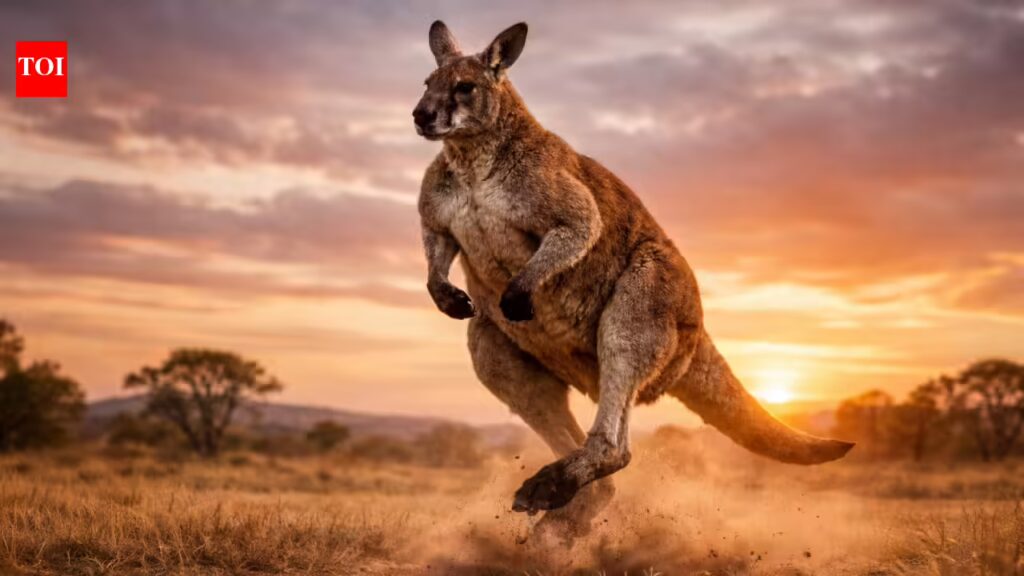
For decades, scientists have debated a simple question with a surprisingly complicated answer: could Australia’s extinct giant kangaroos actually hop like the ones alive today? Modern kangaroos are built for efficient movement, using powerful hind legs and spring-like tendons to travel long distances. But when ancient species grew to enormous sizes, some weighing up to 250kg, many researchers suspected their bodies would have become too heavy for hopping to remain possible. A new fossil-based study, however, suggests those heavyweight kangaroos may still have been capable of jumping on two legs, even if they did not do it as often or as far as modern kangaroos.
Kangaroo fossils bring new evidence to an old debate
The research was led by Dr Megan Jones from the University of Manchester and published in the journal Scientific Reports. Instead of relying only on modern kangaroo anatomy as a guide, the team examined fossils from extinct giant kangaroos themselves to evaluate whether hopping was mechanically possible at extreme body weights.The question matters because hopping is not just a signature kangaroo behaviour. It influences how an animal escapes predators, how far it can travel for food and water, and how it survives across changing landscapes. If giant kangaroos moved differently, it could reshape scientific ideas about their ecology and why they ultimately vanished.
Why size seemed like a deal-breaker
Modern kangaroos are able to hop efficiently because the Achilles tendon acts like a spring. With each landing, it stretches and stores energy, then releases it into the next jump. This helps kangaroos cover distance without burning enormous amounts of energy.But as an animal becomes heavier, the stress placed on the tendon rises sharply. Without major anatomical changes, a bigger kangaroo would risk pushing the tendon beyond safe limits, increasing the likelihood of damage or failure. That is why some scientists believed giant kangaroos may have been too heavy to hop at all.
What the mega-kangaroos looked like
To test the hopping question directly, the researchers studied fossils from multiple groups of giant kangaroos, including:
- Sthenurines, short-nosed browsing kangaroos that lived between about 13 million and 30,000 years ago
- Protemnodon, long-faced kangaroo relatives that lived between about 5 million and 40,000 years ago
- Giant forms of Macropus, resembling oversized versions of modern kangaroos
One of the most famous species examined was Procoptodon goliah, which is believed to have weighed up to around 250kg, far larger than today’s red kangaroo.
The key test was not just the tendon, but the bones too
Hopping is not just about having strong leg muscles. It depends on whether the body’s structures can survive repeated high-impact landings.The researchers estimated the strength of:
- the Achilles tendon, which is essential for hopping
- the fourth metatarsal bone, a relatively vulnerable bone in the hindlimb that could fracture if the forces were too high
Their findings suggested the giant kangaroo species they studied had bones strong enough to withstand hopping, and heel bone anatomy that could support a thick tendon capable of handling the load.
A thicker tendon does not necessarily stop hopping
Some earlier arguments suggested that thick tendons might reduce the spring-like efficiency needed for hopping. But the researchers say thicker does not automatically mean worse.They note that hopping animals alive today, including kangaroo rats, can have relatively thick tendons and still hop effectively, particularly for quick movement and escape rather than long-distance travel.This supports the idea that giant kangaroos may have been physically capable of hopping even if it was not their default way of getting around all day.The researchers are careful not to overclaim. Their study suggests hopping was feasible, not that giant kangaroos were constantly bouncing across Australia like modern red kangaroos.Other gaits, including walking or striding, may also have been used, especially in sthenurine kangaroos, which have been proposed in other studies to move in a more upright, tiptoe-like posture.
Why this changes the story of ancient kangaroos
Locomotion shapes everything about an animal’s life, from feeding range and habitat use to survival strategies. If giant kangaroos could hop, even occasionally, it suggests they may have been more mobile and adaptable than previously assumed.That matters for understanding their biology, their role in prehistoric ecosystems, and the pressures they faced as Australia’s climate and landscapes shifted.A 250kg kangaroo sounds too heavy to hop, but fossil evidence suggests these giants had the tendon capacity and bone strength needed to jump on two legs. That does not mean they hopped like modern kangaroos over long distances, but it does mean hopping was possible, and perhaps used when it mattered.For scientists, the study adds a crucial piece to the puzzle of how these extinct animals lived, moved, and survived in Australia’s ancient past.