The story so far:
In many ways, the spirit of 2025 for Indian foreign policy was “shock and surprise”, as the Narendra Modi government encountered several unexpected international challenges from a number of directions. At the end of a bruising year, what were the global stories that most impacted India, and what are the challenges and opportunities for South Block in 2026?
Which were the biggest global stories for India this year?
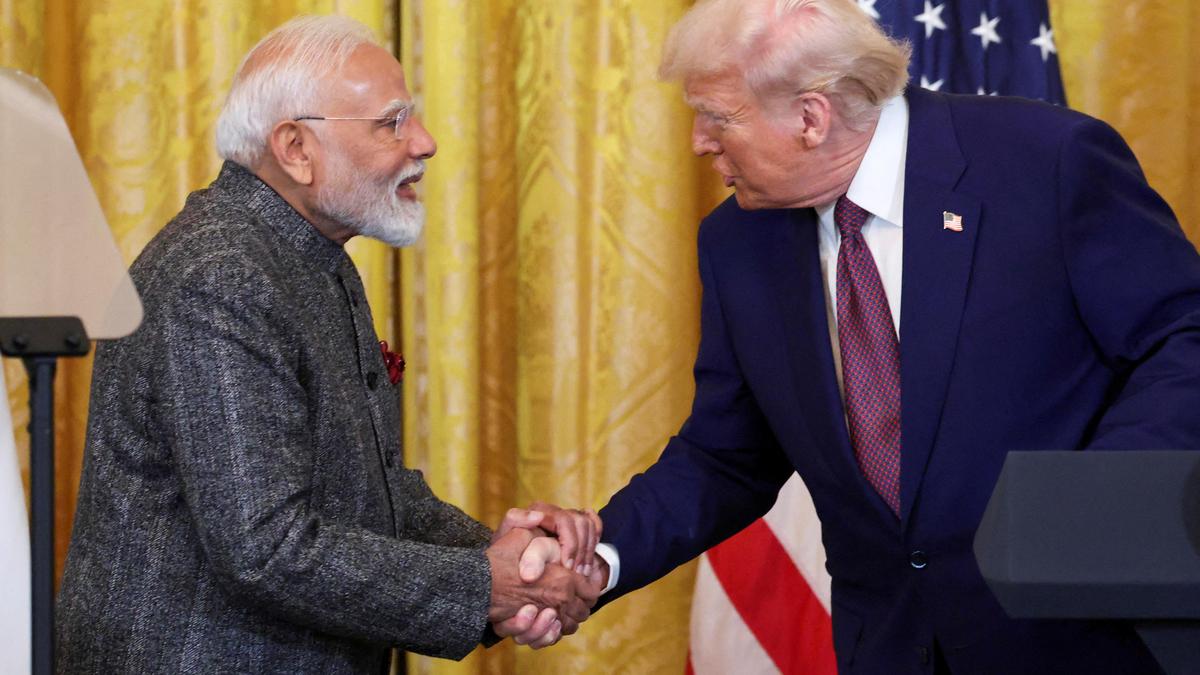
There’s no doubt that the most significant foreign policy story of the year came from Washington, where Donald Trump was sworn in as President for his second term in January. Mr. Trump’s policies have rocked the multilateral economic system with his “Liberation Day” tariffs which destabilised the world order. With his altered policies on Russia and China, once clubbed as the biggest threats to America, Mr. Trump rattled America’s closest alliances in Europe and the Indo-Pacific. He also took global discourse to a new low with his high-handed treatment of world leaders, even as he has commanded obsequiousness from them in his quest for the Nobel Prize for “resolving eight wars”.
While the U.S. election had the biggest impact, the rise of ultra-right politicians from European Parliament elections to Japan and Chile augured a growing conservative and xenophobic trend. Meanwhile, oil prices have dropped due to a glut in production by OPEC countries, indicating some worrying trends for the renewable energy push to combat climate change. Global growth is projected to slow from 3.3% in 2024 to 3.2% in 2025 and 3.1% in 2026.
The Russian war in Ukraine continued for a fourth year, but for the first time, India had to face severe economic consequences for buying Russian oil, with EU and U.K. sanctions on Indian-Russian joint venture Nayara Energy, and U.S. sanctions on Russian oil majors.
The Israeli strikes on Gaza continued, with over 70,000, including 20,000 children, killed, but an American-backed ceasefire deal at the end of the year held out some hope. India’s plans for the India-Middle East Economic Corridor, however, are at a standstill, and the Modi government’s refusal to criticise Israel for strikes on Iran in June led to awkward moments at the Shanghai Cooperation Organisation (SCO) and BRICS grouping, where Iran is a member. Closer home, turmoil in the region continued, with a conflict with Pakistan, Gen-Z protests in Nepal toppling the government, and mob violence in Bangladesh turning anti-India after the killing of a right-wing leader, putting a question mark over the efficacy of India’s “Neighbourhood First” policy.
What made the Trump challenge most difficult?
The U.S.’s altered worldview was felt acutely in South Block, where the Ministry of External Affairs (MEA) is headquartered, as the anticipation that Mr. Trump would run a pro-India foreign policy was cut short by his actions. Mr. Trump first slapped the highest 25% tariffs and 25% surcharge on India for buying Russian oil. His crackdown on immigration, H-1B visas, student visas and the deportation of Indian illegals, led to criticism of the MEA in India. Mr. Trump’s repeated claims that he had mediated the ceasefire of Operation Sindoor, hosting the Pakistani leadership at the White House and clearing F-16 supplies damaged New Delhi’s campaign against cross-border terrorism from Pakistan. The perception that Indian diplomacy failed during the conflict led to strains with Turkiye, Azerbaijan and Malaysia that were seen as supporting Pakistan. External Affairs Minister S. Jaishankar has been criticised for the downturn in India-U.S. ties; this, in spite of the fact that Mr. Jaishankar made at least six trips to the U.S. since Mr. Trump was elected.
What were the diplomatic successes of 2025?
Indian diplomacy racked up some notable successes, including a turnaround in ties with Canada, which had spiralled since 2023 over allegations that India oversaw the assassination of a Khalistani separatist there. Mr. Modi visited Canada to attend the G-7 outreach and agreed with the new Canadian Prime Minister, Mark Carney, to set aside their differences.
An unusual foray was made with the Taliban, long considered a terror group that took Kabul by force in 2021, and one that has targeted Indian diplomats and projects for decades. After a meeting between the Foreign Secretary and Taliban Foreign Minister Amir Khan Muttaqi in early 2025, relations quickly improved, and Mr. Jaishankar accorded full national honours and a warm welcome to Mr. Muttaqi in Delhi in October. Both sides moved past the embarrassment of a men-only press meet by the Taliban leader after Mr. Muttaqi held a more inclusive second press conference, but the government will have to contend with allegations that it is improving ties with Afghanistan by appeasing the restrictive and brutal anti-women regime. The downturn in Afghan-Pakistan ties and their bitter conflict, however, was a boost for Indian strategists as Pakistan faced the “two-front” problem, which India normally faces with China and Pakistan.
With Beijing, New Delhi kept up the rapprochement process begun when Mr. Modi and President Xi Jinping met in October 2024, reopening the Kailash-Mansarovar pilgrimage, restoring visas and flights between the two countries, and resuming the sharing of water data, and so on. Despite China’s strong diplomatic and military support to Pakistan during Operation Sindoor, Mr. Modi, Mr. Jaishankar and National Security Adviser Ajit Doval made visits to China to attend the SCO meetings.
Although ties with some of the neighbours frayed, New Delhi strengthened ties with Bhutan, Sri Lanka and the Maldives, all of which Mr. Modi visited in 2025.
India’s support to Sri Lanka after Cyclone Ditwah, in which more than 600 were killed, was particularly appreciated, as was its aid of $450 million.
What is expected in 2026?
Diplomats and trade negotiators spent much of 2025 working on bilateral trade agreements, of which the BTAs with the U.K., Oman and New Zealand were sealed. But the larger deals, with the U.S., the EU, Australia, EAEU (Eurasian Economic Union), GCC (Gulf Cooperation Council), ASEAN and others are still pending, and they expect to have some breakthroughs at the beginning of 2026.
In January, EU Commission and Council Presidents Ursula Von Der Leyen and Antonio Costa are expected to be the guests for Republic Day, when the India-EU free trade agreement is expected to be finalised. New Delhi will follow the results of elections in Myanmar (December 28), Bangladesh (February 12) and Nepal (March 5) closely, each of which has implications for South Block. In February, India will host the Artificial Intelligence Summit, where more than a dozen international leaders are expected, including French President Emmanuel Macron, and in March, Canadian PM Carney is expected to make a visit to discuss trade, critical minerals and nuclear energy.
All eyes are on whether Mr. Trump will finally travel to India for the Quad Summit, which New Delhi has been unable to host for two years, and on his visit to China, possibly for the APEC summit. Later in the year, leaders of BRICS, including Russian President Vladimir Putin and Chinese President Xi, will be invited to the BRICS Summit. Mr. Modi will be invited to the G-20 Summit on a Trump property in Miami in December, just after key mid-term elections in the U.S. After a year of geopolitical turmoil in 2025, Indian foreign policy makers will hope for a New Year of fewer surprises, and a more realistic and tempered assessment of India’s diplomatic options is in order.
Published – December 28, 2025 02:31 am IST