
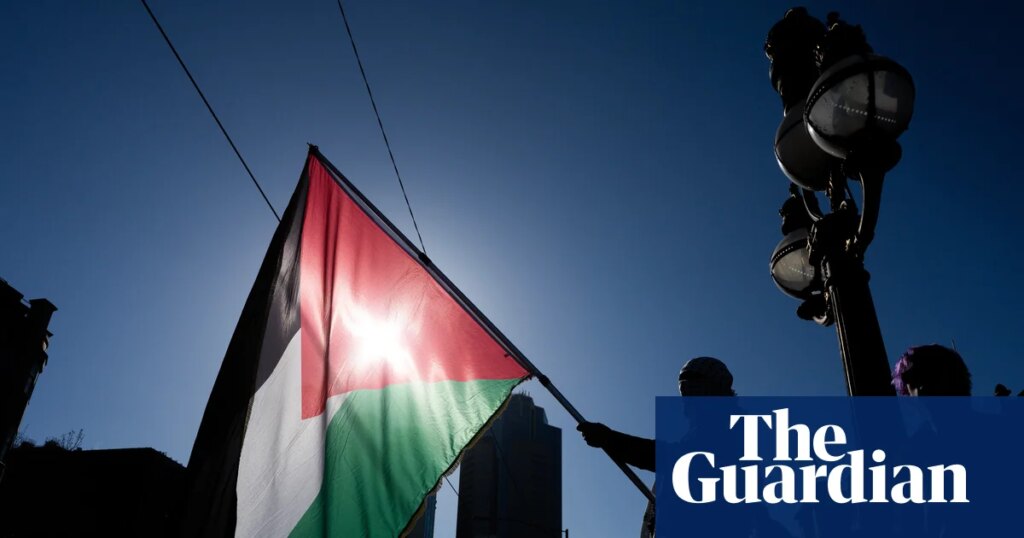
The proposal has divided opinion, reflecting controversies in the UK and the US over the same phrase.
So why has this phrase become such a flashpoint? Here’s what you need know.
What is the NSW government proposing?
In the wake of the Bondi mass shooting, the state government has moved to limit protest rights and ban the display of hate symbols.
Hate speech laws will also be extended, with Minns singling out the phrase “globalise the intifada” as “hateful, violent rhetoric”.
Minns says he intends to ban the phrase and has linked its use to the terrorist attack in Bondi.
“You’ve seen what the consequences of globalising the intifada are,” he said on Monday. “It’s the deaths of 15 innocent people on the beaches of Bondi beach simply for practising their religion in a peaceful way.
“I strongly believe that we have to do everything we can to ensure that words that are said at a rally are not used by somebody at a later point for violent retribution on city streets and that means drawing a line in the sand and saying that this phrase used in this context can lead to violence.”
Details of how the phrase will be outlawed remain unclear after the hate speech proposal was absent from legislation introduced to NSW parliament on Monday.
A NSW parliamentary committee will investigate “hateful statements”, including the phrase, in further hate speech laws to be introduced next year.
What is an intifada?
Intifada is an Arabic word that translates to uprising or “shaking off”.
Two uprisings against Israel in the past four decades are known as the first and second intifadas.
Sign up: AU Breaking News email
The first Palestinian intifada occurred between 1987 and 1993. It began in December 1987 after an Israeli truck struck two vehicles in Gaza, killing four Palestinians. The event sparked unrest and brutal reprisals from Israeli forces.
While figures vary, estimates suggest at least 1,300 Palestinians and 100 Israelis were killed by the end of the intifada.
A second, more violent, intifada began in 2000 and continued until 2005.
The former Guardian correspondent Ewen MacAskill wrote that while the “enduring image of the first [intifada] is of Palestinian youths throwing rocks at Israeli soldiers”, the second intifada was “a full-scale confrontation, with Israel attacking Palestinian cities and towns with artillery, tanks, helicopters and jets while Palestinians fought back with rifles and explosives.
“Palestinians ambushed soldiers and settlers in the West Bank, making roads a risky venture, especially at night, and terrorised Israel by sending suicide bombers across its border to attack bus stops, cafes, hotels and anywhere else that was crowded.”
More than 3,000 Palestinians and about 1,000 Israelis were killed, according to a database maintained by the Israeli human rights group B’Tselem.
What does ‘globalise the intifada’ mean?
Josh Lees, organiser for the Palestine Action Group, says he characterises it as an expression of solidarity with Palestinian resistance.
“It’s a basic act of us supporting the uprisings of Palestinians against their oppression, against illegal occupation and genocide,” he said on Tuesday.
Mamdani said it wasn’t language he used or would use but that he interpreted it as an expression of support for Palestinians.
Pro-Palestine supporters and civil rights groups have condemned the Minns government and others for conflating protests against the Netanyahu government’s actions in Gaza with the Bondi shooting.
But many in the Jewish community, such as Australian Centre for Jewish Civilisation’s director, David Slucki, say it is an “offensive” and “threatening” phrase.
“Intention and impact are two separate questions, and I think it is worthwhile recognising the impact, especially when the impact is harmful and threatening,” he says.
The founder of the Online Hate Prevention Institute, Andre Oboler, who also served as an expert for the federal government’s delegation to the International Holocaust Remembrance Alliance, says there is “no context” in which the phrase should be used.
“The phrase is anti-peace, pro-violence, and specifically pro-terrorism,” he says. “[It] should have been banned a long time ago.”
But Liyana Kayali, an expert in Middle Eastern studies at the University of Sydney, says the discussion is being steered by non-Arabic speakers who fail to understand the word’s meaning. A ban risks further disunity in Australia, she says.
“We’re forgetting about how such moves are received by the communities that use these terms, because they’re received as attacks – attacks on their language, history, and their legitimate calls for struggle against oppression, and that does a great deal of harm,” she says.
Should we ban specific words and phrases at all?
Some academics have warned against banning phrases with contested definitions.
Luke McNamara, a hate speech expert at the University of NSW, says it is dangerous to outlaw phrases with contested meanings. He says the phrase means different things to different people and a ban is likely to lead to court challenges.
“We need to be very careful about locking in a particular interpretation of a contested phrase and making that automatically criminal,” he says. “That, to me, is a problematic development.
“It will be either over interpreted, under interpreted, or found by a court not to constitute promoting hatred. I don’t think that level of specificity is a good way to frame the criminal law.”