- Urbanisation is rapidly changing landscapes, but little is known about its impact on smaller, less charismatic species such as frogs or toads.
- A new assessment in Bengaluru, looks at urbanisation’s impacts on frogs and toads.
- Researchers discuss the need to shift the focus from aesthetics to function while planning cities, and the need for citizen science to maintain data on frogs and toads.
In 1999, researcher S. Karthikeyan documented the fauna of Bengaluru, which included a list of 16 species of frogs. For a long time, this was the only documentation of the city’s anurans (frogs and toads) that people referred to. Now, over 25 years later, a comprehensive, multi-scale assessment of anurans in Bengaluru has documented 11 species. Anura is an order of amphibians comprising frogs and toads. Anura is an order of amphibians comprising frogs and toads.
While urbanisation is rapidly changing landscapes, little is known about its impact on smaller, less charismatic species such as anurans. “The process of urbanisation affecting biodiversity is well-known. There is a change in the ecological community, which may not always be a decline. But we lack such information about amphibians, especially from the Global South,” says Seshadri K. S., a Bengaluru-based researcher and lead author of the study, with the Ashoka Trust for Research in Ecology and the Environment (ATREE).
It’s estimated that more than half of the world’s population will live in cities by 2050, which makes documentation of urbanisation’s different impact on different species even more urgent, he adds.
There is a clear data gap staring people in the face, Seshadri says. During the COVID-19 pandemic, he collaborated with the study authors and decided to take action. “We wanted to go beyond a checklist of Bengaluru and do a systematic study so that there is baseline data that can support further research and help track urbanisation’s impact on anurans,” he says.
The authors also point out in the paper that most research on urban biodiversity continues to originate from the Northern Hemisphere. Hence, in the study, they emphasise the “urgent need to bridge this knowledge gap from the Global South.”
Impact of urbanisation on frogs
For the study, the authors divided Bengaluru’s area of approximately 740 sq km into 100 grids, and for the study, looked at 32 grids. The city’s central area shows the most built-up region, ranging between 60% and 100%. They found 322 individuals of 11 anuran species belonging to six genera and four families from the 32 sampling locations spread across the city.
They found fewer species within the city limits compared to outside it. Among the species, the common paddy field frog showed a dominant presence. “We expected to see the burrowing frog and the common bullfrog, but didn’t find any. When we see the presence of the skipper frog and the absence of the bullfrog, the question arises whether this is linked to resistance and adaptability, but we need a measure for that,” Seshadri says.
Talking about bullfrogs, Gururaja K.V., researcher primarily focusing on anuran behaviour and conservation, explains that they are known to be sporadic breeders. “If there is proper rain and good resources, they’ll just breed. They lay about a thousand eggs in one go, which typically happens once a year.” But he says that currently, these frogs are facing issues.
For breeding, there needs to be proper ground, and for the eggs to develop, they need quality water, which means water devoid of any pollutants. If there are pollutants, they can penetrate through the eggs because frog eggs are a very transparent, jelly-like kind of thing. “They can actually kill the developing embryos. Now, you don’t have such a habitat in the city, so bullfrogs might not be breeding, and if they are breeding, the eggs are not developing,” he explains.
Gururaja goes on to say that if people want to find the bullfrog, another way is to have a species-targeted study where every grid is searched and passive acoustic devices are used, which will take years. He also adds that the presence of more species on the outskirts is a “clear indicator of urbanisation’s impact on frogs.”
Moreover, the presence of anurans alone does not reflect their health. During their research, the authors found frogs in polluted water bodies, hopping around and catching insects. However, Seshadri says finding them in such an environment doesn’t indicate the anurans are doing well. In fact, it could be a lag phase. A lag phase, he explains, is the time before the effects of urbanisation are apparent on the species composition. The findings from this study show that the species richness is similar across levels of urbanisation, but at some unknown point down the line, the differences will become apparent, likely because of population crash.
“Habitat loss, pollution levels, and unsupportive landscapes could be affecting the frogs but have not yet been detected in species compositions. In the next few years, frogs in the city might end up having fewer and fewer offspring over generations. It might just be a matter of time before they disappear completely,” Seshadri explains.

Disappearing frogs in the city
Accumulation of species is known to be negatively impacted by increasing urbanisation, which the study also seems to indicate. Sarbani Nag, President of SAVE THE FROG! India, says that with urbanisation, first comes habitat destruction and then habitat fragmentation. Talking about her observations in her home city Kolkata, she says urbanisation and overpopulation have put anurans at risk.
“We develop a lot of connectivity so that we can travel smoothly, but the amphibians are not taken into account while building these structures. I have come across many anurans dying in roadkill,” she says.
People also tend to use pesticides in their gardens, which affects anurans adversely, she adds. “Over the years, I have seen toads in Kolkata, but I haven’t seen a single frog, which is worrying,” Sarbani says. She remembers visiting her father’s place in Kolkata about a decade ago and would always hear frogs croaking, but points out that, alarmingly, these sounds have now disappeared.
Gururaja also recalls a different time, about 30 years ago, when people in Bengaluru’s Madiwala region would complain that they couldn’t sleep because of frogs constantly croaking. “Now you don’t hear any,” he adds.
In a 2016 article, Gururaja noted that three of the 17 species of frogs that were once found in Bengaluru can now only be seen near the outskirts. Talking to Mongabay-India, he confirms that this number seems to have remained the same. However, he also points out that two new species have been described in recent years — Sphaerotheca bengaluru and Sphaerotheca varshaabhu, but in the city’s periphery, and not within its limits.

More focus on aesthetics instead of function
In 2008, the built-up areas in Bengaluru were much smaller regions, mostly in the centre, surrounded by lush green spaces that clearly dominated the city. Today, as the study’s map shows, the built-up area has almost swallowed the blue-green spaces. Concrete dominates the city.
“In the blink of an eye, habitat loss is happening,” Seshadri says. “There was a wetland near Parappana Agrahara Central Prison in Bengaluru. A while ago, we went there to do a recce, and a week later the area was filled with construction debris and had been levelled out,” he recalls.
Moreover, the wetlands that are being restored have prioritised aesthetics over biodiversity support, Seshadri adds. The paper points out that most wetlands within the Greater Bengaluru Area administration are restored by dredging, deepening the wetland, raising the bund around it, and creating a walking track on the bund.
“If you go to any lake in Bengaluru, it is a standard template. There’s an open lawn, shrubs of Duranta plants, then the stone embankments along the wetland and deep water, so frogs don’t have the habitat that supports them,” Seshadri says. When the lake is shallow, the natural vegetation leaves behind shallow puddles where the frogs can breed, he further explains.
Gururaja also points out that the restoration of wetlands is often seen as a “civil engineering project and not through the ecological lens.” In 2007–08, when the Bengaluru Development Authority was tasked with rejuvenation of lakes, in which crores were spent, they emptied all the water and the sewage and then put a retaining wall, which was cemented with boulders or similar big stones, he recalls.
“In one year, the lake went back to how it was: polluted. This is because they didn’t separate drainage from sewage. They made it look like a teacup where the edges are cemented, and there is a jogging path around it, but how is the lake’s biodiversity healthy? If you see from a frog’s perspective, there is no scope for habitat interaction,” he explains.
The study also points out that cities across the Global South can benefit from decolonising the laws governing cities and ensuring biodiversity conservation is explicitly included in master plans. Seshadri says planning of cities in Karnataka is still under the Karnataka Town and Country Planning Act of 1964, created six decades ago. “There might have been some minor amendments, but no fundamental changes,” he adds.
He further explains that the power of planning for the city should be with the urban local body, which is the Greater Bengaluru Authority (GBA). “However, GBA elections have yet to take place, and the Bangalore Development Authority (BDA) is planning the city. So, in these ways, we are still stuck with colonial governance.”

Need for documentation and citizen science
The study authors have also emphasised the urgent need to monitor anurans to determine trends and detect declines. While the species might still be found in the city, there isn’t much known about the effects of urbanisation on anuran diets, physiology, or the population structure. When it comes to amphibians, data deficiency is a big problem — a challenge that Gururaja, Seshadri, and Nag, all point out.
“We have started surveying areas for birds and have a lot of resources on them. But for frogs and snakes, we don’t have up-to-date information across India. If I want to compare the number and composition of anurans over 10 years in the same place, there is no baseline data available, which is worrying,” Nag explains.
In 2014, Gururaja started a programme, Frog Watch, to map amphibians across India based on photographs, call records, and videos recorded by citizen scientists and naturalists. In the last decade, the website has recorded more than 6,770 observations across India.
He also started FrogFind, an Android app based on his book Pictorial Guide to Frogs and Toads of the Western Ghats. “The intent is for people to look and engage with these anurans. So, the book was translated into an app. It’s currently being updated,” Gururaja shares.
Citizens and independent researchers have clocked in the data gap and have been documenting frogs in different cities. For instance, Amoghvarsha M., herpetologist and an independent researcher, documented frogs in Mysuru from 2018 to 2021. “There are over 100 species of frogs in Karnataka, but no field guides. The only documentation on anurans in Mysuru is a short note by scientist Dr. Pranjalendu Ray, who worked at the National Museum of Natural History,” he says. It was published in SPOTBILL, an occasional publication of the Mysore Amateur Naturalists, in May 1999.
In 2018, he started by looking for frogs at different lakes and photographing them, which he often shared on his Instagram page. He has found 18 species in his hometown, Mysuru. Amoghvarsha was also part of the team that worked on a citizen science website, Mysore Nature, a platform for people to record data on frogs, birds, and more. He is currently documenting frogs in Karnataka, including Bengaluru.
Gururaja says people’s movement is important to conserve frogs and maintain continuous quality data. “It shouldn’t be limited to the four walls of a research lab. It should open up to people in different cities. They should be documenting what is in their backyard, organising and participating in frog walks, and creating events such as bird counts, but for frogs,” he says.
Read more: Listening to frogs can offer clues to their decline [Commentary]
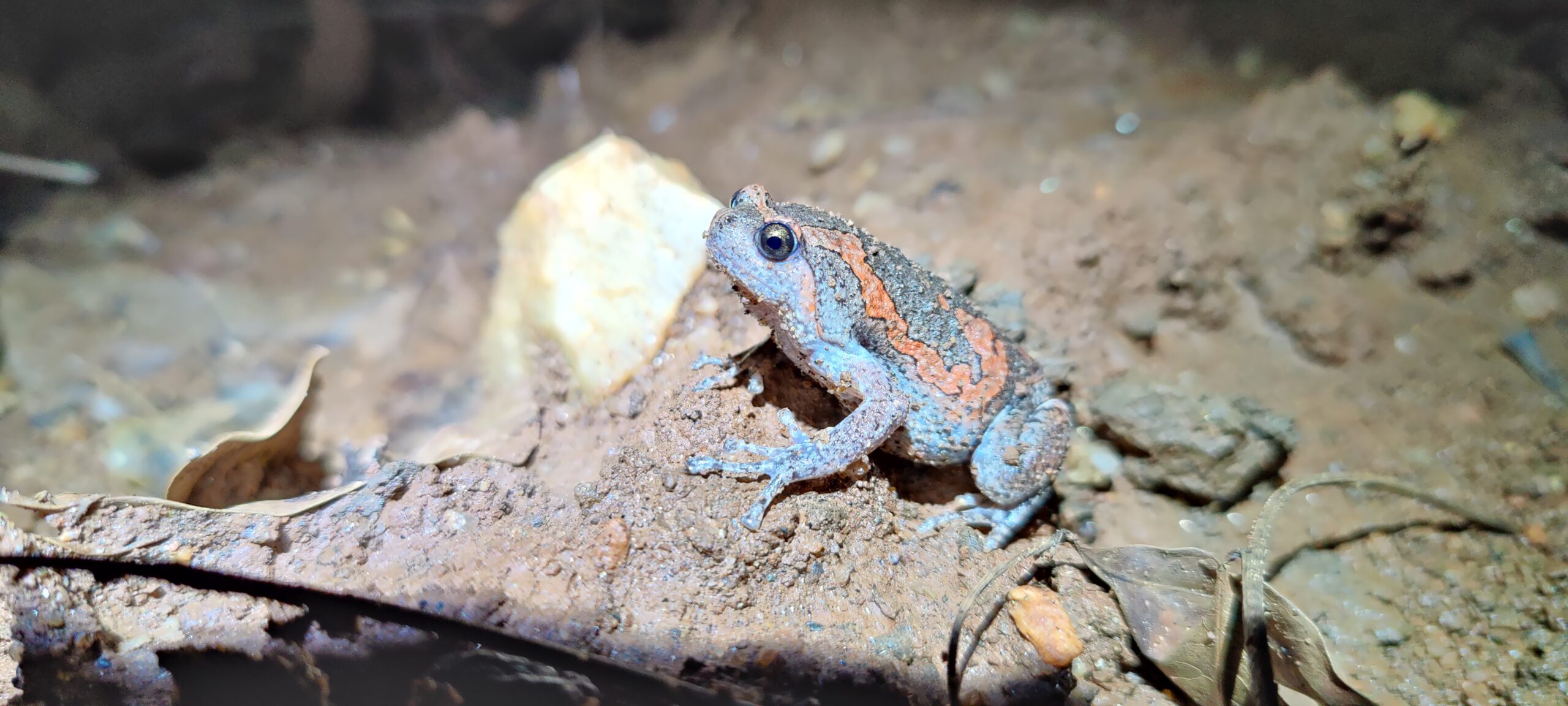
Banner image: A painted balloon frog at Mallathalli lake. Image by Seshadri K.S.