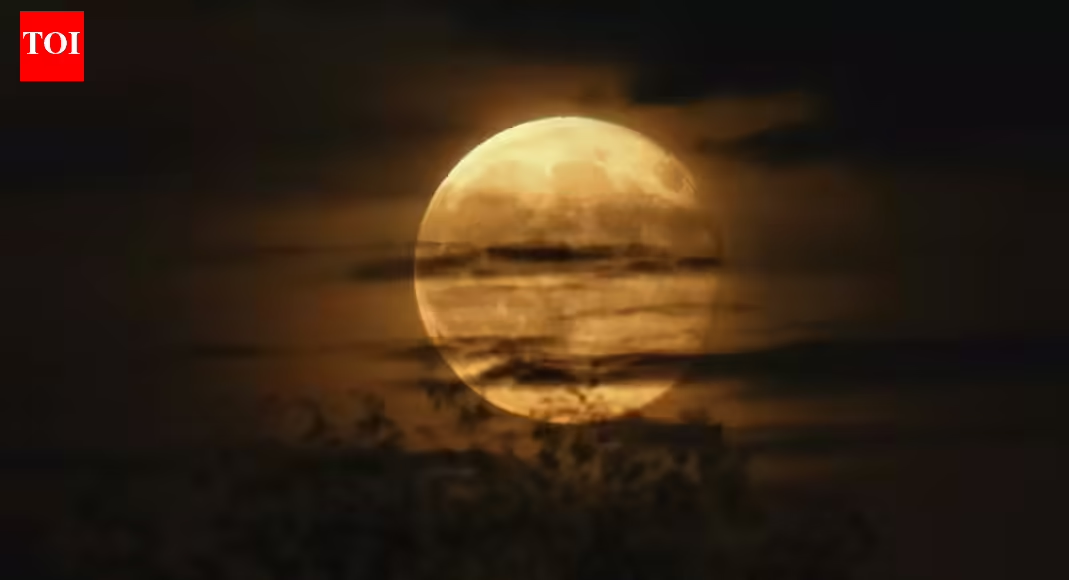
The Moon exerts a constant physical influence on Earth through gravity, light, and orbital interaction. Its mass shapes ocean movement, its orbit affects planetary rotation, and its presence alters conditions at the surface and in the atmosphere. These effects are documented through tidal records, satellite tracking, astronomical observation, and ecological field studies. Removing the Moon from this system provides a way to examine how tightly Earth processes are coupled to a single external body. The scenario is not framed as a prediction but as a controlled removal used in planetary science and Earth system modelling. Each resulting change follows from measured forces rather than speculation, allowing existing data to be applied to a simplified but revealing case.
Can Earth lose its Moon
No known physical process would cause the Moon to vanish from Earth’s orbit within the expected lifetime of the Solar System. Laser ranging experiments show that the Moon is slowly moving away from Earth, but the rate is low and stable. Gravitational binding between the two bodies remains strong, and there is no mechanism by which the Moon could suddenly escape, collapse, or disintegrate. Collisions capable of destroying or ejecting the Moon would require energies far beyond observed conditions in near-Earth space. The scenario, therefore, exists only as a hypothetical construct, used to test how Earth systems respond when a long-established gravitational influence is removed from calculations.A study published in JGR Planets has explained these impacts based on the already known measures of tides, rotation, and orbital dynamics, thus presenting the Moon as a factor that can be measured in the environmental conditions in which human societies have developed.
What happens to the oceans without the Moon
The most direct physical change would occur in the oceans. Lunar gravity is the main reason for the tides we have on Earth. Because of it, water is pulled into the bulges (high tide areas) that are always changing as our planet rotates. If there were no Moon, the Sun would still cause tides, but they would be very small. The difference between the water height at low and high tide would be decreased in the coastal areas. Tidal currents that are strong in channels and estuaries would become weaker, which would slow down water exchange between the coastal and the open ocean zones. Shorelines that were specially shaped due to regular tidal exposure would slowly change their shape as a result of sediment transport decreasing. The daily rhythm of the seas would still be there, but tidal heights and currents would be less intense.
How marine life depends on the Moon
Marine ecosystems are very dependent on tidal motion. Many coastal species that live in the sea use tides to get nutrients, remove waste, and regulate temperature and oxygen levels. A reduced tidal flow would change salinity patterns in estuaries, thus organisms that are adapted to more stable conditions would be favoured. Intertidal habitats that rely on repeated exposure to air and water would shrink, affecting shellfish, algae, and invertebrates specialised for that zone. Weaker mixing in shallow seas would change plankton distribution, which forms the base of many marine food chains. Over time, these physical changes would reshape species composition and productivity along coastlines.
Predators in a world without moonlight
Moonlight influences the behaviour of many nocturnal predators. Research on hunting patterns has revealed that animals like owls, big cats, and some fish vary their activity depending on the brightness of the Moon. In an environment without a Moon, night-time illumination would be at the level provided by starlight and atmospheric glow, and that would make visual hunting more difficult for predators that rely on sight to detect movement. Some species would become more dependent on hearing or smelling, and others might shift their activity towards dusk or dawn. In the ocean, predators that feed during the tidal cycles will no longer have a fixed time, which will make their hunting success even more difficult.
How prey behaviour changes without the Moon
Prey animals often reduce movement during bright nights to lower detection risk. If there were no moonlight, this limitation would vanish. The increased nocturnal activity would bring about more feeding and mating, thus survival rates for some species would be better. Population growth would follow where food and habitat were available. Such increases would not be equal, however, as disease, competition, and resource limitations would still be factors. However, the removal of a major behavioural control would alter predator prey balance. Nevertheless, a higher number of prey may lead to an increased grazing pressure, changes in vegetation cover, and shifts in soil stability, especially in ecosystems that are already under some kind of environmental stress.
How the Moon stabilises Earth’s tilt
Earth’s axial tilt is influenced by gravitational interaction with the Moon. Measurements and simulations show that the Moon dampens variations caused by the pull of other planets. Without this stabilising effect, the tilt would vary over a wider range across long timescales. These changes would occur gradually, unfolding over tens of thousands of years rather than within human lifespans. Variations in tilt would change the angle at which sunlight reaches different latitudes. The underlying mechanics of this process are described in orbital models and comparative studies of planets without large moons.
How a missing Moon reshapes seasons
Seasonal conditions depend on axial tilt. Greater variation in tilt would lead to corresponding variation in seasonal intensity. Higher tilt angles would produce stronger contrasts between summer and winter, especially at higher latitudes. Lower tilt angles would diminish these differences, resulting in more uniform temperatures throughout the year. The formation and melting of ice would adapt to these changes in solar exposure, thus affecting sea levels and the circulation of the atmosphere. Climate patterns such as monsoons and prevailing wind systems would adjust accordingly. These outcomes are inferred from climate modelling and geological records rather than direct observation.
Human life after the Moon disappears
Human activity would be affected both immediately and over extended periods. Coastal industries such as fishing, shipping, and harbour management would have to make changes due to reduced tidal ranges and weakened currents. It would be darker at night, thus affecting outdoor work, navigation, and security. Lunar calendars used in agriculture, cultural practice, and religious observance would lose their astronomical reference point. Over geological timescales, increased climate variability due to axial instability will determine where crops can be grown and where populations can settle. Also Read | 10 myths about lightning and why you should not believe them