- The Aravallis are under threat of being opened up for mining and other development activities. Simultaneously India’s largest rural employment scheme has been reincarnated into a new law.
- While both the earlier and new rural employment schemes emphasise climate-resilient rural works, the new law centralises funding decisions, making environmental outcomes vulnerable to political expediency rather than local need.
- India’s once-robust rural safety net has been weakened, with far-reaching social and environmental consequences.
- The views in this commentary are that of the author.
It was the summer of 1988, and the fourth consecutive year of drought in Rajasthan. A few months before the summer, I had joined the communication wing of an NGO called Action for Food Production (AFPRO). I was just out of college, raw, energetic and full of impractical idealism. My boss wanted me to learn, and sent me to the Aravallis of Rajasthan.
AFPRO was launched in 1966, as a response to the Bihar famine of the year, and with the aim to improve water resources management in villages across the country. In 1987, it established a field unit in Udaipur, Rajasthan, to implement watershed development work and strengthen regreening efforts in the Aravallis.
Those were the heady days of global discussions on desertification, which later culminated in the United Nations Convention to Combat Desertification (UNCCD). The multi-year drought focused attention on the tree felling that had happened in the Aravallis over years. Many development NGOs working in the region were focusing on the regreening of the hills, along with soil and water management measures to help communities tide over the immediate crisis. Their aim was to prevent such a disaster in future. There was the strong understanding that regreening the Aravallis would help prevent the spread of the Thar Desert into the plains of northern India. After all, Delhi too is located at the edge of the hill range.
What I saw in the hills of Udaipur district in May 1988 was bleak — dry riverbeds, barren farms stretching across acres, and carcasses of dead cattle in different stages of decomposition. But, to the credit of both the state and national governments, there were hardly any reports of starvation deaths. All along the roads and elsewhere families were involved with food for work and livelihood support programmes that kept starvation at bay. There were extensive discussions in the Parliament on the drought situation, and the effectiveness of the drought relief in itself became a case study for the future.
This was years before the Mahatma Gandhi National Rural Employment Guarantee Act (MGNREGA) came into being in 2005. In 1987-88, the idea of reaching food and income to people to prevent starvation, and to use their labour to build assets that could help with the conservation of natural resources was effectively implemented in Rajasthan. The MGNREGA codified the learnings from this and other livelihood support activities to provide an employment guarantee of 100 days a year for eligible rural adults.
Today, while the Aravallis are under threat of being opened up for mining and other development activities, the MGNREGA is dead and has been reincarnated into the Viksit Bharat Guarantee for Rozgar and Ajeevika Mission Gramin Bill (VB-G RAM G), which has been passed by both houses of the Parliament.
A push without a pull?
The MGNREGA itself was a legislation that was born in the space between the yin and the yang of Indian political governance between 2004 and 2014. During the years of the two United Progressive Alliance governments led by the Congress, Prime Minister Manmohan Singh pulled towards economic growth and party chief Sonia Gandhi pulled towards a socialist anchoring. The MGNREGA and a few other rights-based legislations were born in the space between the two contrasting pulls.
The key significance of the MGNREGA was that it made rural employment a right for rural adults — up to 100 days per family in a year. Any rural adult across India could demand employment from the government. Even though the VB-G RAM G talks about 125 days of guaranteed employment per rural family in a year, it is applicable only in places that are notified for such work by the national government.
Thus, from a universal right, the new law turns rural employment into a potential victim of political and administrative whimsicality. This is further accentuated by the fact that the national government’s financial contribution for the scheme is reduced from 90% to 60%, thereby also adding the possibility of inadequate funding into rural employment guarantee.
Since the time it was launched in 2005, the MGNREGA grew to become the largest such employment guarantee scheme across the world. Studies show that the scheme has increased incomes and livelihood support in rural India; improved the consumption basket of rural households to include more nutritious food and white goods; improved the nutritional level of rural labour; and an overall improvement in the rural economy through the construction of community and individual assets.
The most significant contribution of the old employment guarantee scheme, however, was the fact it provided a safety net when the economy was in trouble. This, in fact, provided survival support during 2020 and 2021 when millions returned from cities and towns to their villages during the COVID lockdown.
In short, the MGNREGA provided a certain financial stability to the rural economy, and in turn kept more people attached to agriculture and rural-development sectors. Undoing of this support could lead to a greater migration to urban centres.
This push of labour from rural areas has to be seen in conjunction with the national government’s efforts to create a pull through the new labour codes announced in November 2025. The management consultancy company KPMG, in its advisory to the Indian corporate sector, states that the new labour codes are intended to create a more predictable and transparent environment that streamlines process and provides improved worker protection.

Together, the two new laws have the potential of moving significant workforce from the agricultural sector to the manufacturing and services sector. While prima facie this is in sync with the trajectory of a country moving higher in its economic growth, the first question is are there enough jobs in these sectors? While the national government figures talk of job growth, experts tracking the situation claim otherwise.
The problem with the period since the late 1990s has been that India seems to have done a hop, step and jump from the agricultural to the services sector, without giving due importance to manufacturing in its growth story. An October 2025 Niti Aayog report on employment trends reports that after the COVID-19 pandemic, service sector absorption of jobs was second only to the agricultural sector. However, looking at a longer trend — from 2011 to 2024 — it was the construction sector that had the highest growth, followed by the services.
There is a problem though. The services sector jobs on offer are not of high quality, according to the same Niti Aayog report. “While agriculture continues to be the primary employer in rural regions, services fulfil this role in urban economies. The expansion of service jobs in urban areas has not been uniformly associated with improvements in job quality.”
In addition to poor quality, much of these service sector jobs are also through informal arrangements. “Several sub-sectors, particularly trade, hospitality, and parts of transport, have seen rising informality, with many workers employed without written contracts or access to social security,” the report notes. “Informality remains a persistent characteristic of India’s labour markets, even within cities where service employment is expanding most rapidly.”
With the prime minister himself leading the call to action, the national government wants to focus on manufacturing-led growth where it hopes to absorb labour. This is seen as the roadmap for Viksit Bharat by 2047. It is also in keeping with international recommendations for India to break into the developed countries club by 2047.
The World Bank’s India Country Economic Memorandum for 2025 states that India is not capitalising on its demographic dividend to strengthen manufacturing. Comparing India’s growth aspirations with that of other countries, the report notes: “In successful East Asian and East European economies, productivity growth was underpinned by the movement of labour from low to high productivity sectors (i.e. from agriculture to manufacturing, typically for export) and from low to high productivity regions (i.e. from rural hinterlands to urban growth poles).
“In India, however, this transition has been relatively slow; agriculture still accounted for over 45 percent of total employment in 2023-24, while traditional market services and construction (low productivity) together accounted for nearly 30 percent. In contrast, the share of manufacturing in total employment was around 11 percent and modern market services accounted for only 7 percent,” the economic memorandum noted.
The immediacy recommended is due to the current demographic dividend, where the majority of the Indian population is young and within the working age. This, however, is changing and India too is ageing.

A larger ecological footprint
It is natural that the manufacturing and services sector jobs will open in the urban centres of peri-urban industrial estates. During 2023-24, services contributed to 60.8% and manufacturing contributed 20.5% jobs in urban areas. This trend is likely to continue into the future, since it is easier to create economies of scale in urban and peri-urban clusters.
By their inherent nature, cities and towns are centres of consumption. They add value to mineral resources through manufacturing, and intellectual innovation creates economic value through services. The urban dwellers consume the agricultural produce, goods and services, and do not want to be burdened with the responsibility of disposing their garbage and waste.
Almost all Indian urban centres have grown organically. Many are overgrown villages, that subsumed other villages as they grew. Some are overgrown crossroads along old national highways. The utility infrastructure — water supply, sewerage, waste collection and disposal — is mostly inadequate. In bigger cities, most of the utility companies are parastatal bodies run by IAS officers reporting to state governments, effectively keeping their control away from elected representatives — mayors and corporators — and thereby from the city dwellers.
With urban centres steadily losing their green spaces and waterbodies to construction, and being unable to deal with their own environmental issues, the new influx can only make the situation worse, worsening the heat trap, air pollution and floods. Those having to depend on an employment guarantee scheme in the villages would add to the population that lives in the margins of urban centres.
There are environmental implications even at the rural end of the labour supply chain. Almost all the activities listed under the MGNREGA were related to building climate resilience for communities living in India’s rural hinterlands. These include natural resource management, watershed management, water and soil conservation, afforestation, construction of community assets for rural and agricultural development. The VB-G RAM G Bill talks of similar activities — works that will strengthen water security to strengthen climate resilience; construction of rural infrastructure; construction of livelihood-related infrastructure and special works to mitigate the impact of extreme weather events and deal with natural disasters.
The narrow-scoping with the new legislation, however, is neither in the objectives nor the activities, but in the fact that the decision on the place where to allocate what financial resources is purely under the control of the national government. Considering the precedents in the past decade, the decision on how much funding to allocate to which state or region would depend on the political expediency of the moment rather than the need from the ground.
It rained in the Aravallis of Rajasthan in 1988. The momentum to green the Aravallis continued for a few years, ebbed and continues in spurts. The economic framing in the country changed, and so did the political framing. Nature got commodified and the policymakers started seeing the Aravalli range as a repository of resources. There was a search for a new geological definition for a feature that was billions of years old.
If the drought of 1987-88 were to return, the official response could depend on how political lines are aligned and whether the Aravalli region is in the list of the places prioritised for employment guarantee. The new law has removed the certainty of the safety net.
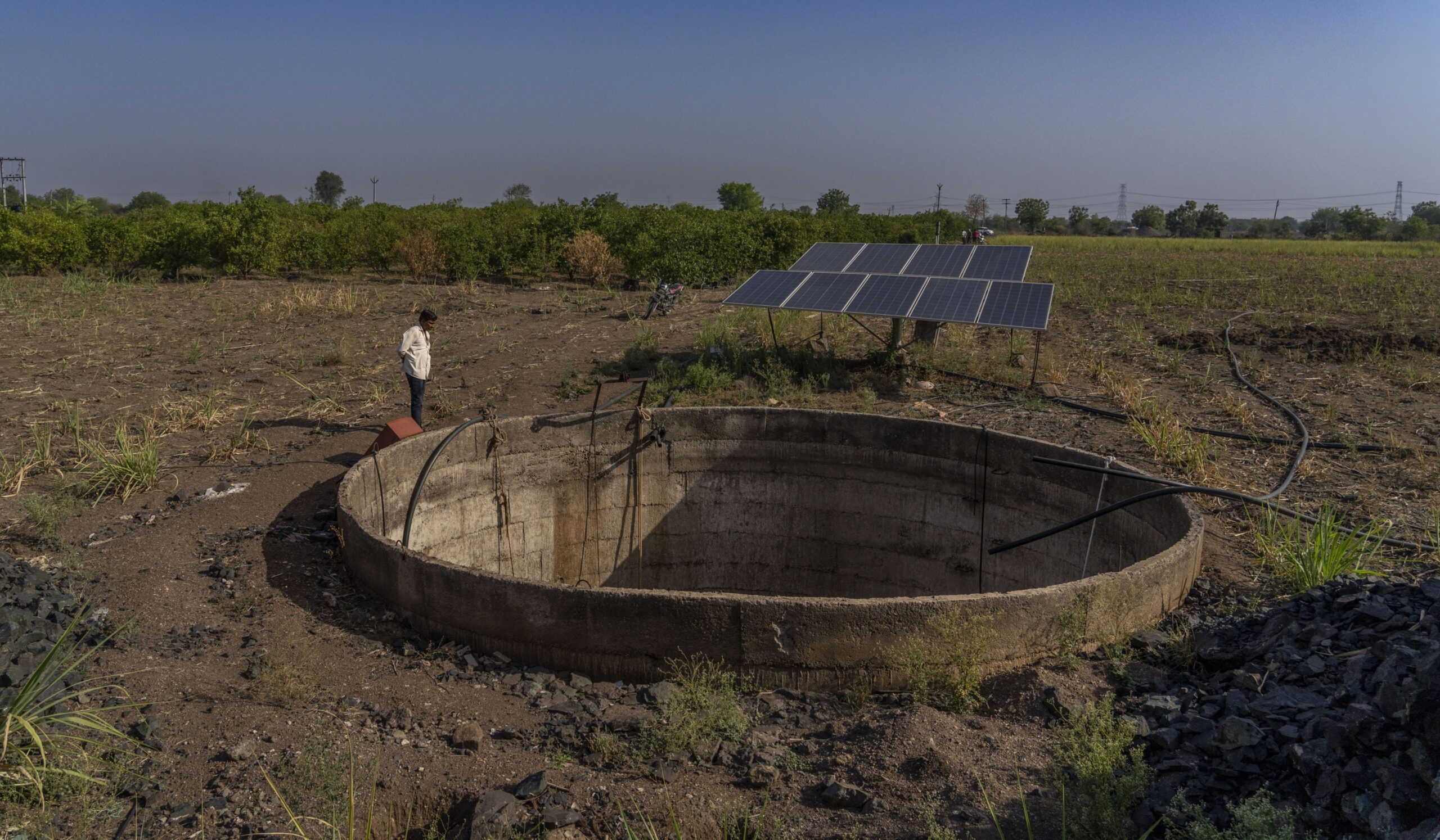
Banner image: A village head gazes into a dry well near sugarcane fields damaged by a drought in Beed district, Maharashtra. (AP Photo/Rafiq Maqbool)