
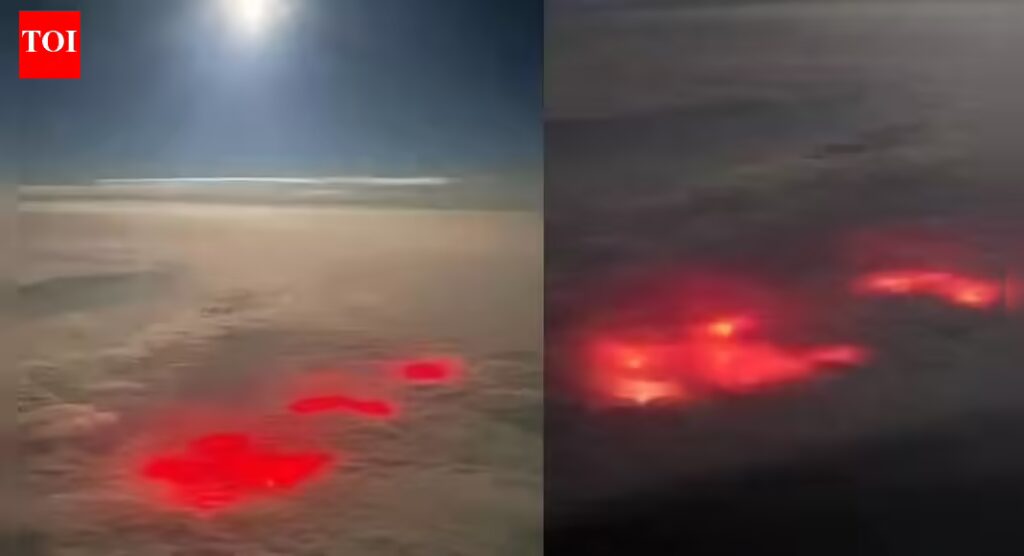
Photographs taken from directly above the Pacific Ocean have shown large areas of red light emitted against the backdrop of the surrounding environment, enough to rival the scale of a large city. These images, taken by pilots and circulated on the internet, raise questions about whether this phenomenon could be a product of the atmosphere, the ocean, or a technological aspect. The relevance of this evidence is found in the ways that the various sightings of the red light inform us about the previously unseen human activity that is taking place in one of the most isolated areas on the planet. A light that rivals the scale of a large city, emitted enough to change the nocturnal atmosphere of the ocean, is clearly a product of human systems.
How fishing lights turn the open ocean red at night
Public attention to the red glow intensified after a described photographs taken by a pilot flying over the Pacific Ocean, showing what appeared to be an eerie red light spread across the night sky. The post explained that the glow was not a natural phenomenon but the combined illumination of Chinese fishing vessels using red LED lights to hunt giant squid, highlighting the sheer size of modern fishing fleets operating far from land. According to the research paper published in Marine Policy, the use of high-intensity lighting in the form of lamps positioned along the sides of the fishing vessels became highly vital in squid fishing in order to lure the target species. The use of red Light Emitting Diodes is highly preferred due to the wavelength that attracts a high number of squid to the surface at night. The use of hundreds of fishing vessels concentrated in a closely spaced fleet creates a continuous glow, without which the glow would not be detectable at heights of thousands of meters in flying aircraft.
Why squid are drawn to artificial light in deep waters
This is because squids are very sensitive to changes in light. This is owing to their biology and patterns of movement. In particular, many of the squid that are of interest to fisheries exhibit a daily vertical migration in which they spend their daytime periods at greater depths and then rise toward the surface of the water during their nightly feeding excursions. The effect of artificial lighting is to interrupt this cycle. The squid are attracted to an intense point of light that they associate with fishing activity. The difference between illuminated and non-illuminated spaces means that fishing vessels become very attractive points. This is because red light is very effective because it moves through the water in a way that makes it distinguishable from other lights and does not disperse. With developments in fishing technology, lighting attraction has become very accurate, and thus, the night ocean has been rendered a very controlled fishing space.
How massive fishing fleets create glowing oceans at night
The great visibility of such lighting also indexes the growing size of long-distance fishing fleets operating far from national boundaries. Indeed, over the past decades, China has established the largest fishing fleet in terms of long-distance fishing vessels and operations, ranging from crossing over the Pacific to target squid “rich areas” in international waters. The fishing of squid has increased dramatically with the decrease of traditional target species of fish in many areas, and has led to cephalopods being considered a viable target species due to their rapid growth. Such fishing fleets tend to target predetermined areas with suitable oceanographic conditions related to high squid concentrations. When tens and even hundreds of vessels fish in the same general location, the overall lighting effect results in underwater “cityscapes” visible from space.
Why lighting up the ocean at night raises ecological concerns
Though these red lights are aesthetically pleasing, their effect on the ecosystem can be far more profound. Artificial lighting in the ocean changes the natural light cycles, which are used by various marine species for navigation, feeding, or avoidance. Certain species, such as those taking shelter in darkness, could be stressed or displaced, while others could be attracted towards new habitats. These lights could further have a complex effect on predator-and-prey dynamics, as well as plankton, a basic component of the marine food chain. Scientists are still investigating the long-term impacts of such changes, especially in areas where fishing seasons are a regular phenomenon. These red lights, in this sense, symbolise not just a fishing technique, but a tool for manipulating an ecosystem, where artificial conditions have been imposed on natural cycles of light and darkness, which have long been established.
What the red glow reveals about high seas fishing regulation
The red light emitted from glowing oceans is also a reminder of the pending regulation of the global oceans. Most of the squid fishing that causes this light is done in international waters, where there is no regulation to monitor activities. The regulation of adherence to fishing quotas, labour practices, and environmental policies becomes challenging when vessels are far from land for such a long time. The issue of IUU fishing practices is now common with the increasing number of distant water fisheries. The squid fisheries are often characterised as hard to regulate because of their migration and large size. The light from above is thus imbued with some form of significance. The light points to areas where there is heavy harvesting of resources that is done away from the watchful eyes of humans. The light from above is thus likely to signify areas where human actions have already characterised the dark oceans of the Pacific.Also Read | Why this Indian river turns red during the monsoon