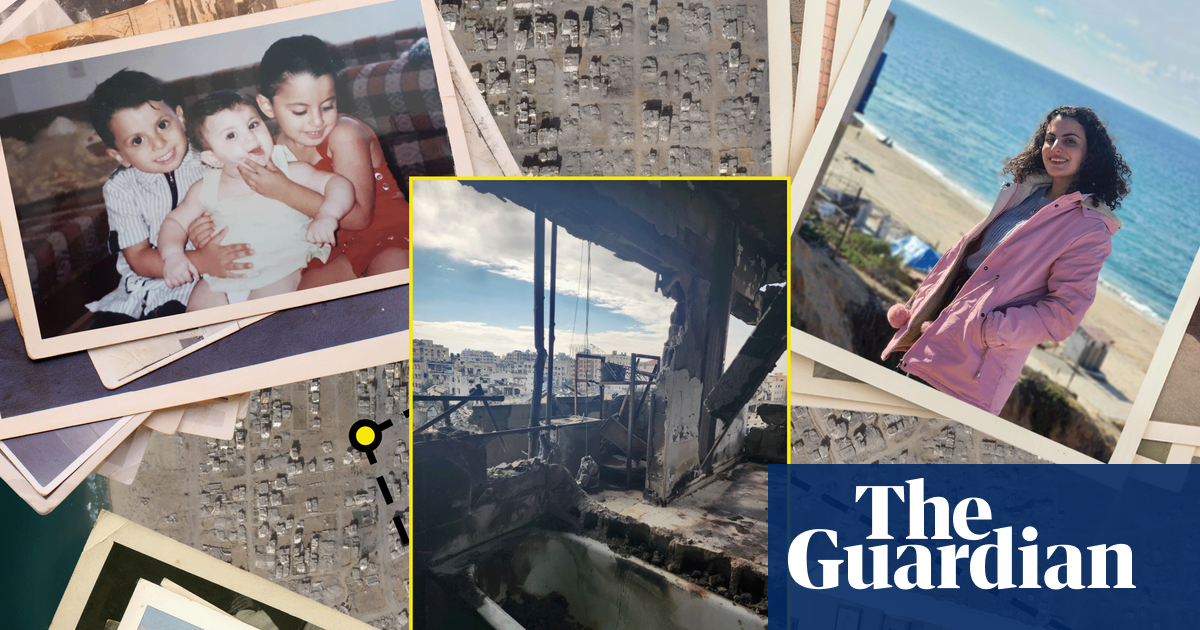
When 26-year-old Nour AbuShammala stepped back into her family’s apartment in Gaza City in October the rooms were gutted, the walls were damaged by bombing, and there was no water or electricity, but it was still home.
Since the outbreak of war in October 2023 she has been forced to flee six times. This is her story of relentless displacement, survival and loss, told using photography and videos provided by AbuShammala and satellite imagery of a ruined Gaza.
AbuShammala speaks of both hope and caution when looking to the future: “There’s a sense of relief, that the killing has stopped, the displacement has stopped, the destruction has stopped, and that there’s finally a chance to return home.
“But at the same time, things are still very hard. Gaza needs a lot of time to recover, life hasn’t really come back yet. The pain and the scars are still there. There’s sadness despite everything. And Israel isn’t making things any easier, there’s always this fear that we’ll wake up one morning and the war will start again, that our home will be gone, that our dreams will be stolen once more.”
Still determined to return to her career in international law, AbuShammala remembers the advice her mentor gave her when she first began: “The road to justice is long.”
UN experts have concluded that Israel’s actions in Gaza amount to genocide – a charge Israel rejects.
As those investigations unfold, AbuShammala’s life remains suspended, balancing daily survival and the struggle to rebuild with her hopes for education and a career beyond the war.
AbuShammala is waiting for a border crossing to open so she can begin her master’s degree in Jordan – the path she set out on before the war.
“Gaza is not just a place or walls for me,” she said. “It’s something alive inside me. Sometimes I wish we never woke up on October 7, that our lives hadn’t turned upside down like this. Or I wish I could forget everything that’s happened, as if I never lived through it.”
For now, she remains in a broken city, with her family, trying to rebuild what’s left of their home.
AbuShammala is currently writing a book about her experiences during the war.
Methodology
This project draws on multiple sources to trace where the AbuShammala family have lived over the past two years and how each neighbourhood has changed through the war.
The Guardian was in regular contact with Nour and Khalil AbuShammala over a two-month period to document their story, gather imagery and verify events.
Satellite imagery from Planet and Vantor was used to assess damage and movement across time. Images are dated within the piece and span periods before and during the conflict, with additional imagery used for verification.
Reported damage was verified against satellite analysis, user-generated footage, news reports and official IDF updates. Footage provided by Nour was geolocated using identifiable landmarks and compared with satellite images. Using a combination of these visuals and archive pictures, the Guardian verified footage showing buildings before and after they were destroyed by Israeli strikes.