
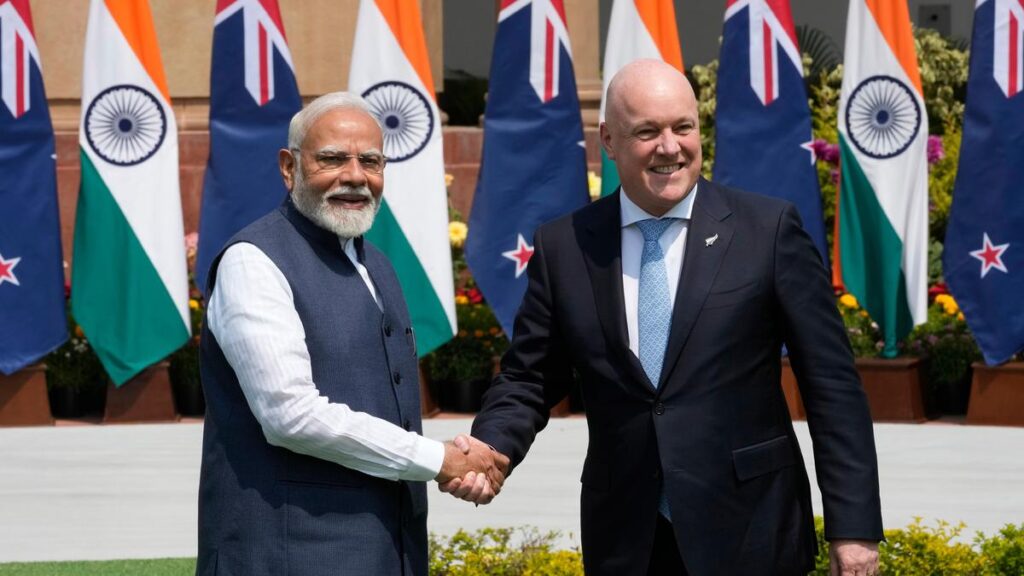
The story so far:
The recent India-New Zealand Free Trade Agreement (FTA) was concluded in December, under which New Zealand will levy zero duty on 100% of India’s exports and bring in $20 billion in Foreign Direct Investment (FDI) by 2030.
What are the key bargains?
India will receive zero-duty market access for all its exports to New Zealand. In return, India will relax tariffs on 95% of imports from New Zealand, with 57% of these products becoming duty-free from day one.
New Zealand has committed to investing $20 billion in India over the next 15 years, with firm clawback mechanisms in case the investment doesn’t meet the stipulated timeline. The FDI is aimed at promoting skill mobility and services, creating employment and growth opportunities across 118 sectors. For the first time, New Zealand has agreed to facilitate trade in Ayurveda, yoga, and traditional medicine services with India.
The deal also makes provisions for the support and mobility of Indian skilled workers. Youth, students, and professionals will find it easier to live and work in New Zealand.
The FTA creates opportunities for India to become a key supplier of skilled workforce in services such as IT professionals, Engineers, Yoga instructors, Indian chefs, Music teachers, as well as in sectors including healthcare, education, and construction.
Student mobility, work permits of up to 20 hours per week while studying, and extended post-study work visas are some of the opportunities for Indian youth to get global exposure.
The agreement also builds on MSMEs and employment opportunities through labour-intensive sectors, including textiles and apparel, leather and footwear, gems and jewellery, engineering goods, and processed food items.
Which sectors has India kept outside the agreement?
India has refused to give market access to major items crucial to New Zealand, such as dairy and agricultural products, including milk, cheese, cream, butter, yogurt, onions, sugar, edible oils, spices, and rubber, in order to protect Indian farmers and small and medium industries.
New Zealand will develop focused action plans to develop and improve productivity, quality, and sectoral capabilities for fruit growers in India, particularly for exotic fruits like kiwifruit, apples, and honey. This cooperation will ensure the establishment of centres of excellence, improved planting material, capacity building for growers, technical support for orchard management, post-harvest practices, supply chains, and food safety.
Why is the FTA important?
More than a breakthrough, the India-New Zealand FTA is a framework for deeper cooperation in the future. It is India’s conscious move to increase its global economic footprint. Trade diversification demands a deep and deliberate transformation of the country’s productive sector and integration into global value chains.
The India-New Zealand FTA is hailed for being the fastest concluded, completed in a record time of nine months after being announced in March 2025. It enhances market access and tariff preferences for Indian exports to New Zealand, while proving to be a gateway to Oceania and Pacific Island markets. Standing at $49,380, New Zealand is among the higher-income economies in Oceania.
The Indian diaspora in New Zealand constitutes 5% of its population, which amounts to 3,00,000 persons. This creates a promising exchange and opens opportunities for soft power politics between the two nations.
Currently, India’s bilateral merchandise trade with New Zealand stands at $1.3 billion. The deal aims to double this figure over the next five years.
India has instated strict safeguards to protect its sensitive sectors, like agriculture and dairy, from one of the world’s largest dairy exporters.
This is also one of the first FTAs negotiated and concluded entirely by a women-led and women-driven team, from the chief negotiating officer to the ambassador to New Zealand.
Why is India accelerating new FTAs?
By engaging with the Pacific, West Asia, and Africa as trade partners, India is leveraging its position and promoting realignments through bilateral engagements and FTAs.
FTAs provide a platform to pursue unique and region-specific commitments, creating room for WTO-plus commitments, especially in areas like services, digital trade, and investment. Diversification of trade partners means that India doesn’t have to be dependent on traditional markets such as the EU, the U.S., and China.
FTAs are aligned with India’s development goals and policies, such as Make in India, and securing India’s sensitive sectors through technology transfers and production-induced incentive schemes that can help in aligning Indian manufacturing with the global value chains.
India is currently determined to materialise FTAs with several countries, including Russia, Oman, the U.K., and New Zealand, in spite of its not-so-successful past FTA engagements. This points to India’s attempt at securing strategic and geopolitical alliances via economic and trade liberalisation.
This is India’s third FTA this year, after agreements with the U.K. and Oman. It is a part of a broad strategy that India is determined to take forward after the U.S. imposed steep tariffs. A large chunk of India’s trade is U.S.-dependent. The bilateral trade between India and the U.S. stands at $132 billion, and changes in the tariffs by the U.S. really hurt India’s trade.
India’s exports to the U.S. declined sharply in September and October, dropping to 12% and 8.5%, respectively. The Indo-U.S. free trade deal is in slow progress, and 50% of the tariffs still remain unchanged. This has resulted in a departure from the U.S. and into an urgent need for diversification of India’s trade policies and strategic alliances in order to attract greener trade pastures.
One of the main reasons for the stalling of the Indo-U.S. bilateral talks is India’s steadfast policy of not opening up its farming and dairy sector to concessions in the FTA. India is thus making a substantial move from short-term economic partnerships to long-term trade alliances.
The India-New Zealand deal builds a structure that is more investor-friendly. India is willing to let go of its protectionist image by lowering trade barriers, promoting ease of business, and opening its markets. India’s FTAs today go well beyond tariff reduction; they are more of a framework for future cooperation and economic alignment.
What criticisms does the agreement face?
This is New Zealand’s first FTA that excludes dairy and agriculture from its purview, due to which it is heavily criticised in New Zealand by coalition partners of the current government. The Foreign Minister of New Zealand said that the deal is ‘neither free nor fair’ as it bypasses the dairy and agriculture sector, the country’s largest industry, and added that they will vote against the bill when it comes to the floor in the New Zealand Parliament in 2026. India, on the other hand, assumes an easy passage to legislation.
In India, FTAs are criticised for widening trade deficits and generating asymmetric gains, as it has led to imports from partner countries growing faster than our exports. Although the safeguards established by the current India-New Zealand FTA claim to cover these risks and protect and promote India’s sensitive sectors through manufacturing collaboration. The success of which will have to be determined as the implementation unfolds over the years.
What is the way forward?
Even though the India-New Zealand FTA is considered historic, it is important to learn from the trade agreements in the past, as many resulted in low yields.
India needs to invest in domestic competitiveness, meet global market standards and quality requirements, ensure strong rules of origin, define anti-dumping provisions, strengthen its sensitive sector and MSMEs and formulate them in line with global markets.
India also needs to invest in research and development for increasing quality and competitiveness of its products if it has to thrive in the global market
.Saee Pande is a freelance writer with a focus on politics, current affairs, international relations, and geopolitics