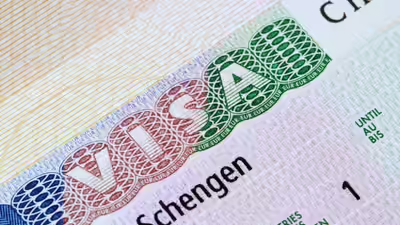
A Schengen visa is a short-stay permit that allows travel across 29 European countries without internal border checks, for up to 90 days within any 180-day period. It is typically issued for tourism, business, or family visits. Applicants must apply through the embassy or consulate of their main destination and submit documents such as a valid passport, photographs, and proof of funds and travel insurance. While the visa allows free movement within the Schengen Area, final entry is always subject to checks by border authorities. Here’s how this traveller got his Schengen visa approved, as per his post he shared on reddit.So when three friends, two of whom had never travelled abroad, submitted their first-ever Schengen visa applications earlier this year, they were not that optimistic about it.
They applied through Switzerland, booking their VFS appointment in Delhi for January 9. Among them, only one applicant had international travel credentials: a valid US visa and previous Schengen travel. The other two had no stamps, no history, no precedent. What they did have, however, were stable jobs at well-known companies, carefully prepared documentation, and a clear plan.Still, doubts do linger when it comes to visa approvals. One of the applicants had switched jobs barely a month earlier, and had an average bank balance of around INR 1.5 lakh. It was reasonable, but not extravagant. They didn’t opt for any short cuts, had all the documents in place, no-objection certificates from employers, employment verification letters, salary slips, income tax returns, and detailed financial statements, all of which were submitted exactly as the checklist demanded.Then came the waiting.For first-time applicants, the time between submission and decision can feel endless. Each passing day feeds the worry that a missing detail or a misunderstood number could undo weeks of preparation. The applicant later wrote, the waiting period was “quite anxiety-inducing,”especially with limited travel history and a recent job change in the mix.When the approval finally came, they were all relieved. All three visas were granted.

The post struck a chord online almost immediately. Questions poured in from others standing at the same threshold. How long was the visa valid? Was it single-entry or multiple-entry? The answer: first-time applicants received a single-entry visa valid for 30 days, while repeat applicants could expect multiple entries and up to 90 days.Others wanted to know if they applied as a family, how much money was enough to show, were fixed deposits and mutual funds required, and more. As per his response. a savings balance of roughly INR 10,000 per person per day was generally sufficient. What mattered more was consistency, steady balances over time rather than last-minute infusions. Bank statements, payslips, and ITRs were key. Investment proofs, while not mandatory anymore, could still be carried as backup.There was also confusion around routes and rules, common among first-time applicants. If Switzerland was the first point of entry, did the visa allow travel elsewhere? Yes, the itinerary included five days in Switzerland, followed by four days split between France and Spain, all clearly mentioned in the application. Once admitted through Switzerland, travel across Schengen states was permitted.
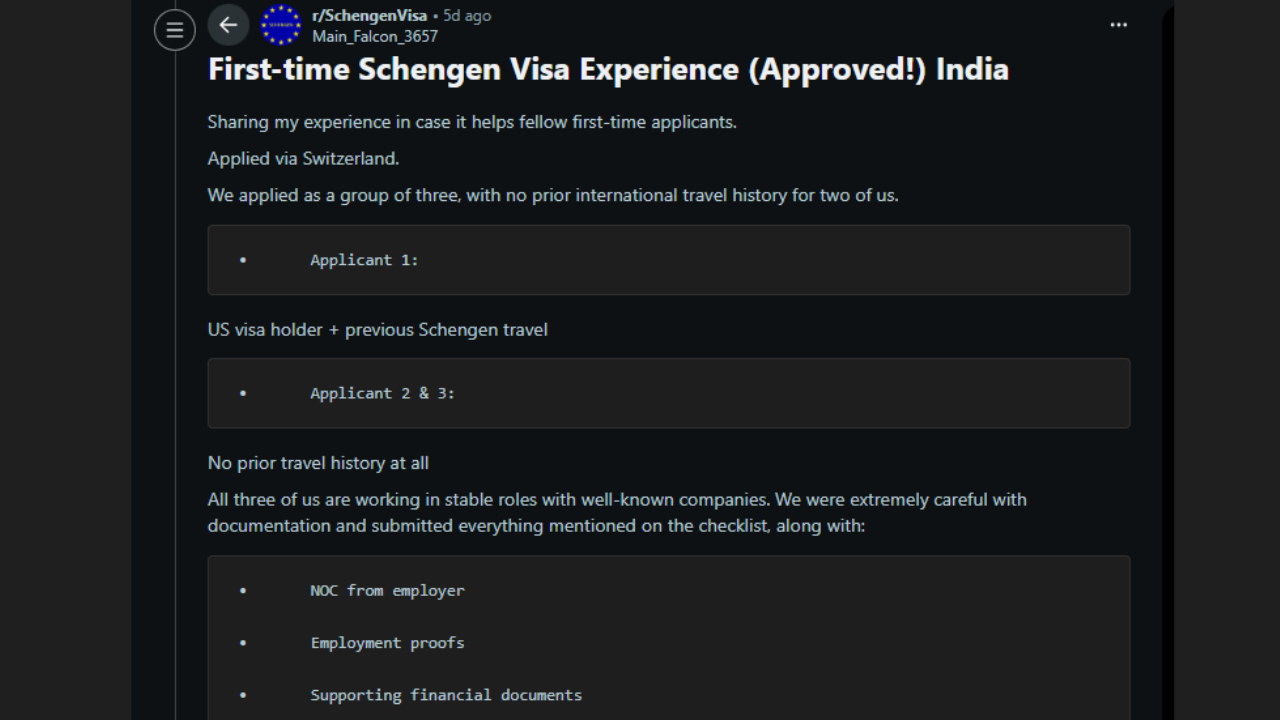
Some asked whether an agent had been used. The answer was: yes, but an inexpensive one. Dummy flight tickets were booked through the agent and would be changed later, an open secret in visa applications, handled cautiously but transparently. Hotel plans, internal travel, and daily itineraries were all documented.One of them asked if the NOC was enough, or was a separate employment verification letter required? He said an NOC confirms permission to travel. An employment verification letter confirms your role, tenure, and employment status, often downloadable directly from HR systems. They serve different purposes, and both help establish intent to return.The post assures that if your documents are clean, your employment is stable, your finances make sense, and your intent is clearly explained, lack of travel history alone does not doom an application.