
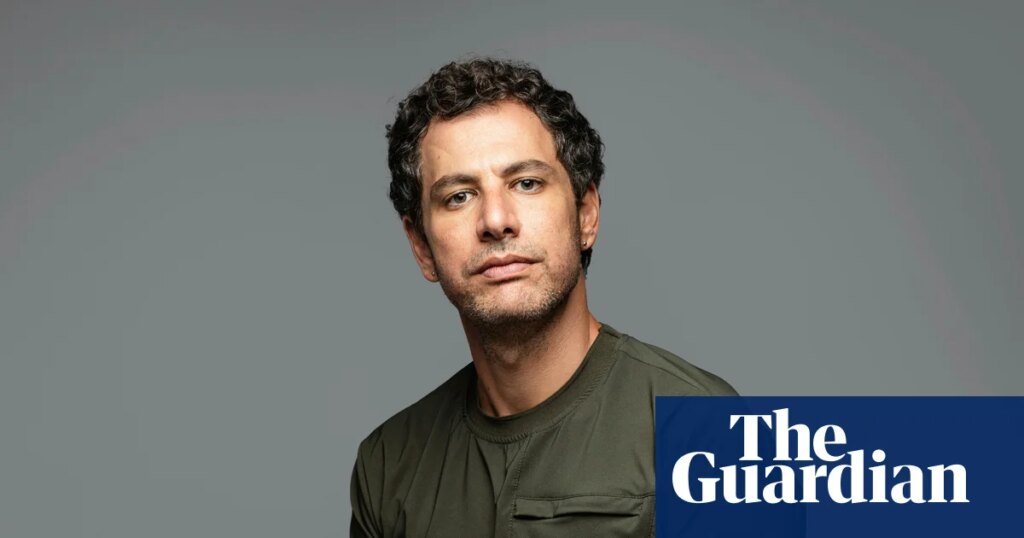
Seven decades after Tareq Baconi’s grandmother fled in terror from the port city of Haifa, carrying a Bible, a crucifix and a week’s worth of clothes, he followed her directions to the family home a few blocks from the sea.
The building was still standing, almost as she had left it in 1948, instantly familiar from childhood stories. Standing beside his husband, Baconi could not bring himself to ring the bell, to find out who was living in the rooms that held Eva’s childhood memories.
“I want to imagine it empty, loyal, waiting for our return. I want it to exist outside of time, as if everything stopped that April,” he writes in his memoir. Simply finding the house was the physical connection he sought between her past and his inheritance of memories. “I have finally bent time, held her history in my present.”
The long road to that sunny seaside street, from a childhood of personal and political repression as a refugee in Jordan, is the heart of the memoir Fire in Every Direction, published last month.
Weaving the story of his first love with his family’s history of generational flight and dispossession – from Haifa, to Beirut and then to Amman, before moving on his own to London – it explores Baconi’s struggle to recognise and embrace his enmeshed Palestinian and queer identities.
“The book at its core is a love story between two boys. And I always knew that it was something I wanted to write because I felt like it was completely absent from the world around me,” Baconi said in an interview in London of a book that is both intimate and fiercely political.
The memoir is a departure for Baconi, who is well known as a political analyst and expert on Hamas. By instinct a very private person, he began writing it as a personal project that he imagined as an extended letter to “Ramzi”, the boy he loved, “recounting everything that I wanted to tell him that I didn’t really have the words or capacity to say when I was in my teenage years”.
He was able to be both intimate and vulnerable, creating an unsparing portrait of his younger self, in part because he convinced himself it would never be published.
The explicitly political aspect of the book expanded as he realised readers needed to understand why the boys were in Jordan, the silences and trauma in their homes and everything that had to be left unspoken in a country that offered refuge only to Palestinians who renounced politics.
His mother had been a firebrand political activist but was driven into exile from Lebanon when civil war exploded and her best friend was murdered. In Amman, she burned against forced domesticity and boredom, but complied with what she felt was the unwritten cost of physical safety.
“Our parents’ lives had come unhinged too many times, and – rightly or wrongly – they decided it was enough for us to have been given shelter,” he writes of their years in Jordan. “To demand more was a betrayal of that gift. There was an unacknowledged pact with our host country: to live, we had to be silent.”
She was an ally and a refuge for Baconi, who chronicles his early realisation that he did not entirely fit into Palestinian life in Amman, skipping football games to look for wild tortoises, and begging his mother to buy him a doll in a glittery ballgown.
“In some ways queerness served to put me out of the norm. It forced me into the margins. It forced me to reconcile with the fact that I didn’t quite belong in this patriarchal and homophobic society I was growing up with,” he said.
Bullied at school, he was rescued from social isolation by the friendship of Ramzi. The pair were closer than brothers until Baconi’s declaration of love in his final year of school ended the friendship and he moved to London to escape gossip in Amman.
The politics of the second intifada that was raging at the time were little more than background noise to an engineering degree for Baconi. But the US-led invasion of Iraq in 2003 would fan the spark inherited from his mother into life.
He flew back to join his family in Amman on a plane filled largely with journalists racing to cover the war, many of them with a degree of enthusiasm, and a conversation with one of them would crystallise a growing sense of unease into a moment of radicalisation.
“Sitting there, chatting to the well-meaning British man, I realized I was, in fact, and despite all performances to the contrary, an Arab man who was scared and filled with foreboding, with a force I had not realized was within me,” he writes in the memoir.
He had been seduced by a western liberal promise that he could find safety and freedom by moving to cosmopolitan London, leaving behind the Palestinian community that rejected his queerness. But he began to understand that day that his Palestinian identity could no more be suppressed or abandoned than his sexuality, and spent the years that followed exploring both.
Traveling around the Middle East as a consultant and discovering a semi-hidden queer subculture, Baconi began to recognize that he had been largely oblivious to Palestinian political history, even though it permeated the Amman of his youth through shared memories of massacres, stolen homes and scattered family.
“What other silences have filled my childhood?” he writes. Returning to university he studied the history that gave his patchwork of family stories a broader context.
The US invasion of Iraq, he said, “was a moment of political awakening that then took me into Palestine in a very academic way in terms of trying to reclaim my family history”.
He became a political analyst and scholar, writing Hamas Contained, a highly regarded account of the rise of the Islamist group as a political force. Eventually, armed with a British passport, he went to live in Ramallah and visited Haifa with the husband he was never able to tell his grandmother about.
Baconi’s exploration of the damage caused by silence and suppression is powerful in part because it is so frank, an exploration of a family struggling to reconcile their deep love for Baconi with a cultural and religious context that condemns him.
When he came out for a second time to his father – the first was dismissed as a teenage phase – his mother prepared coffee with sedatives for her husband, in a pre-emptive attempt to prevent any confrontation spiralling.
Even so, Fadi told his son: “I wish you had the decency to let me die not knowing you were like this.” Despite the cutting cruelty of those words, over time love prevailed. Fadi became a devoted father-in-law before his death, chiding Tareq for not visiting more often with his husband.
Baconi’s family have been supportive of the book, something he does not take for granted and says is “not necessarily representative” for other queer Palestinians in the region.
“In Jordan specifically, maybe more broadly in the region, there’s something funny about how certain things are accepted, [including] queer life, as long as we don’t talk about it,” he said.
“This book is disruptive in that way, because it’s not only telling, but it’s unapologetic in the telling. It’s saying this is what it is to be queer and Palestinian, and this is how I hold these politics together.”
He hopes it will come out in Arabic, but is unsure how it will be received. “It’s either the stupidest or the bravest thing I’ve done. I really don’t know what the implications are.”
Baconi’s exploration of the world of queer Palestinians is a powerful counterpoint to Israeli attempts to portray the country as an LGBTQ+ haven, and Palestinian society as entirely and violently homophobic.
This campaign, which critics call “pinkwashing”, has included Israeli soldiers in Gaza unfurling the rainbow flag with the slogan “in the name of love” in front of ruined Palestinian homes.
Presenting Israel as the sole regional defender of LGBTQ+ rights erases the existence and activism of queer Palestinians, Baconi said.
“It puts queer people in a very difficult position, because they’re then seen in some ways as being foreign implants, not necessarily as people who are Indigenous to the region or their sexuality or gender identities as being Indigenous to the region,” Baconi said.
The book was largely finished before the Hamas-led attacks of 7 October 2023, and Israel’s war in Gaza which a UN commission, genocide scholars and rights groups say is genocidal.
“I really struggled with the idea that this would be published at this moment, in the same way that I struggle with doing anything normally on a day-to-day at a moment of genocide,” Baconi said. “On the one hand, life is continuing, and on the other hand, it shouldn’t be.”
The book does not directly address the last two years. But as a chronicle of one Palestinian family’s losses over decades of mass killing, theft and forced displacement, in Baconi’s words “a timeline etched in massacres”, it provides vital context.
For all the tragedies, however, it is ultimately a book filled with love, from and for his own family, for the region, Palestine and queer culture – a call for “an imagined future where none of us must cover, or absent, a part of ourselves to live”.