

Pallab Ghosh,Science Correspondentand
Alison Francis

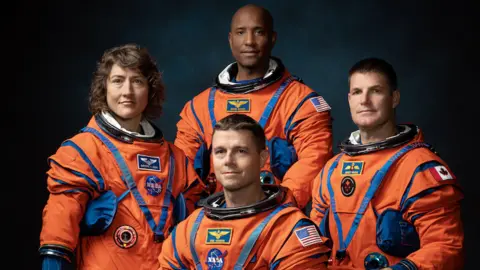
The first crewed Moon mission in more than 50 years could be launched by Nasa as soon as the first week of February.
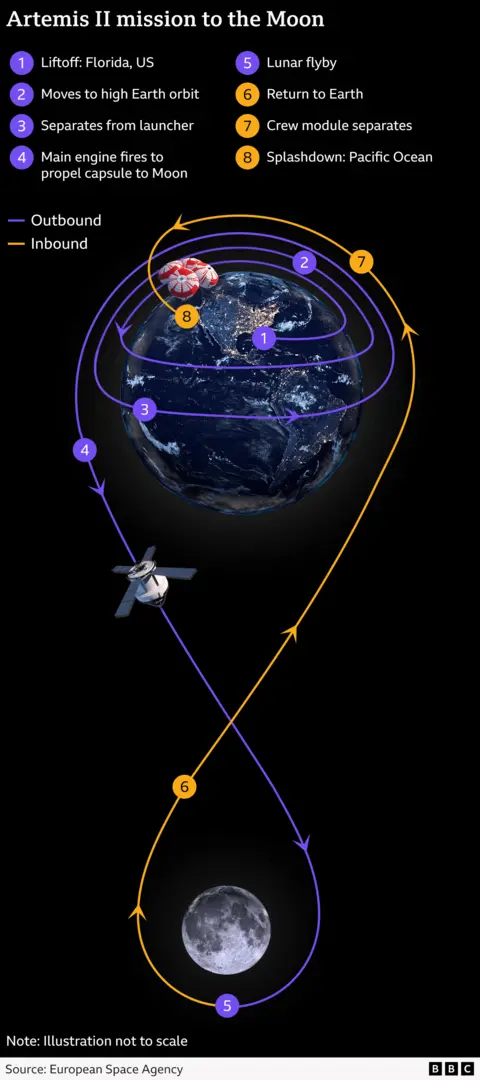
The Artemis II mission, which will last about 10 days, could take its astronauts further into space than anyone has been before.
It aims to set the stage for an eventual human landing on the lunar surface for the first time since the Apollo missions of the 1960s and 70s.
When does Artemis II launch?
Nasa’s planned launch window opens on 6 February and runs into the spring. The US space agency wants the rocket to blast off before the end of April.
A date will not be set until final checks on its Space Launch System (SLS) rocket, the Orion capsule – which carries the crew – and ground systems are completed.
The mission will be launched from the Kennedy Space Center in Florida.
Who are the Artemis II crew and what will they be doing?
Artemis II’s crew of four includes Nasa’s commander Reid Wiseman, pilot Victor Glover and mission specialist Christina Koch. A second mission specialist, Jeremy Hansen of the Canadian Space Agency, will also be on board.
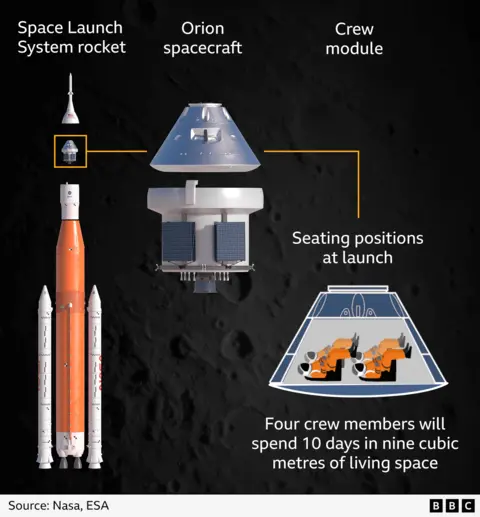
The mission involves the first crewed flight of SLS and Orion.
Once they are safely in orbit, the astronauts will test how the Orion spacecraft handles. This will involve manually flying the capsule in Earth orbit to practise steering and lining up the spacecraft for future Moon landings.
They will then head out to a point thousands of kilometres beyond the Moon to check Orion’s life‑support, propulsion, power and navigation systems.
The crew will also act as medical test subjects, sending back data and imagery from deep space.
They will work in a small cabin in weightlessness. Radiation levels will be higher than on the International Space Station, which is in low‑Earth orbit, but still safe.
On return to Earth, the astronauts will experience a bumpy return through the atmosphere and a splashdown off the west coast of the US, in the Pacific.
Will Artemis II land on the Moon?
No. This mission is to lay the ground for a lunar landing by astronauts in the Artemis III mission.
Nasa says the launch of Artemis III will take place “no earlier than” 2027. However, experts believe 2028 is the earliest possible date.
The final choice of a spacecraft to take the crew down to the lunar surface has not yet been made. It will either be SpaceX’s Starship lander or a craft designed by Jeff Bezos’s Blue Origin.
New spacesuits made by US company Axiom are also not ready.
When Artemis III finally flies, the astronauts will be heading to the Moon’s south pole.
After this, the aim is to have a sustained human presence on the Moon.
Artemis IV and V will begin building Gateway, a small space station circling the Moon. After that, there will be more Moon landings, extra sections added to Gateway, and new robotic rovers on the surface. More countries will be involved in keeping people living and working on and around the Moon for longer periods.



When was the last Moon mission?
The last crewed Moon mission was Apollo 17, which landed in December 1972 and returned to Earth later that month.
In all, 24 astronauts have travelled to the Moon and 12 of them have walked on its surface, all during the Apollo programme.
America first went in the 1960s, primarily to beat the Soviet Union to assert its geopolitical and technological dominance. Once that goal was achieved, political enthusiasm and public interest ebbed, as did the money for future Moonshots.
Artemis grew out of a desire to return humans to the Moon, this time for a longer-term presence built around new technology and commercial partnerships.

Do other countries plan to send astronauts to the Moon?
Several other countries have ambitions to put people on the Moon in the 2030s.
European astronauts are set to join later Artemis missions and Japan has also secured seats.
China is building its own craft, targeting a first landing near the Moon’s south pole by 2030.
Russia continues to talk about flying cosmonauts to the surface and building a small base sometime between about 2030 and 2035. Sanctions, funding pressures and technical setbacks mean its timetable is highly optimistic.
India has also expressed ambitions to one day see its own astronauts walking on the Moon.
Following the success of Chandrayaan 3’s landing near the lunar south pole, India’s space agency set out a goal of sending astronauts to the Moon by about 2040. This would be part of a push to move its human spaceflight programme beyond low Earth orbit.
Additional reporting by Kevin Church.