
Every Tuesday at dawn, Raildon Suplício Maia goes to the market in Macururé, in Brazil’s Bahia state, to sell goats. He haggles with buyers to get a good price for the animals, which are reared in the open and roam freely.
Goats are the main – and sometimes only – source of income for the people of Macururé, a small town in the Brazilian sertão. This rural hinterland in the country’s north-east is known for its dry climate and harsh conditions.
But earning a living from goat rearing is becoming more difficult as the dry season extends and the native vegetation withers in the Caatinga, a shrubland and thorn forest biome that spans much of the sertão, leaving even these hardy animals starved for food.
“It used to rain earlier,” says Maia, 54, a short, wiry man with the weathered face of someone who has spent a life outdoors. “Now, there are no cacti, there’s no grass, there’s not enough water. We have to spend what we earn from selling the animals on buying feed.”
Macururé and four neighbouring municipalities in northern Bahia state are facing a disturbing new climate reality. In 2023, researchers found that a 5,700 sq km area in Brazil’s semi-arid north-east could be classified as an arid region – the first in the country – a change brought on by decreased rainfall and higher temperatures over a sustained period.
“We never previously had an arid zone [in Brazil],” says Ana Martins do Amaral Cunha, a researcher at the national centre for monitoring and warning on natural disasters (Cemaden), and one of the study’s authors. “It’s an area in which the climate changed, from semi-arid to arid. That means it got hotter and drier,” she says.
“We know that the increase in temperatures is linked to climate change, to anthropogenic global warming, that is to say, the emission of greenhouse gases,” she adds.
-
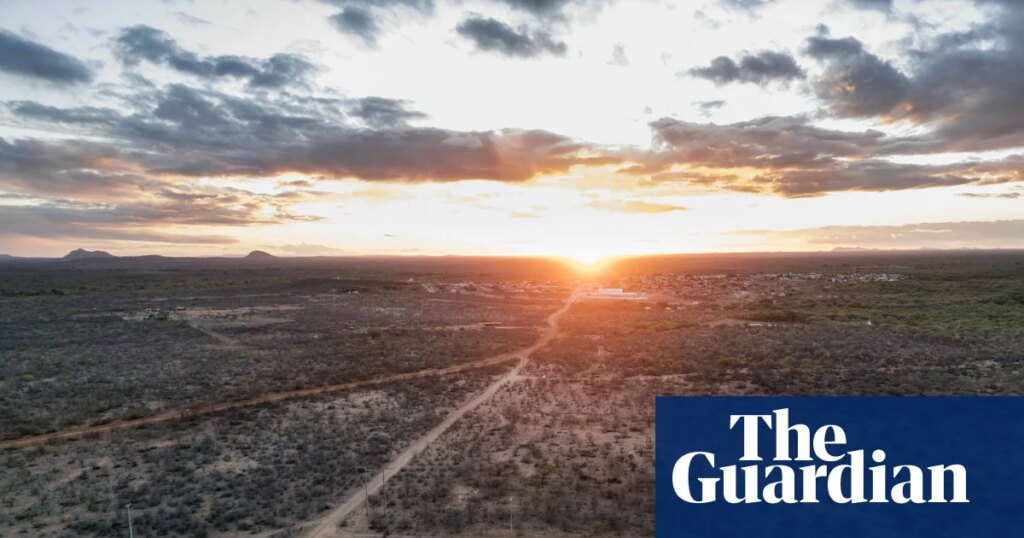
An aerial view of Raildon Suplicio Maia’s farm. He used to farm crops as well, but ‘now, when you plant something, it dies,’ he says
Cunha and her colleagues analysed data on rainfall and evapotranspiration – the transfer of water from soil and plants to the atmosphere – over four overlapping 30-year periods, from 1960 to 2020. In the area newly classified as arid, average annual rainfall fell below 400mm during the period 1990 to 2020. It’s a climate shift that has taken place over just one generation.
The arid climate could accelerate desertification, which already threatens about 13% of the Caatinga. If steps aren’t taken to prevent or reverse soil degradation, which stems primarily from human activity, the region could become an infertile desert.
In Macururé, residents are accustomed to punishing droughts and few are aware of their municipality’s new climate status. But they feel the shift in the unpredictable rainfall and in their lean goats, which struggle to find food in the parched landscape.
“Everything has changed,” says Maia, looking out at the naked shrubs that surround his home. A few steps from the house, a goat gets up on its hind legs to nibble at the scarce leaves.
The rainy season would normally run from year’s end to April. But by early September, it hadn’t rained properly since January, when about a year’s worth of rain fell in the space of a month.
“We used to grow corn, beans, potatoes, everything,” Maia says. “Now, when you plant something, it dies.”
Macururé and the surrounding towns are among the poorest in Bahia. The decline of subsistence agriculture means the population must spend more on food and animal feed.
About 30 miles north, in the Curral da Pedra quilombo – a traditional afro-Brazilian community descended from people who escaped enslavement more than 200 years ago – Marisete dos Santos tells a similar story.
“There was so much watermelon. Watermelons the size of a little boy,” she says, recalling the abundant crops tended to by her grandfather. The fruits she plants now are small and dry, and the beans she saves for the following planting season don’t germinate.
Although the current situation is more extreme, water scarcity has always been a challenge in the sertão. People have long relied on engineered solutions to the problem, such as artesian wells and dams that divert streams into small reservoirs.
In Maria Alves dos Santos’s neighbourhood, a cluster of government-built bungalows a bone-rattling 20-minute drive from the town centre, a white cistern stands outside each home. Water trucks operated by the army routinely pass by to fill the 16,000-litre cisterns, installed as part of a government policy launched in the early 2000s to provide water for human consumption.
Families have only recently been provided with a rainwater catchment system for livestock and irrigation. Deep trenches known as barreiro trincheira dot the surrounding shrubland. Holding up to 500,000 litres each, they are designed to prevent the rainwater they capture from evaporating in the heat.
-
Left, Maria Alves dos Santos and right, Marisete Dolores Graciliano dos Santos whose community has recently been provided with barreira-trincheira
Alves dos Santos’s trench hit groundwater and already contains some precious inches of water, even though there has been no rain. She plans to use it for laundry, for her animals and, in the long run, to irrigate cash crops such as coriander and onions. “Things are going to get better now that we have this water,” says the 41-year-old, while her youngest son plays around the edge of the ditch.
Yet these solutions have their limitations, particularly under the new climate conditions. Water tanks such as that used by Alves dos Santos no longer outlast the lengthier, more punishing dry seasons.
“You don’t know any more how long the water will remain stored. The sources empty quicker, because it’s hotter,” says Gustavo Vieira, who has served as Macururé’s municipal secretary for agriculture, environment and livestock for the past 12 years.
The town of just over 7,000 people, which lost 10% of its population between 2010 and 2022 as young people left in search of work, is a warning for the rest of Brazil as the climate grows hotter and drier in most of the country.
Brazil’s semi-arid region expanded by 75,000 sq km every decade between 1960 and 2020, the Cemaden study found, while two dry subhumid areas have appeared outside the north-east, in Rio de Janeiro state and the Pantanal wetlands.
“These changes should also be on our radar. It’s not just a problem in the north-east, it’s a problem that affects the whole country,” says Cunha.
Once the climate has shifted, the change is irreversible, she says. Addressing this starts with climate mitigation measures. Efforts to prevent or reverse desertification are also necessary. The environment ministry, which commissioned the research, will present an updated national policy for fighting desertification in the coming months.
Public policies are slow to reach places such as Macururé, says Vieira. “There has always been a lot of concern with the Amazon, a biome that attracts attention from abroad. The Caatinga is an extraordinary biome, but it’s small and attention reaches us more slowly,” he says.
People have gathered in Macururé’s town hall to discuss solutions to their predicament, as part of a government rural development initiative. Desalination devices are dismissed as too expensive and polluting. Most would like the water trucks to visit more frequently.
Vieira pins his hopes on the development of alternative sources of income and employment. But some industries, such as mining and renewable energy plants, he admits, would bring little benefit to the local communities. Others, such as ecotourism and carbon credits for preserving the Caatinga, seem distant possibilities.
And for most Macururenses, such as 53-year-old Venancio Lorenzo do Santo, life doesn’t make sense without their goats, of which there are 30 for every human in the town. “The day I stop breeding goats, I know I’m going to have to leave,” he says, as the sun sets on his herd gathered in their pen for the night.